
Commerce Periodic Test & Annual Syllabus
Bifurcation of Syllabus of Class X Commerce for the session 2026-2027 decided at STS School AMU, Aligarh.
The bifurcation of the Class X Commerce syllabus for the academic session 2026-2027 was decided in a meeting held at STS School AMU, Aligarh on 24.03.2026. The curriculum establishes fundamental business concepts across Three Periodic Tests (20 marks each, reduced to 10) and an Annual Examination (80 marks).
Commerce Periodic Tests & Annual Exam
Click a card to jump directly to the relevant examination syllabus.
First Periodic Test
Class X — Commerce (Assignment)
| Name of the Chapter & Topics | Question Pattern | Marks |
|---|---|---|
Ch 1: Joint Stock Company
| Evaluated as an Assignment. | 10 |
Ch 2: Sources of Business Finance (Company)
| 10 | |
| Total Marks (Reduced to 10 Marks) | 20 | |
📝 Assignment Format
The First Periodic Test is formatted entirely as an Assignment. You must submit your work on ‘Joint Stock Companies’ and ‘Business Finance’ to be evaluated for 20 marks (later reduced to 10).
🏢 Corporate Fundamentals
Focus your assignment on distinguishing between Private and Public companies, and explaining the difference between Owned and Borrowed funds.
Second Periodic Test
Class X — Commerce
| Name of the Chapter & Topics | Question Pattern | Marks |
|---|---|---|
Ch 3: Communication in Business Organisation
|
• MCQ/VSA: 02 • SA (2 Marks): 02 | 10 |
Ch 4: Selling and Distribution
|
• MCQ/VSA: 02 • SA (2 Marks): 02 | 10 |
| Total Marks (Reduced to 10 Marks) | 20 | |
Third Periodic Test
Class X — Commerce
| Name of the Chapter & Topics | Question Pattern | Marks |
|---|---|---|
Ch 5: Large Scale Retail Trade
Non Store Retailing – Meaning
|
• MCQ/VSA: 04 • SA (4 Marks): 04 | 20 |
| Total Marks (Reduced to 10 Marks) | 20 | |
Pattern Shift: The Third Periodic Test focuses entirely on a single chapter (Chapter 5), shifting the question pattern from 2-mark short answers to heavier 4-mark short/long answers.
Annual Examination
Class X — Commerce
| Chapter Name | Weightage Breakdown | Total |
|---|---|---|
| 1. Joint Stock Company | MCQ/VSA(1): 1, VSA(2): 1, SA(3): 1, LA(6): 1 | 13 |
| 2. Source of Business Finance | MCQ/VSA(1): 1, VSA(2): 1, SA(3): 1, LA(6): 1 | 13 |
| 3. Communication in Business Organisation | MCQ/VSA(1): 1, VSA(2): 1, SA(3): 1, LA(6): 1 | 13 |
| 4. Selling & Distribution | MCQ/VSA(1): 1, VSA(2): 1, SA(3): 1, LA(6): 1 | 13 |
| 5. Large Scale Retail Trade | MCQ/VSA(1): 2, VSA(2): 1, SA(3): 1, LA(6): 1 | 14 |
|
6. Selling (i) Personal Selling – Meaning, Importance (ii) Advertising – Meaning, Importance & Media of Advertising (iii) Sales Promotion Techniques | MCQ/VSA(1): 2, VSA(2): 1, SA(3): 1, LA(6): 1 | 14 |
| Annual Exam Total Marks | 80 | |
Important Paper Notes & Internal Assessment:
- There may be internal choices in any long answer type questions (6 marks).
- Internal Assessment (20 Marks Total):
- Average of Best two Periodic Tests: 10 Marks
- Notebook: 5 Marks
- Subject Enrichment: 5 Marks
A Word from the Teacher
The Class X Commerce syllabus builds a strong foundation in corporate structures and modern retail formats. The Annual Exam (80 marks) is perfectly balanced, with almost every chapter carrying equal weight (13 to 14 marks).
For your Periodic Tests, note that PT1 is an Assignment. Use this opportunity to secure a perfect score on Joint Stock Companies and Finance. PT3 is unique because it focuses entirely on Chapter 5 (Large Scale Retail Trade) and introduces 4-mark questions instead of 2-mark questions. Prepare detailed points on Departmental stores versus Multiple shops.
In the Annual Examination, every single chapter features a 6-mark Long Answer Question. The syllabus notes that internal choices may be provided for these 6-mark questions. You must prepare 6 strong points (headings with explanations) for major concepts like ‘Media of Advertising’, ‘Sales Promotion Techniques’ (Chapter 6), and ‘Sources of Business Finance’ (Chapter 2).
How to Excel in Commerce
A strategic approach to business definitions and 6-mark essays.
Master the 6-Mark Format
Every chapter has one 6-mark question in the Annual Exam. Format your answers with an introduction, 5-6 clear headings, brief explanations, and a short conclusion.
Differentiate Concepts
Commerce is built on differences. Create comparison tables for ‘Private vs. Public Company’ (Ch 1) and ‘Departmental Store vs. Multiple Shops’ (Ch 5).
Focus on Modern Retail
Chapter 5 covers Non-Store Retailing (Automated Vending, Teleshopping). These are frequent topics for 2-mark and 3-mark short answers.
Prepare Chapter 6 Early
Chapter 6 (Selling, Advertising, Promotion) is not covered in the Periodic Tests but carries 14 marks in the Annual Exam. Do not leave it for the last minute.
Understand Finance
For Chapter 2, understand the exact difference between ‘Owned Funds’ (Equity) and ‘Borrowed Funds’ (Debentures/Loans) for both MCQs and Long Answers.
Secure Internal Marks
Internal assessment accounts for 20 marks. Keep your Notebook neat and submit Subject Enrichment activities on time to secure the 10 direct marks easily.
Class X Commerce — Quick View
| Test / Exam | Chapters & Focus | Marks |
|---|---|---|
| 1st Periodic Test | Ch 1 (Joint Stock Co.) & Ch 2 (Business Finance) [Assignment] | 20 (Reduced to 10) |
| 2nd Periodic Test | Ch 3 (Communication) & Ch 4 (Selling/Distribution) | 20 (Reduced to 10) |
| 3rd Periodic Test | Ch 5: Large Scale Retail Trade | 20 (Reduced to 10) |
| Annual Exam | All 6 Chapters (Each carries a 6-Mark Long Answer) | 80 |
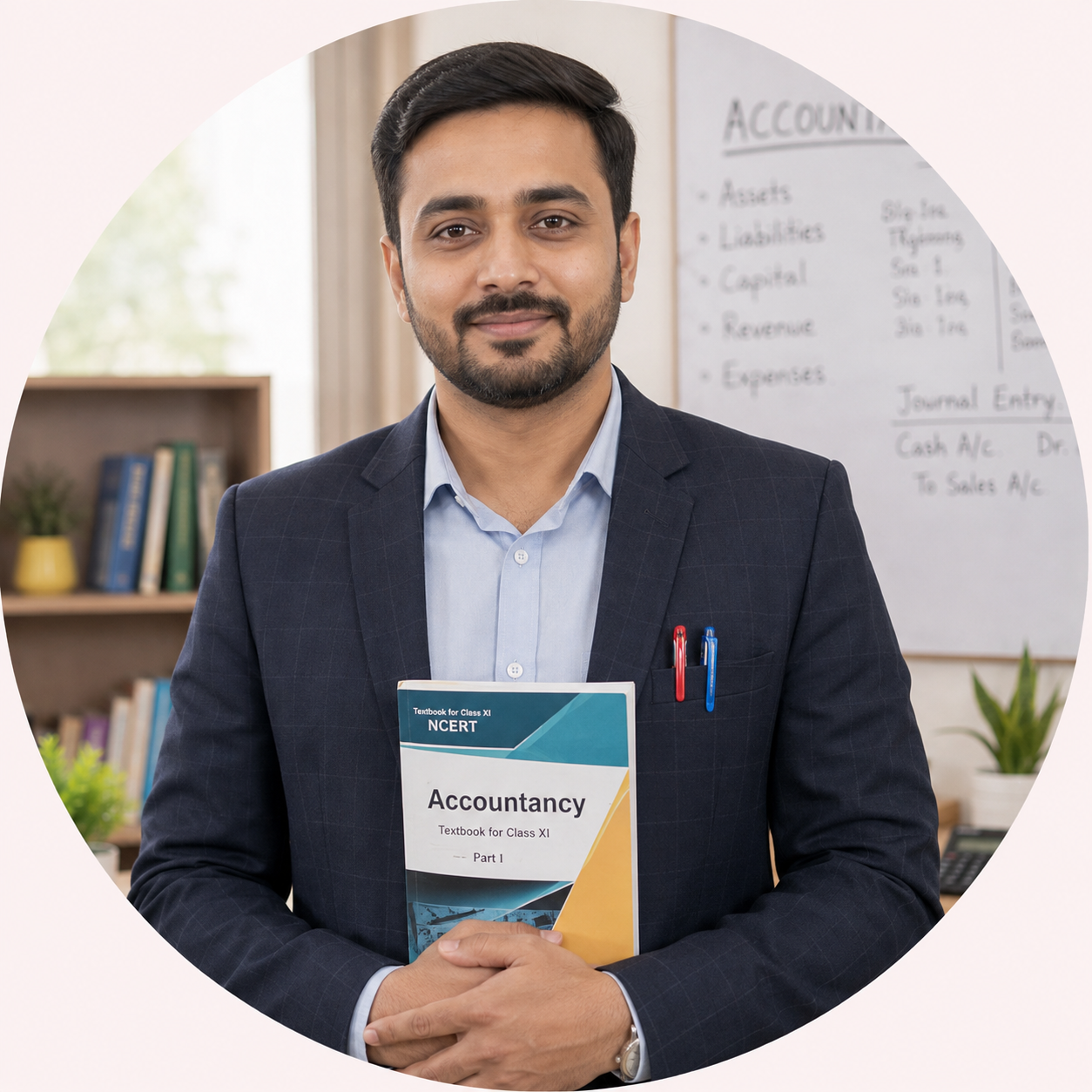
The Accountancy Faculty at SolvedNotes is a team of PGT Commerce Teachers and subject matter experts with decades of experience in the CBSE Senior Secondary curriculum. We specialize in decoding the technicalities of NCERT textbooks—‘Financial Accounting’ and ‘Company Accounts’. Our notes focus on the strict formatting and accounting standards required in Board Exams, providing logic-based solutions for Journal Entries, Ledger Posting, and Balance Sheets. From Partnership Fundamentals to Cash Flow Statements, our step-by-step numericals are crafted to help students minimize errors and maximize scores in Class 11 and 12 Accountancy.