Complete Solution to Class 8 New Learning to Communicate Workbook 8(Oxford University Press) Unit 3.
ANSWER A:
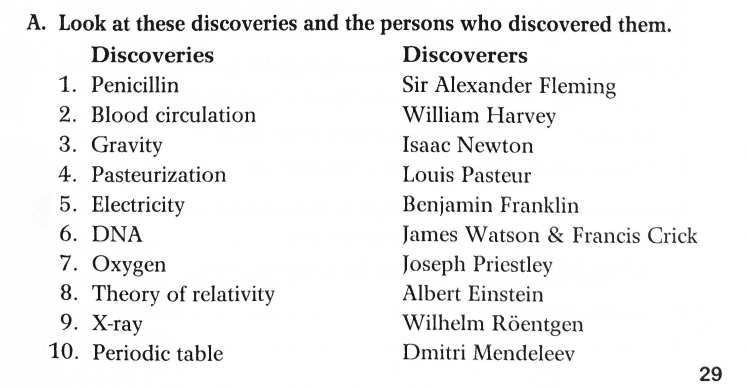
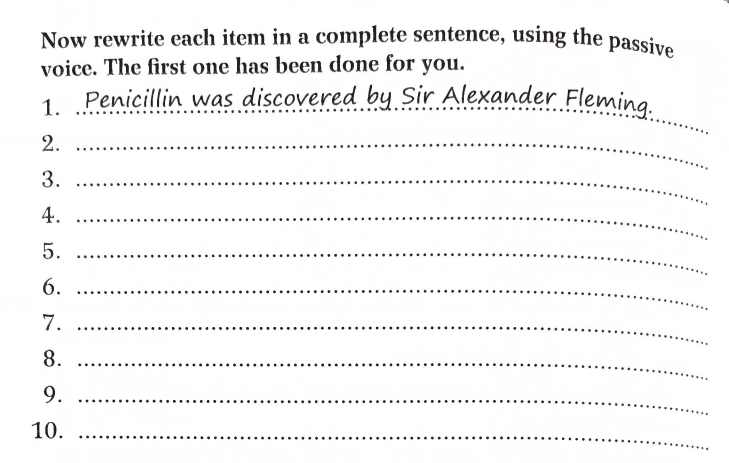
- Penicillin was discovered by Sir Alexander Fleming.
- Blood circulation was discovered by William Harvey.
- Gravity was discovered by Isaac Newton.
- Pasteurization was discovered by Louis Pasteur.
- Electricity was discovered by Benjamin Franklin.
- DNA was discovered by James Watson and Francis Crick.
- Oxygen was discovered by Joseph Priestley.
- The theory of relativity was discovered by Albert Einstein.
- X-rays was discovered by Wilhelm Roentgen.
- The periodic table was discovered by Dmitri Mendeleev.
ANSWER B:
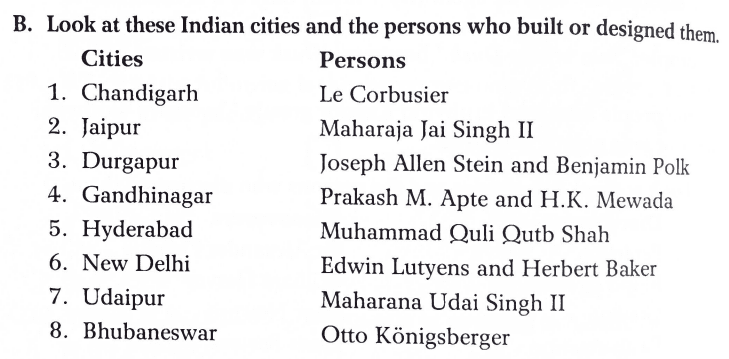
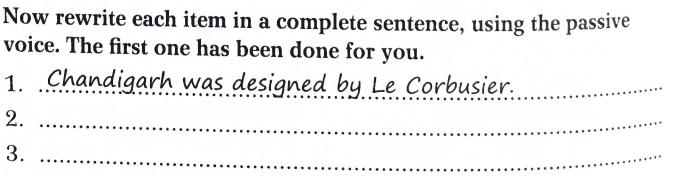
- Chandigarh was designed by Le Corbusier.
- Jaipur was built by Maharaja Jai Singh II.
- Durgapur was designed by Joseph Allen Stein and Benjamin Polk.
- Gandhinagar was designed by Prakash M. Apte and H.K. Mewada.
- Hyderabad was built by Muhammad Quli Qutb Shah.
- New Delhi was designed by Edwin Lutyens and Herbert Baker.
- Udaipur was built by Maharana Udai Singh II.
- Bhubaneswar was designed by Otto Königsberger.
C. Fill in the blanks with must, mustn’t, should or ought to in these instructions for the boarders in a small residential school.
- You should try and get to know all your fellow boarders.
- You mustn’t ever get into a fight with any boarder.
- When you have a problem, you ought to speak to the warden.
- Important: You must switch off the lights at 10 p.m.
- You should try and keep your voice down in the study room.
- Important: You must keep your bed and cabinet clean and tidy.
- Important: You ought to be on time for all three meals.
- If you want to call your parents, you ought to contact the warden.
- Important: If you are feeling unwell, you must tell the warden.
- When you hear the boarding bell ring early in the morning, you must tell yourself: it must be 5.30 a.m.!
Words in action
A. Look at these expressions beginning with on. Use the appropriate ones in the sentences below.
on air on call on about on the beat on and on
- When my pocket was picked, a policeman on the beat was just round the corner; he rushed to my help and caught the thief.
- Dr Mehta is always on call, even on Sundays.
- The one o’clock women’s programme has been on air for years and is still very popular.
- David went on and on about his trip.
- I don’t know what he is on about. It doesn’t make sense.
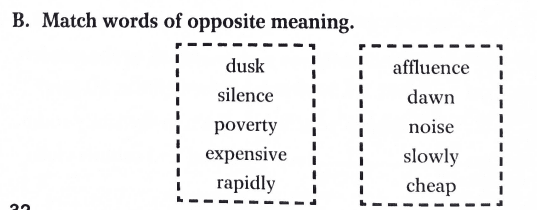
B. Match words of opposite meaning.
ANSWER:
| Word | Opposite |
|---|---|
| dusk | dawn |
| silence | noise |
| poverty | affluence |
| expensive | cheap |
| rapidly | slowly |
C. Now use the words in the left column of the previous exercise to fill the blanks below.
- The phone call she was expecting came after months of silence.
- Curfew was imposed from dawn to dusk.
- My brother keeps losing watches. There is no point in getting an expensive one for him.
- Poverty and illiteracy are two of the greatest social evils.
- India is a rapidly growing economy.
D. Make three words from each of the words given below. You can combine the letters in different ways but cannot add any new ones.
Example:
PREPARATORY
Clues: a talking bird—parrot
a portion—part
the head of the Roman Catholic Church—pope
- COMPENSATION
a. to bring one’s foot down with force— STAMP
b. It is dangerous to board a train while it is in— MOTION
c. After retirement a person gets— PENSION - DISCOURAGEMENT
a. to rub out— ERASE
b. a small river— STREAM
c. extreme anger— RAGE - FORTNIGHT
a. Father is returning— TONIGHT
b. These shoes pinch because they are— TIGHT
c. another word for ‘fear’— FRIGHT
E. Fill in the blanks using an appropriate sound word.
Example: Ajay awoke to the pattering of raindrops against his bedroom window.
- The room was so quiet that the ticking of the clock could be plainly heard.
- The loud rumbling of thunder warned the picnickers to take shelter from the approaching storm.
- There was a loud flapping of wings as a large flock of pigeons flew up into the air.
- The croaking of the frog made the child nervous.
- The buzzing of bees was the only sound we could hear.
Writing Practice
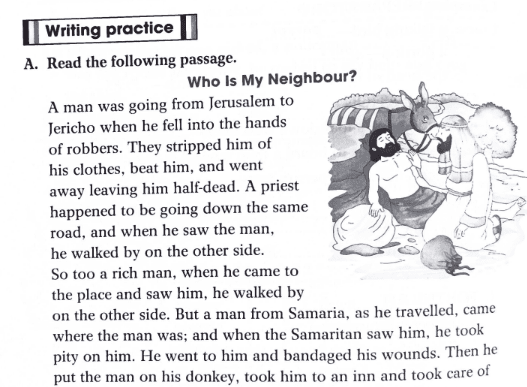
A. Read the following passage.
Answer these questions based on your understanding of the passage.
- What happened to the traveller when he was on his way to Jericho?
He was attacked by robbers. They took his clothes, beat him, and left him half-dead. - What did the priest and the rich man do when they saw the half-dead traveller lying on the road?
Both of them saw the traveller but walked by on the other side and did not help him. - How did the Samaritan react when he saw the badly injured traveller?
The Samaritan felt sorry for him, helped him, cleaned his wounds, and took care of him. - a. Why did the Samaritan give some money to the innkeeper?
He gave money to the innkeeper so that the traveller could be looked after until he got better.b. This shows he was kind, caring and generous. True or False?
True. - According to this story, can strangers be our neighbours? Explain.
Yes, even strangers can be our neighbours if we show kindness and help them when they need it.
B. Imagine that these two aliens who look like giant ants come to your school. Write a story in about 200 words about the incident.
One sunny morning, our school was busy as usual. Suddenly, everyone started shouting and running towards the playground. Curious, I rushed outside to see what was happening. To my surprise, I saw two big aliens standing near the school gate! They looked just like giant ants, with long feelers and sparkling eyes.
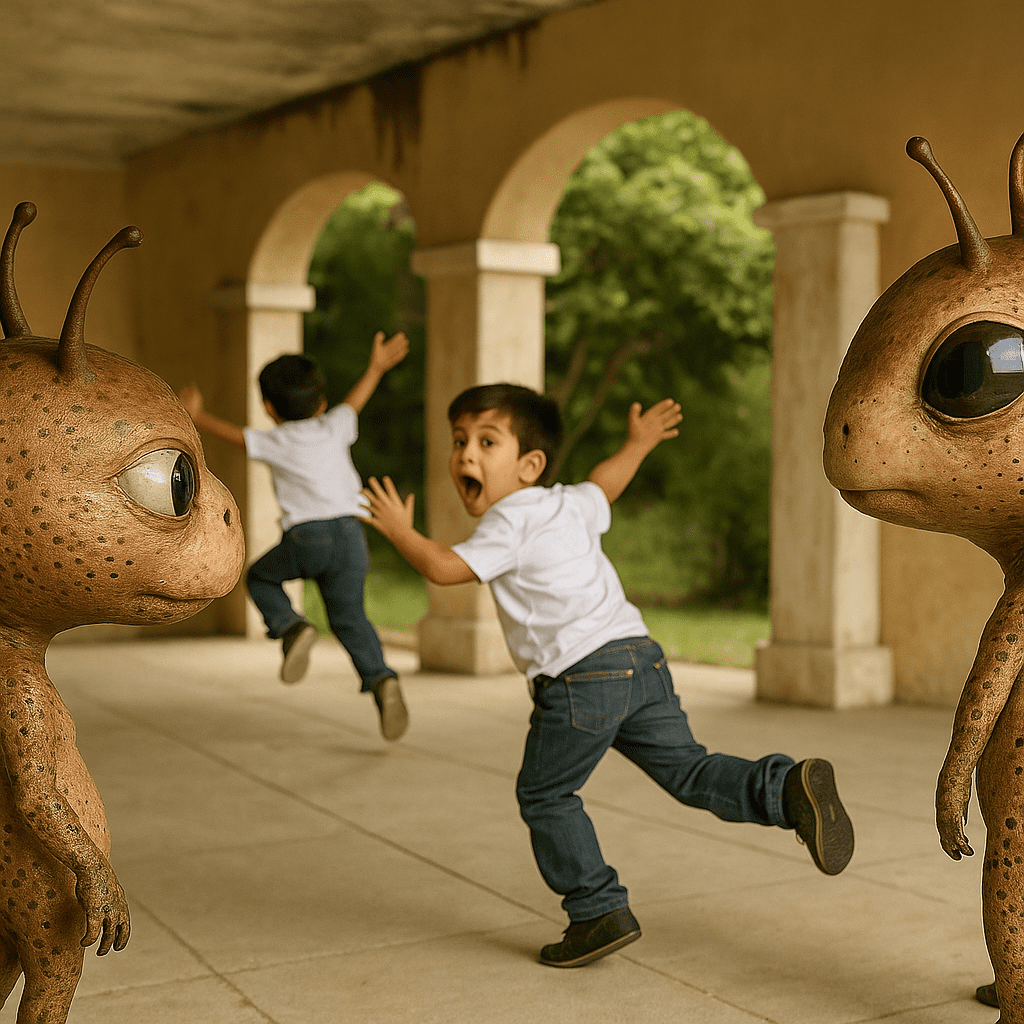
At first, many students were scared and tried to hide inside their classrooms. But the two ant-aliens didn’t seem dangerous. They waved their hands and gave friendly smiles. Our principal bravely walked up to them and asked, “Who are you? What do you want?” The aliens made funny sounds, then pressed a button on a small machine. Instantly, we could understand their language! They said they had come from a far-away planet called Antara and only wanted to learn about life on Earth.
Soon, everyone was excited. The teachers and students started showing the aliens around the school. We taught them some English words and even gave them cookies during lunch break. They were amazed by our classrooms and playground. The aliens showed us fun tricks with their gadgets and could lift huge books easily. After a few hours, they said goodbye and waved as their spaceship appeared above the ground. We all watched in wonder as they flew away, wishing they could visit us again. It was the most surprising and wonderful day in our school!
C. Look at the picture below. Write a composition in about 200 words describing the state of the room and what it tells you about the person living in it.
The moment you look at this room, you can tell it is very messy and untidy. Clothes are scattered on the floor, the bedsheet is crumpled, and the pillow is out of place. Books and papers are lying everywhere—some on the bed, some on the chair, and even some on the ground. A backpack is open with items spilling out, and the lamp on the table is tilted. There are shoes and socks lying in the middle of the room, not put away neatly. The curtain is hanging unevenly, and pictures or papers are stuck on the wall in a haphazard manner.
Seeing this room, we can guess that the person living here might not be very organized. He or she could be careless and doesn’t pay much attention to keeping things in order. Maybe the person is always in a rush and leaves things wherever they fall. It is possible that the person is very busy with studies or other activities and does not get time to clean the room. Or perhaps, the person just does not care about neatness. This messy room shows that the person could be creative because creative people sometimes forget about tidiness when they are busy with ideas. Overall, the room suggests that its owner needs to start organizing and cleaning up a little more!
- Write a short character sketch of one of your classmates in about 200 words. Describe his/her physical appearance (e.g. height, colour of hair and eyes), his/her dress and unusual character traits (for example, perhaps she/he has the habit of saying ‘OK’ after every sentence).
Answer:
One of my closest classmates is Amir. He is of medium height and has a slim body. His hair is short, black, and always neatly combed. His eyes are dark brown, and they shine when he smiles. He usually keeps a cheerful face, which makes him look friendly and approachable.
Amir likes to wear clean and simple clothes. Most of the time, he wears a white shirt and blue trousers, which make him look smart. On sports days, he is always in his track suit, ready to play cricket, his favourite game.
Amir is very punctual and disciplined. He always comes to class on time and sits in the front row. He has a unique habit of saying “you know” at the end of many sentences, which makes us laugh sometimes. He is very helpful and often explains difficult lessons to those who cannot understand easily.
He is also good at painting and has won prizes in many competitions. He is polite, kind, and never uses rude words. Everyone in our class likes him. I admire Amir not only for his studies but also for his good nature. He is truly an ideal classmate and a good friend.
Sure 🙂 Here’s the full question with the instruction written first, followed by the answer:
- Imagine you are a forest ranger working on a conservation project. You had rescued an abandoned animal (for example, a deer or a tiger cub) and helped to rear it. Now the animal needs to be released into the wild.
Write a report for your project-in-charge stating:
- which animal you rescued
- where you found it
- how you rescued it
- how you looked after it
- when the animal recovered and what should be done with it (whether it should be sent to a zoo or set free in the jungle)
Answer (Report):
Report on Rescued Animal
By: Forest Ranger
I would like to report about the rescue and rearing of a tiger cub under my care.
Some months ago, I found an abandoned tiger cub near a dried river bed inside the reserve forest. The cub looked weak and frightened. It was calling for its mother, but there was no sign of her. I carefully carried it to safety and brought it to our camp.
The cub was very weak and undernourished. I fed it milk at first and later introduced small pieces of meat. With regular food, medical check-ups, and proper care, the cub grew stronger day by day. I also spent time with it so that it would feel safe and learn to trust.
After nearly six months of care, the cub has now recovered fully. It has become healthy and active. I believe the cub is ready to live in the wild. It should not be sent to a zoo, because its natural home is the jungle. I suggest it be released into a protected forest area, where it can hunt and live freely in its natural habitat.
Submitted for consideration
Forest Ranger

Malik Mohd. Arshad is a Senior English Teacher at STS High School, Aligarh Muslim University, with 21+ years of experience in English Language Teaching (ELT). An M.A. in English and Linguistics, he combines traditional academic values with modern digital learning methods. He is also a certified alumnus of the Texas Intensive English Program (USA).