Are you searching for reliable answers and a simple summary of the “Arjun” story from the Class 8 Literary Reader (Oxford)? This blog post provides complete, concise Q&A for every question in Chapter 4, along with a plain-language chapter summary ideal for exam preparation. If you’re looking for “Arjun class 8 questions and answers,” “NCERT solutions for Class 8 English Oxford Literary Reader,” or “Class 8 English chapter-wise Q&A with explanations,” you’ve come to the right place. Explore below for detailed, easy-to-understand solutions perfect for students, teachers, and parents looking to quickly revise or clarify Chapter 4 of the Class 8 English Literature syllabus.
- Summary of "Arjun" by Mahasweta Devi
- Let's infer Arjun by Mahasweta Devi
- Let's discuss Arjun by Mahasweta Devi
- अर्जुन – कहानी का सारांश (हिंदी में)
- Extra Questions and Answers for "Arjun" (Class 8 Literary Reader)
- 3. How did Ketu’s attitude begin to change during the story?
- 4. What tactic did Ketu and his friends use to prevent the arjun tree from being cut?
- 5. How did the villagers across different tribes react to the plan to save the tree?
- 6. What does the story reveal about the relationship between power and justice?
- 7. Why is the arjun tree considered the "last mute symbol" by the tribals?
- 8. How does fear affect Bishal Mahato at the climax of the story?
- 9. What message about courage does the story convey?
- 10. How do the roles of Mohoni and other women reflect the struggle of the community?
Summary of “Arjun” by Mahasweta Devi
Ketu is a poor tribal man from the Shabar community who lives in a village called Bandihi. To earn money, he is forced to work for powerful people like Ram Haldar and Bishal Mahato, who make him cut down trees illegally. Because of this, Ketu often goes to jail, but he accepts it as his fate.
One day, Bishal Mahato asks Ketu to cut down a big and old arjun tree that stands at an important road. This tree is special to the Shabars. It gave them shelter, reminded them of their past, and was seen as a symbol of God.
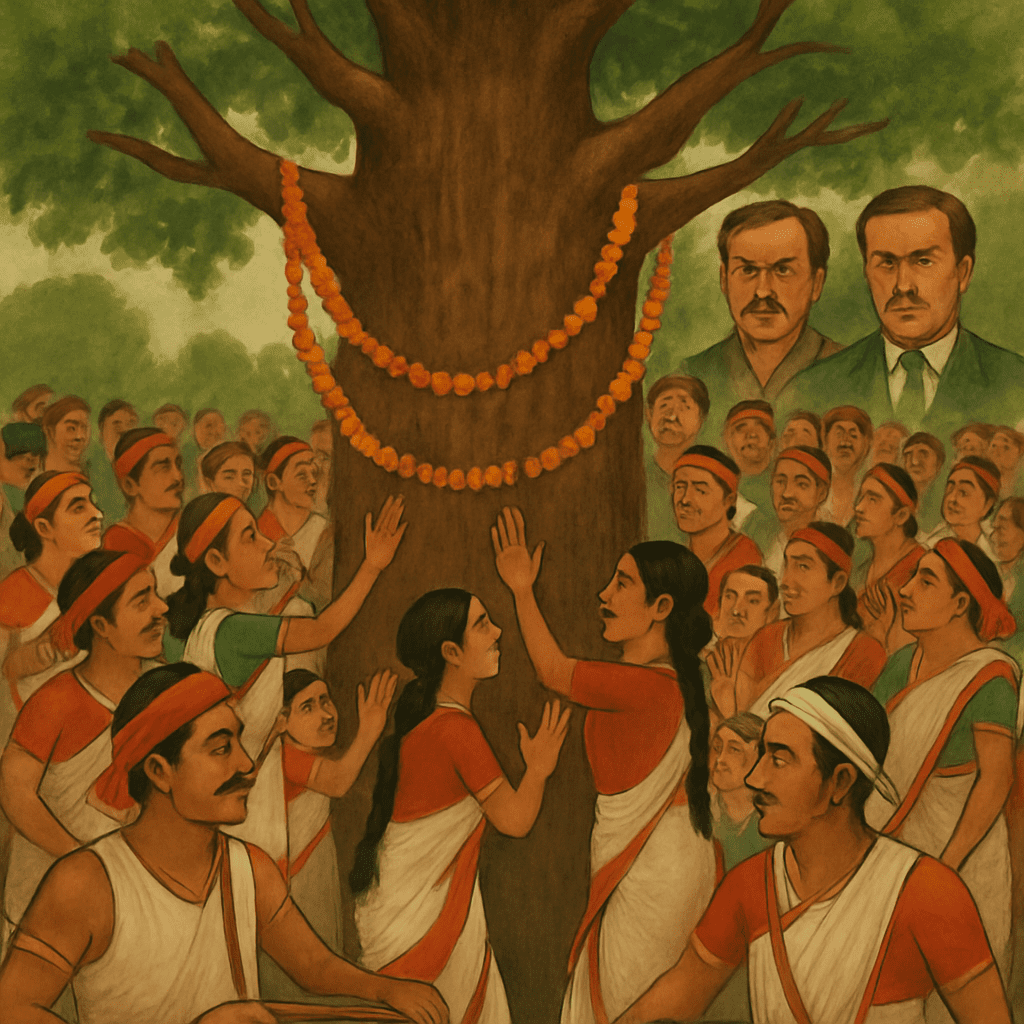
Ketu and his friends realize how important the tree is to them. They remember everything it has done for their people. Together, they come up with a clever plan. They pretend to have a religious vision and tell everyone that the arjun is now a sacred tree. Soon, people from many tribal communities gather and decorate the tree as part of a festival.
Because of this, the arjun tree is saved. The powerful men are surprised and feel defeated. The story shows how the poor tribals used their unity and smart thinking to protect what mattered to them.
Let’s infer Arjun by Mahasweta Devi
1. ‘Ketu did not ever question his predicament.’
a. What was Ketu’s predicament?
Ketu had to cut down trees illegally for survival and frequently landed in jail.
b. Did he mind being in this situation? Why/Why not?
No, because he saw it as his fate being a Shabar and never questioned it.
2. ‘The people will have to elect whoever I nominate, won’t they?’
a. Who says this? To whom?
Bishal Mahato says this to Ketu.
b. What does this tell you about the speaker?
It shows Mahato’s arrogance and belief in his absolute political control over the people.
3. Bishal Mahato and Ram Haldar ‘were two of a kind’. Why did Ketu and his friends think that the two men were quite similar?
Both exploited the Shabars for personal gain and used their power to threaten or manipulate them.
4. ‘Haldar and Mahato too knew that the Shabars were indispensable.’ This means that the two men believed that they could function without the help of the Shabars. True or False?
False. It means they knew they needed the Shabars to do the work.
5. Why do you think Bishal Mahato wanted the arjun tree to be cut down?
He wanted to profit from its timber and possibly remove it for political convenience or deals.
6. ‘Why should only the Shabars get trapped in a false case? I’m going to tell the others …,’ says Diga to his friends. Does this mean that the tribals finally realized that they were being treated most unfairly by Mahato and Haldar? How can you tell?
Yes. They began questioning the injustice, remembered the tree’s importance, and united all tribes to protect it, proving their growing awareness and resistance to exploitation.
7. ‘Each one realized that their lives and fate were inextricably linked with that of the arjun.’
a. In what ways had the arjun tree been of help to the tribals?
It gave them shelter, hope, and was seen as divine—a guardian of their past and existence.
b. Do you think Mahato and Haldar understood the special relationship that the tribals shared with the tree? Why do you think so?
No, because they prioritized personal gain and underestimated tribal customs and emotions. I think so because they cut all trees in the neighbourhood for profit.
8. Haldar says: ‘We’d thought these fellows were fools. But they have made fools of us, Mahato!’ How did Ketu and his friends fool Haldar and Mahato and save the arjun tree?
Ketu and his friends fooled Haldar and Mahato and save the arjun tree. They staged a ritual around the tree, making it a sacred site, so no one could cut it legally or publicly.
9. ‘Fear. An uncomprehending fear gripped him.’ Was Mahato afraid that something unpleasant would happen? What did he think would happen?
Yes, he feared people’s resistance and the rising power of the united, spiritually charged tribals.
Let’s discuss Arjun by Mahasweta Devi
1. The Shabar men were frequently sent to jail. How did this affect the Shabar women?
Women had to find work alone, suffered financially, and bore the family burden during the men’s absence.
2. Exploitation is a situation in which a person treats another person in an unfair manner.
a. How were the Shabars exploited?
They were forced to cut trees illegally and punished for it, while powerful men profited freely.
b. Which of these words would you use to describe how they felt?
Unhappy, hurt, miserable, wretched, upset, anxious, worried, harassed.
अर्जुन – कहानी का सारांश (हिंदी में)
यह कहानी केतु नाम के एक गरीब शबर जनजाति के व्यक्ति की है, जो पश्चिम बंगाल के पुरुलिया क्षेत्र में रहता है। उसे और उसके जैसे लोगों को जंगल के पेड़ काटने के लिए मजबूर किया जाता है ताकि वे अपनी आजीविका चला सकें। इसके लिए उन्हें अक्सर जेल जाना पड़ता है, लेकिन वे इसे अपनी किस्मत मानकर स्वीकार कर लेते हैं।
एक दिन बिशाल महतो, जो एक शक्तिशाली राजनीतिक नेता है, केतु को एक बड़ा और पुराना अर्जुन का पेड़ काटने का आदेश देता है। यह वही पेड़ है जो शबरों के लिए बहुत खास है—यह पेड़ उन्हें आश्रय, यादें और आस्था देता है। यह उनके बीते जंगल जीवन का अंतिम प्रतीक है और कई जनजातियों के लिए एक पवित्र वृक्ष भी है।
केतु और उसके दोस्त इस पेड़ को बचाने का एक चालाक तरीका खोज निकालते हैं। वे पूरे गांव में यह प्रचार करते हैं कि किसी को एक सपना आया है जिसमें गांव की देवी ने कहा कि अर्जुन पेड़ की पूजा होनी चाहिए। वे पेड़ को सजाते हैं, पूजा करते हैं और जनजातियों को इकट्ठा करते हैं।
अब, महतो और हलदार इस पेड़ को न तो काट सकते हैं और न ही हटा सकते हैं क्योंकि यह अब एक धार्मिक प्रतीक बन चुका है। इस तरह, केतु और उसके दोस्तों ने चालाकी और सामूहिकता से अर्जुन पेड़ को बचा लिया।
Extra Questions and Answers for “Arjun” (Class 8 Literary Reader)
1. Why did Ketu accept cutting trees as his fate?
Ketu believed being a Shabar meant he must cut trees and go to jail, so he accepted it as destiny.
2. What role did the arjun tree play in the lives of the tribals?
The arjun tree offered them shelter, memories of the past, and was a symbol of hope and unity.
3. How did Ketu’s attitude begin to change during the story?
He started questioning past injustices and joined his friends in protecting their sacred tree.
4. What tactic did Ketu and his friends use to prevent the arjun tree from being cut?
They spread the belief that the tree had become sacred, organizing a festival to protect it.
5. How did the villagers across different tribes react to the plan to save the tree?
They united, decorated the tree, and participated in the festival, showing collective resistance.
6. What does the story reveal about the relationship between power and justice?
It shows those in power often exploit the weak, but unity can help reclaim justice and respect.
7. Why is the arjun tree considered the “last mute symbol” by the tribals?
Because it is the only remaining tree from the old jungle, representing their lost heritage.
8. How does fear affect Bishal Mahato at the climax of the story?
Seeing the strong tribal unity and rituals, Mahato grows fearful and senses he’s losing control.
9. What message about courage does the story convey?
It encourages the marginalized to unite, speak up, and protect what is valuable to their identity.
10. How do the roles of Mohoni and other women reflect the struggle of the community?
Shabar women bear the burden when men are jailed, highlighting their resilience and sacrifices.

Malik Mohd. Arshad is a Senior English Teacher at STS High School, Aligarh Muslim University, with 21+ years of experience in English Language Teaching (ELT). An M.A. in English and Linguistics, he combines traditional academic values with modern digital learning methods. He is also a certified alumnus of the Texas Intensive English Program (USA).