Welcome to the start of your Class 12 Physics journey! It all begins with Chapter 1: Electric Charges and Fields. Getting a good handle on these core ideas is the key to feeling confident and acing your board exams later on.
To make sure you get off to a great start, we’ve brought together everything you need in one easy-to-find place. Here you’ll find quick notes for revision, detailed solutions to every NCERT problem, a handpicked list of important multiple-choice questions, solved examples from past exams, and the key derivations explained simply.
Let’s dive in and build a rock-solid foundation in electrostatics together!
Quick Revision Guide on Electric Charges and Fields
1. Electric Charge
- Types: Positive and Negative.
- Basic Property: Like charges repel, unlike charges attract.
- Quantisation: Charge is quantized; any charge
 is an integral multiple of the fundamental charge
  .
. , where
  and
and  .
. - Conservation: The total charge in an isolated system remains constant.
- Additivity: The total charge of a system is the algebraic sum of all individual charges.
 and
and  .
.2. Coulomb’s Law
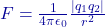
The electrostatic force between two point charges  and
and  separated by distance
  is:
is:
- Magnitude:

- Vector Form:

- Constant:



3. Electric Field
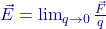
- Definition: Force per unit positive test charge.

- Field due to a point charge
 :
: 
- Superposition Principle: The net electric field at a point is the vector sum of fields due to all individual charges.



4. Electric Dipole
- A pair of equal and opposite charges (
 and
and  ) separated by a small distance
  .
. - Dipole Moment
 :
:  (Direction: from to ).
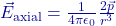
 - Field on Axial Line:
 (for
(for  )
) - Field on Equatorial Line:
 (for )
 - Torque in a Uniform Field (
 ):
):  ; Magnitude:
 and
and  ) separated by a small distance
  .
. :
:  (Direction: from
  (for
(for  )
) (for
(for  ; Magnitude:
5. Electric Flux
- Definition: Measure of the flow of the electric field through a given area.

- For a closed surface:



6. Gauss’s Law
- The net flux through a closed surface is
 times the net charge enclosed by the surface.
- Key Applications:
- Infinite Long Wire:

- Infinite Plane Sheet:

- Thin Spherical Shell:
- Outside (
 ):
): 
- Inside (
 ):
): 
- Outside (
 times the net charge enclosed by the surface.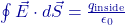


 ):
): 
 ):
): 7. Continuous Charge Distribution
- Linear Charge Density (
 ):
): 
- Surface Charge Density (
 ):
): - Volume Charge Density (
 ):
): 

 ):
): 
 ):
): 
Quick Revision Tip:
Focus on the formulas for the electric field of a point charge, a dipole (axial and equatorial), and the three standard applications of Gauss’s Law (wire, sheet, shell). Remember that Gauss’s Law is most useful for symmetric charge distributions.
Chapter‑End Questions: Fully Worked Solutions
Exercise 1.1
Question: What is the force between two small charged spheres having charges of  and
and  placed 30 cm apart in air?
Solution:
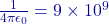
- Use Coulomb’s Law:
- Substitute values:
 , ,
, ,  ,
, 
- Calculate:


 ,
,  ,
,  ,
, 




Answer:  (repulsive)
Exercise 1.2
Question: The electrostatic force on a small sphere of charge 0.4  C due to another small sphere of charge -0.8 C in air is 0.2 N. (a) What is the distance between the two spheres? (b) What is the force on the second sphere due to the first?
Solution:
(a)
- Coulomb’s Law:
- Rearrange:

- Substitute:
 , ,
, , 
- Calculate:


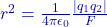
 ,
,  ,
, 





(b) By Newton’s Third Law, the force is equal in magnitude and opposite in direction.
Answer: (a) 12 cm, (b) 0.2 N (attractive)
Exercise 1.3
Question: Check that the ratio  is dimensionless. Look up a Table of Physical Constants and determine the value of this ratio. What does the ratio signify?
Solution:
- Dimensional Analysis:
![[k] = [\text{N m}^2 \text{C}^{-2}] = [\text{ML}^3\text{T}^{-4}\text{I}^{-2}]](data:image/svg+xml;base64,PHN2ZyB4bWxucz0iaHR0cDovL3d3dy53My5vcmcvMjAwMC9zdmciIHdpZHRoPSIyNDciIGhlaWdodD0iMjEiIHZpZXdCb3g9IjAgMCAyNDcgMjEiPjxyZWN0IHdpZHRoPSIxMDAlIiBoZWlnaHQ9IjEwMCUiIHN0eWxlPSJmaWxsOiNjZmQ0ZGI7ZmlsbC1vcGFjaXR5OiAwLjE7Ii8+PC9zdmc+ "Rendered by QuickLaTeX.com")
![[e] = [\text{IT}]](data:image/svg+xml;base64,PHN2ZyB4bWxucz0iaHR0cDovL3d3dy53My5vcmcvMjAwMC9zdmciIHdpZHRoPSI2NyIgaGVpZ2h0PSIxOCIgdmlld0JveD0iMCAwIDY3IDE4Ij48cmVjdCB3aWR0aD0iMTAwJSIgaGVpZ2h0PSIxMDAlIiBzdHlsZT0iZmlsbDojY2ZkNGRiO2ZpbGwtb3BhY2l0eTogMC4xOyIvPjwvc3ZnPg== "Rendered by QuickLaTeX.com")
![[G] = [\text{N m}^2 \text{kg}^{-2}] = [\text{M}^{-1}\text{L}^3\text{T}^{-2}]](data:image/svg+xml;base64,PHN2ZyB4bWxucz0iaHR0cDovL3d3dy53My5vcmcvMjAwMC9zdmciIHdpZHRoPSIyNTAiIGhlaWdodD0iMjEiIHZpZXdCb3g9IjAgMCAyNTAgMjEiPjxyZWN0IHdpZHRoPSIxMDAlIiBoZWlnaHQ9IjEwMCUiIHN0eWxlPSJmaWxsOiNjZmQ0ZGI7ZmlsbC1vcGFjaXR5OiAwLjE7Ii8+PC9zdmc+ "Rendered by QuickLaTeX.com")
![[m_e] = [m_p] = [\text{M}]](data:image/svg+xml;base64,PHN2ZyB4bWxucz0iaHR0cDovL3d3dy53My5vcmcvMjAwMC9zdmciIHdpZHRoPSIxMzUiIGhlaWdodD0iMTkiIHZpZXdCb3g9IjAgMCAxMzUgMTkiPjxyZWN0IHdpZHRoPSIxMDAlIiBoZWlnaHQ9IjEwMCUiIHN0eWxlPSJmaWxsOiNjZmQ0ZGI7ZmlsbC1vcGFjaXR5OiAwLjE7Ii8+PC9zdmc+ "Rendered by QuickLaTeX.com")
- Therefore:
![[\frac{k e^2}{G m_e m_p}] = \frac{[\text{ML}^3\text{T}^{-4}\text{I}^{-2}][\text{I}^2\text{T}^2]}{[\text{M}^{-1}\text{L}^3\text{T}^{-2}][\text{M}][\text{M}]} = [\text{M}^0\text{L}^0\text{T}^0\text{I}^0]](data:image/svg+xml;base64,PHN2ZyB4bWxucz0iaHR0cDovL3d3dy53My5vcmcvMjAwMC9zdmciIHdpZHRoPSIzMTUiIGhlaWdodD0iMzIiIHZpZXdCb3g9IjAgMCAzMTUgMzIiPjxyZWN0IHdpZHRoPSIxMDAlIiBoZWlnaHQ9IjEwMCUiIHN0eWxlPSJmaWxsOiNjZmQ0ZGI7ZmlsbC1vcGFjaXR5OiAwLjE7Ii8+PC9zdmc+ "Rendered by QuickLaTeX.com") → Dimensionless
→ Dimensionless
![[k] = [\text{N m}^2 \text{C}^{-2}] = [\text{ML}^3\text{T}^{-4}\text{I}^{-2}]](https://solvednotes.com/wp-content/ql-cache/quicklatex.com-00d154379154e1517d3a9a37e6dd5a0d_l3.png "Rendered by QuickLaTeX.com")
![[e] = [\text{IT}]](https://solvednotes.com/wp-content/ql-cache/quicklatex.com-0a6263a4707459fa4babe06be848304b_l3.png "Rendered by QuickLaTeX.com")
![[G] = [\text{N m}^2 \text{kg}^{-2}] = [\text{M}^{-1}\text{L}^3\text{T}^{-2}]](https://solvednotes.com/wp-content/ql-cache/quicklatex.com-729919f9296ff202a53169dc3eb739e9_l3.png "Rendered by QuickLaTeX.com")
![[m_e] = [m_p] = [\text{M}]](https://solvednotes.com/wp-content/ql-cache/quicklatex.com-3858e1f3a4bdc83b7bb31a697f62e5a9_l3.png "Rendered by QuickLaTeX.com")
![[\frac{k e^2}{G m_e m_p}] = \frac{[\text{ML}^3\text{T}^{-4}\text{I}^{-2}][\text{I}^2\text{T}^2]}{[\text{M}^{-1}\text{L}^3\text{T}^{-2}][\text{M}][\text{M}]} = [\text{M}^0\text{L}^0\text{T}^0\text{I}^0]](https://solvednotes.com/wp-content/ql-cache/quicklatex.com-75c2378d11a0958ad8d419d0ec7819df_l3.png "Rendered by QuickLaTeX.com") → Dimensionless
→ Dimensionless- Numerical Value:
 ,
,  , ,
, ,  ,
, 

 ,
,  ,
,  ,
,  ,
, 

- Significance: This ratio represents the strength of the electrostatic force to the gravitational force between an electron and a proton.
Answer: Dimensionless, value  , ratio of electrostatic to gravitational force.
Exercise 1.4
(a) Electric charge is quantized means that any observable charge is an integral multiple of the elementary charge  (
( ).
).
(b) For macroscopic charges, the number of electrons transferred is so large that the discreteness (quantization) is not noticeable.
Exercise 1.5
Question: Explain how rubbing a glass rod with silk is consistent with the law of conservation of charge.
Solution: During rubbing, electrons are transferred from one body to another. The total charge before and after remains zero. The positive charge on one body is exactly equal to the negative charge on the other.
Exercise 1.6
Question: Four point charges  ,
,  ,
,  , and
, and  are located at the corners of a square ABCD of side 10 cm. What is the force on a charge of 1 C placed at the centre?
Solution:
- The centre is equidistant from all corners.
- Forces due to and
 are equal and opposite → cancel out.
 - Forces due to and are equal and opposite → cancel out.
- Net force = 0.
 are equal and opposite → cancel out.
Answer: Zero
Exercise 1.7
(a) Electric field lines are continuous because the electric field is a continuous function in space. A break would imply no field, which isn’t true.
(b) Two field lines cannot cross because the electric field must have a unique direction at every point.
Exercise 1.8
Question: Two point charges  and
and  are located 20 cm apart in vacuum. (a) What is the electric field at the midpoint O? (b) If a negative test charge of magnitude
  is placed at O, what is the force experienced?
Solution:
(a)
- At midpoint, from each charge.
- Field due to :
 (away from A, towards B)
 - Field due to :
 (towards B)
 - Both fields are in the same direction (A→B), so
 (from A to B)
 from each charge.
 (away from A, towards B)
 (towards B)
 (from A to B)
(b)
- Force on test charge :


- Since is negative, force is opposite to (from B to A)


Answer: (a)  (A→B), (b)
  (B→A)
(B→A)
Exercise 1.9
Question: A system has two charges  and
and  at A: (0,0,-15 cm) and B: (0,0,+15 cm). What are the total charge and electric dipole moment?
Solution:
- Total charge:
- Dipole moment:


 from -q to +q = from A to B = (0,0,0.3) m
- Direction: along +z axis

 from -q to +q = from A to B = (0,0,0.3) m
Answer: Total charge = 0, 
Exercise 1.10
Question: An electric dipole with dipole moment  is aligned at
  with a uniform electric field of magnitude
  . Calculate the torque.
Solution:
- Torque:
- Substitute:
 ,
,  ,
, 


 ,
,  ,
, 


Answer: 
Exercise 1.11
Question: A polythene piece rubbed with wool has a negative charge of . (a) Estimate the number of electrons transferred. (b) Is there a transfer of mass?
Solution:
(a)
 electrons
- Electrons are transferred from wool to polythene.
 electrons
(b) Yes, mass of electrons transferred:
Answer: (a)  electrons (wool to polythene), (b)
Exercise 1.12
(a)


(b) If charge doubled and distance halved:
Answer: (a)  , (b)
, (b) 
Exercise 1.13
Question: Figure 1.30 shows tracks of three charged particles in a uniform electrostatic field. Give the signs of the three charges. Which particle has the highest charge to mass ratio?
Solution:
- Positive charges deflect with the field, negative charges against it.
- The particle with the sharpest curvature has the highest charge-to-mass ratio (
 ).
).
 ).
).(Without the figure, a general answer is provided)
Exercise 1.14
Question: Consider  . (a) Flux through a square of side 10 cm parallel to the yz plane? (b) Flux if normal makes
  with x-axis?
Solution:
(a)
- Area

- Flux



(b)

Answer: (a)  , (b)
, (b) 
Exercise 1.15
Question: Net flux of the same field through a cube of side 20 cm with faces parallel to coordinate planes?
Solution:
- In a uniform field, the net flux through any closed surface is zero.
- Reason: Equal flux enters and exits the cube.
Answer: 0
Exercise 1.16
Question: Net outward flux through a black box is  . (a) Net charge inside? (b) If flux were zero, could you conclude no charges inside?
Solution:
(a)
- Gauss’s Law:



(b) No, there could be equal positive and negative charges inside (net charge zero).
Answer: (a)  , (b) No
Exercise 1.17
Question: A point charge +10 C is 5 cm above the centre of a square of side 10 cm. Find flux through the square.
Solution:
- Imagine the square as one face of a cube of side 10 cm with the charge at the centre.
- By symmetry, flux through each face is equal.
- Total flux through cube:

- Flux through one face:



Answer: 
Exercise 1.18
Question: A point charge of 2.0 C at the centre of a cubic Gaussian surface 9.0 cm on edge. Net flux?
Solution:
- Gauss’s Law:


Answer: 
Exercise 1.19
Question: A point charge causes a flux of  through a spherical Gaussian surface of 10.0 cm radius. (a) Flux if radius doubled? (b) Value of charge?
Solution:
(a) Flux depends only on enclosed charge, not radius. So, flux remains .
(b)

Answer: (a) , (b) 
Exercise 1.20
Question: A conducting sphere of radius 10 cm has an unknown charge. Electric field 20 cm from centre is  inward. Net charge on sphere?
Solution:
- For a conducting sphere:


- Since field is inward, charge is negative.



Answer: 
Exercise 1.21
Question: A uniformly charged conducting sphere of 2.4 m diameter has  . (a) Charge on sphere? (b) Total flux leaving the surface?
Solution:
(a)
- Radius

- Surface area

- Charge




(b)

Answer: (a)  , (b)
, (b) 
Exercise 1.22
Question: An infinite line charge produces  at 2 cm. Calculate
  .
.
Solution:
- For infinite line charge:





Answer: 
Exercise 1.23
Question: Two large parallel plates have surface charge densities  and
and  on inner faces. Find E in (a) outer region of first plate, (b) outer region of second plate, (c) between plates.
Solution:
- For two parallel plates with equal and opposite charges:
- Field outside the plates = 0
- Field between plates:


(a) 
(b)
(c) 
Answer: (a) 0, (b) 0, (c) 
20 MCQs with Answers: Electric Charges and Fields
JEE‑oriented MCQs from NCERT Class 12 Physics Chapter 1 (Electric Charges and Fields).
- Quantisation check
A metal sphere carries charge . Which statement is most accurate?
A. may be any real number
B. must be an integer multiple of 
C. is an integer, but can appear continuous at macroscopic scale
D. Quantisation holds only for insulators - Conservation in rubbing
When a glass rod is rubbed with silk, which process best describes what happens?
A. Protons flow from silk to glass; total charge increases
B. Electrons flow from glass to silk; total charge is conserved
C. Protons flow from glass to silk; total charge is conserved
D. Electrons flow from silk to glass; total charge decreases - Coulomb vector form
Charges at
at  and
and  at
at  . Force on due to is
A.
B.
C.
D. with
with  from 2 to 1
 - Superposition
Which statement correctly expresses electrostatic superposition?
A. Forces add scalarly; direction is irrelevant
B. Each pairwise Coulomb force is unaffected by other charges; vector sum gives net force
C. A genuine three-body force appears for three charges
D. Net force depends only on total enclosed charge regardless of positions - Force ratio scale
For an electron–proton pair separated by, the ratio  equals
A. (independent of )
B.
C.
D. Depends only on - Field definition
Best operational definition of electric field at a point is
A. for any test charge
B. to avoid disturbing sources
C. by definition for all cases
D. equals force per unit mass
 - Field lines
Which property of electrostatic field lines is correct?
A. They can intersect where fields superpose
B. They form closed loops in charge-free space
C. They never cross; local density indicates
D. They start on negative and end on positive charges - Flux element
Electric flux through a small oriented area with outward normal is
A.
B.
C. for all orientations
D. for closed surfaces always - Dipole far-field (axial)
At a distant axial point ( ) of a dipole with moment , the field magnitude is
A.
B.
C.
D. - Dipole in uniform field
A rigid electric dipole in a uniform experiences
A. Net force and zero torque
B. Zero force and zero torque for any orientation
C. Zero net force and torque
D. Net force toward higher if aligned - Gauss’s law (global)
Total electric flux through any closed surface equals
A.
B.
C. Zero if the conductor is neutral
D. Depends on shape for the same enclosed charge - Infinite line charge
For an infinitely long straight wire with uniform linear density, the field at radial distance is
A.
B.
C.
D.
- Infinite plane sheet
A uniformly charged infinite plane sheet with surface density produces field magnitude
A. on each side, normal to the sheet
B. decreasing with distance
C. only near edges
D. inside a conductor only
 - Spherical shell
For a thin uniformly charged spherical shell (total charge, radius ), the field is
A. for and  for
for
B. for and for
C. Constant everywhere
D. Non-zero only at the centre - Continuous distribution integral
For a volume charge density , the field at is
A.
B.
C. (no constant)
D.
- Flux in non-uniform field
A cube of side occupies
  . If
. If  , the net outward flux through the cube is
A.
B.
C.
D. - Atom-like model
A point charge at the centre of a sphere of radius is embedded in a uniform negative charge
  spread throughout the sphere. For , the radial field magnitude
  is
is
A.
B.
C.
D.
- Dipole in gradient field
A permanent dipole aligned with placed in a non-uniform field experiences
A. Zero net force and nonzero torque
B. Force toward weaker field, torque zero
C. Force toward stronger field and torque when aligned
D. Neither force nor torque - Sharing + distance change
Identical insulated spheres A and B initially carry each and are far apart. A is touched by an identical uncharged sphere C and B by an identical uncharged sphere D. After removing C and D, A and B are brought to half the original separation. The force between A and B becomes
A. Four times the original
B. Unchanged
C. One fourth of the original
D. Doubles - Flux by symmetry
A point charge is located a distance above the centre of a square of side . The electric flux through the square is
A.
B.
C.
D. Depends on in a non-trivial way
 . Which statement is most accurate?
 may be any real number
 and
and  . Force on

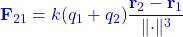
 with
with  from 2 to 1
 equals
 (independent of


 for any test charge
  to avoid disturbing sources
 by definition for all cases
 equals force per unit mass
 with outward normal is

 for all orientations
 for closed surfaces always
 ) of a dipole with moment
  , the field magnitude is


 in a uniform
  and zero torque



 on each side, normal to the sheet
 decreasing with distance
 only near edges
 inside a conductor only
 ), the field is
 for
for  and
and  for
for 
 , the field at
  is
is

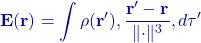 (no constant)
 occupies
  . If
. If  , the net outward flux through the cube is


 at the centre of a sphere of radius
  spread throughout the sphere. For
  is
is


 placed in a non-uniform field experiences


Answer Key with Explanations
- C. Charge is quantised: with integer . For macroscopic , appears continuous, but quantisation remains valid.
- B. Electrons transfer from glass to silk; glass loses electrons and becomes positive. Net charge of the isolated system is conserved.
- A. The correct vector form uses
 divided by its cube; it points along the line joining the charges with the correct inverse-square magnitude.
 - B. In electrostatics, each pairwise Coulomb force is independent of other charges; the net is the vector sum (no three-body term).
- A. Both forces vary as
 , hence the ratio is independent of and extremely large.
 - B. Using ensures the test charge does not disturb the source configuration.
- C. Field lines never cross (unique direction). Their density indicates field strength qualitatively.
- B. By definition, .
- B. On the axis and for ,
 .
. - C. In a uniform field, a dipole experiences zero net force but a torque .
- B. Gauss’s law: total flux through a closed surface equals .
- B. From Gauss’s law with cylindrical symmetry:
 , radial.
 - A. For an infinite sheet, on each side, uniform and normal to the sheet.
- B. A thin charged shell behaves as a point charge externally; internally (for ).
- B. Coulomb integral for a continuous volume charge:
 .
. - D. Only the
 -faces contribute:
 ![\Phi=\big[\alpha x^2\big]_{0}^{a}a^2=\alpha a^4](data:image/svg+xml;base64,PHN2ZyB4bWxucz0iaHR0cDovL3d3dy53My5vcmcvMjAwMC9zdmciIHdpZHRoPSIxNTciIGhlaWdodD0iMjMiIHZpZXdCb3g9IjAgMCAxNTcgMjMiPjxyZWN0IHdpZHRoPSIxMDAlIiBoZWlnaHQ9IjEwMCUiIHN0eWxlPSJmaWxsOiNjZmQ0ZGI7ZmlsbC1vcGFjaXR5OiAwLjE7Ii8+PC9zdmc+ "Rendered by QuickLaTeX.com") .
. - C. Enclosed negative charge at radius is
 ; net enclosed
 ![=Ze[1-r^3/R^3]](data:image/svg+xml;base64,PHN2ZyB4bWxucz0iaHR0cDovL3d3dy53My5vcmcvMjAwMC9zdmciIHdpZHRoPSIxMjUiIGhlaWdodD0iMjAiIHZpZXdCb3g9IjAgMCAxMjUgMjAiPjxyZWN0IHdpZHRoPSIxMDAlIiBoZWlnaHQ9IjEwMCUiIHN0eWxlPSJmaWxsOiNjZmQ0ZGI7ZmlsbC1vcGFjaXR5OiAwLjE7Ii8+PC9zdmc+ "Rendered by QuickLaTeX.com") gives
gives  .
. - C. In a non-uniform field, a dipole aligned with is pulled toward stronger field regions; torque is zero when aligned or anti-aligned.
- B. After sharing, A and B each have
 . Halving separation multiplies by , but
  cancels it, leaving the force unchanged.
 - B. By symmetry (imagining a cube with the charge at its centre), each of the six faces receives flux .
 with integer
  . For macroscopic
  divided by its cube; it points along the line joining the charges with the correct inverse-square magnitude.
 .
. , radial.
 .
.![\Phi=\big[\alpha x^2\big]_{0}^{a}a^2=\alpha a^4](https://solvednotes.com/wp-content/ql-cache/quicklatex.com-6556f4ee04901a9063189819cb126a21_l3.png "Rendered by QuickLaTeX.com") .
. ; net enclosed
 ![=Ze[1-r^3/R^3]](https://solvednotes.com/wp-content/ql-cache/quicklatex.com-6394c703dda966e3835314d82511abaa_l3.png "Rendered by QuickLaTeX.com") gives
gives  .
. . Halving separation multiplies
  by
by  , but
, but  cancels it, leaving the force unchanged.
CBSE PYQs: Electric Charges and Fields
Question 1: Charge Quantization (MCQ)
Source : CBSE Class 12, 2022-25, Paper Code 55(B), Question 1 (Section A), 1 Mark
Question: A charge of  on a body represents (A) loss of
  electrons by the body. (B) gain of electrons by the body. (C) gain of
  electrons by the body. (D) loss of electrons by the body.
Solution:
- Identify the given charge and sign. The charge is
 . Since the charge is negative, the body has gained electrons.
 - Convert the charge magnitude to Coulombs:
![\[Q = 1 \mu \text{C} = 1 \times 10^{-6} \text{ C}\]](data:image/svg+xml;base64,PHN2ZyB4bWxucz0iaHR0cDovL3d3dy53My5vcmcvMjAwMC9zdmciIHdpZHRoPSIxNzkiIGhlaWdodD0iMjEiIHZpZXdCb3g9IjAgMCAxNzkgMjEiPjxyZWN0IHdpZHRoPSIxMDAlIiBoZWlnaHQ9IjEwMCUiIHN0eWxlPSJmaWxsOiNjZmQ0ZGI7ZmlsbC1vcGFjaXR5OiAwLjE7Ii8+PC9zdmc+ "Rendered by QuickLaTeX.com")
- Use the principle of quantisation of charge,
 , where is the number of electrons and
  is the magnitude of elementary charge (
 ).
). ![\[n = \frac{Q}{|e|}\]](data:image/svg+xml;base64,PHN2ZyB4bWxucz0iaHR0cDovL3d3dy53My5vcmcvMjAwMC9zdmciIHdpZHRoPSI1NSIgaGVpZ2h0PSI0MiIgdmlld0JveD0iMCAwIDU1IDQyIj48cmVjdCB3aWR0aD0iMTAwJSIgaGVpZ2h0PSIxMDAlIiBzdHlsZT0iZmlsbDojY2ZkNGRiO2ZpbGwtb3BhY2l0eTogMC4xOyIvPjwvc3ZnPg== "Rendered by QuickLaTeX.com")
- Substitute the values:
![\[n = \frac{1 \times 10^{-6} \text{ C}}{1.6 \times 10^{-19} \text{ C}}\]](data:image/svg+xml;base64,PHN2ZyB4bWxucz0iaHR0cDovL3d3dy53My5vcmcvMjAwMC9zdmciIHdpZHRoPSIxNDMiIGhlaWdodD0iMzkiIHZpZXdCb3g9IjAgMCAxNDMgMzkiPjxyZWN0IHdpZHRoPSIxMDAlIiBoZWlnaHQ9IjEwMCUiIHN0eWxlPSJmaWxsOiNjZmQ0ZGI7ZmlsbC1vcGFjaXR5OiAwLjE7Ii8+PC9zdmc+ "Rendered by QuickLaTeX.com")
![\[n = \frac{1}{1.6} \times 10^{13} = 0.625 \times 10^{13}\]](data:image/svg+xml;base64,PHN2ZyB4bWxucz0iaHR0cDovL3d3dy53My5vcmcvMjAwMC9zdmciIHdpZHRoPSIyMzMiIGhlaWdodD0iMzYiIHZpZXdCb3g9IjAgMCAyMzMgMzYiPjxyZWN0IHdpZHRoPSIxMDAlIiBoZWlnaHQ9IjEwMCUiIHN0eWxlPSJmaWxsOiNjZmQ0ZGI7ZmlsbC1vcGFjaXR5OiAwLjE7Ii8+PC9zdmc+ "Rendered by QuickLaTeX.com")
![\[n = 6.25 \times 10^{12} \text{ electrons}\]](data:image/svg+xml;base64,PHN2ZyB4bWxucz0iaHR0cDovL3d3dy53My5vcmcvMjAwMC9zdmciIHdpZHRoPSIxOTUiIGhlaWdodD0iMTciIHZpZXdCb3g9IjAgMCAxOTUgMTciPjxyZWN0IHdpZHRoPSIxMDAlIiBoZWlnaHQ9IjEwMCUiIHN0eWxlPSJmaWxsOiNjZmQ0ZGI7ZmlsbC1vcGFjaXR5OiAwLjE7Ii8+PC9zdmc+ "Rendered by QuickLaTeX.com")
- Since the charge is negative, this represents a gain of electrons.
 . Since the charge is negative, the body has gained electrons.
![\[Q = 1 \mu \text{C} = 1 \times 10^{-6} \text{ C}\]](https://solvednotes.com/wp-content/ql-cache/quicklatex.com-be8ea1f2a202b098d95367e1c9b7d7c4_l3.png "Rendered by QuickLaTeX.com")
 , where
  is the magnitude of elementary charge (
 ).
). ![\[n = \frac{Q}{|e|}\]](https://solvednotes.com/wp-content/ql-cache/quicklatex.com-90901844319dcb4745be9b83147d6283_l3.png "Rendered by QuickLaTeX.com")
![\[n = \frac{1 \times 10^{-6} \text{ C}}{1.6 \times 10^{-19} \text{ C}}\]](https://solvednotes.com/wp-content/ql-cache/quicklatex.com-c7fc83297d78aef9078e232b1b9893e1_l3.png "Rendered by QuickLaTeX.com")
![\[n = \frac{1}{1.6} \times 10^{13} = 0.625 \times 10^{13}\]](https://solvednotes.com/wp-content/ql-cache/quicklatex.com-f960efe32b035d880df57290a08c4ac6_l3.png "Rendered by QuickLaTeX.com")
![\[n = 6.25 \times 10^{12} \text{ electrons}\]](https://solvednotes.com/wp-content/ql-cache/quicklatex.com-70d275d60952b2a597d23ebe4af1914f_l3.png "Rendered by QuickLaTeX.com")
Final answer: (B) gain of electrons by the body.
Question 2: Electric Dipole Work
Source: CBSE Class 12, Paper Code 2155/4/3, 2022-25, Question 1 (Section A), 1 Mark
Question: An electric dipole of dipole moment  is kept in a uniform electric field
  . The amount of work done to rotate it from the position of stable equilibrium to that of unstable equilibrium will be (A)
  (B)
(B)  (C)
(C)  (D) zero
Solution:
- State the formula for the potential energy () of a dipole
 in a uniform electric field :
 ![\[U = - \vec{p} \cdot \vec{E} = - \text{pE} \cos \theta\]](data:image/svg+xml;base64,PHN2ZyB4bWxucz0iaHR0cDovL3d3dy53My5vcmcvMjAwMC9zdmciIHdpZHRoPSIxODUiIGhlaWdodD0iMjIiIHZpZXdCb3g9IjAgMCAxODUgMjIiPjxyZWN0IHdpZHRoPSIxMDAlIiBoZWlnaHQ9IjEwMCUiIHN0eWxlPSJmaWxsOiNjZmQ0ZGI7ZmlsbC1vcGFjaXR5OiAwLjE7Ii8+PC9zdmc+ "Rendered by QuickLaTeX.com")
- Determine the initial position (stable equilibrium). This occurs when the dipole moment is aligned with the field (
 ).
). ![\[U_i = - \text{pE} \cos(0^\circ) = - \text{pE}\]](data:image/svg+xml;base64,PHN2ZyB4bWxucz0iaHR0cDovL3d3dy53My5vcmcvMjAwMC9zdmciIHdpZHRoPSIxOTMiIGhlaWdodD0iMTkiIHZpZXdCb3g9IjAgMCAxOTMgMTkiPjxyZWN0IHdpZHRoPSIxMDAlIiBoZWlnaHQ9IjEwMCUiIHN0eWxlPSJmaWxsOiNjZmQ0ZGI7ZmlsbC1vcGFjaXR5OiAwLjE7Ii8+PC9zdmc+ "Rendered by QuickLaTeX.com")
- Determine the final position (unstable equilibrium). This occurs when the dipole moment is anti-parallel to the field (
 ).
). ![\[U_f = - \text{pE} \cos(180^\circ) = - \text{pE} (-1) = + \text{pE}\]](data:image/svg+xml;base64,PHN2ZyB4bWxucz0iaHR0cDovL3d3dy53My5vcmcvMjAwMC9zdmciIHdpZHRoPSIzMDkiIGhlaWdodD0iMjAiIHZpZXdCb3g9IjAgMCAzMDkgMjAiPjxyZWN0IHdpZHRoPSIxMDAlIiBoZWlnaHQ9IjEwMCUiIHN0eWxlPSJmaWxsOiNjZmQ0ZGI7ZmlsbC1vcGFjaXR5OiAwLjE7Ii8+PC9zdmc+ "Rendered by QuickLaTeX.com")
- Calculate the work done () to rotate the dipole:
![\[W = U_f - U_i\]](data:image/svg+xml;base64,PHN2ZyB4bWxucz0iaHR0cDovL3d3dy53My5vcmcvMjAwMC9zdmciIHdpZHRoPSIxMDMiIGhlaWdodD0iMTgiIHZpZXdCb3g9IjAgMCAxMDMgMTgiPjxyZWN0IHdpZHRoPSIxMDAlIiBoZWlnaHQ9IjEwMCUiIHN0eWxlPSJmaWxsOiNjZmQ0ZGI7ZmlsbC1vcGFjaXR5OiAwLjE7Ii8+PC9zdmc+ "Rendered by QuickLaTeX.com")
![\[W = (\text{pE}) - (-\text{pE})\]](data:image/svg+xml;base64,PHN2ZyB4bWxucz0iaHR0cDovL3d3dy53My5vcmcvMjAwMC9zdmciIHdpZHRoPSIxNDkiIGhlaWdodD0iMTkiIHZpZXdCb3g9IjAgMCAxNDkgMTkiPjxyZWN0IHdpZHRoPSIxMDAlIiBoZWlnaHQ9IjEwMCUiIHN0eWxlPSJmaWxsOiNjZmQ0ZGI7ZmlsbC1vcGFjaXR5OiAwLjE7Ii8+PC9zdmc+ "Rendered by QuickLaTeX.com")
![\[W = \text{pE} + \text{pE} = 2 \text{ pE}\]](data:image/svg+xml;base64,PHN2ZyB4bWxucz0iaHR0cDovL3d3dy53My5vcmcvMjAwMC9zdmciIHdpZHRoPSIxNjgiIGhlaWdodD0iMTYiIHZpZXdCb3g9IjAgMCAxNjggMTYiPjxyZWN0IHdpZHRoPSIxMDAlIiBoZWlnaHQ9IjEwMCUiIHN0eWxlPSJmaWxsOiNjZmQ0ZGI7ZmlsbC1vcGFjaXR5OiAwLjE7Ii8+PC9zdmc+ "Rendered by QuickLaTeX.com")
![\[U = - \vec{p} \cdot \vec{E} = - \text{pE} \cos \theta\]](https://solvednotes.com/wp-content/ql-cache/quicklatex.com-7a41f6fcf41901d942ac26c5c5c76580_l3.png "Rendered by QuickLaTeX.com")
 ).
). ![\[U_i = - \text{pE} \cos(0^\circ) = - \text{pE}\]](https://solvednotes.com/wp-content/ql-cache/quicklatex.com-e3116e7ad67c129094dcbea8a344c5d2_l3.png "Rendered by QuickLaTeX.com")
 ).
). ![\[U_f = - \text{pE} \cos(180^\circ) = - \text{pE} (-1) = + \text{pE}\]](https://solvednotes.com/wp-content/ql-cache/quicklatex.com-c0fce0268dc97d7df057dc2acc5b864a_l3.png "Rendered by QuickLaTeX.com")
![\[W = U_f - U_i\]](https://solvednotes.com/wp-content/ql-cache/quicklatex.com-88ecf57dc79d912401465707744ce1b9_l3.png "Rendered by QuickLaTeX.com")
![\[W = (\text{pE}) - (-\text{pE})\]](https://solvednotes.com/wp-content/ql-cache/quicklatex.com-f6a990190fa5c6de9ec9f3b697d2d98c_l3.png "Rendered by QuickLaTeX.com")
![\[W = \text{pE} + \text{pE} = 2 \text{ pE}\]](https://solvednotes.com/wp-content/ql-cache/quicklatex.com-cf6f528ce079a6f82f50357cae5780a6_l3.png "Rendered by QuickLaTeX.com")
Final answer: (A)
Question 3: Force Due to Infinite Line Charge
Source: CBSE Class 12, Paper Code 2155/4/3, 2022-25, Question 2 (Section A), 1 Mark
Question: An infinite long straight wire having a charge density is kept along  axis in
  plane. The Coulomb force on a point charge
  at a point
  will be (A) attractive and
  (B) repulsive and (C) attractive and
  (D) repulsive and
Solution:
- State the electric field () produced by an infinitely long straight wire with linear charge density at a perpendicular distance (using Gauss’s Law):
![\[E = \frac{\lambda}{2\pi\epsilon_0 x}\]](data:image/svg+xml;base64,PHN2ZyB4bWxucz0iaHR0cDovL3d3dy53My5vcmcvMjAwMC9zdmciIHdpZHRoPSI4NCIgaGVpZ2h0PSIzOCIgdmlld0JveD0iMCAwIDg0IDM4Ij48cmVjdCB3aWR0aD0iMTAwJSIgaGVpZ2h0PSIxMDAlIiBzdHlsZT0iZmlsbDojY2ZkNGRiO2ZpbGwtb3BhY2l0eTogMC4xOyIvPjwvc3ZnPg== "Rendered by QuickLaTeX.com")
- The force () exerted on a point charge placed in this field is given by
 .
. ![\[F = q \left( \frac{\lambda}{2\pi\epsilon_0 x} \right) = \frac{q\lambda}{2\pi\epsilon_0 x}\]](data:image/svg+xml;base64,PHN2ZyB4bWxucz0iaHR0cDovL3d3dy53My5vcmcvMjAwMC9zdmciIHdpZHRoPSIxOTQiIGhlaWdodD0iNDMiIHZpZXdCb3g9IjAgMCAxOTQgNDMiPjxyZWN0IHdpZHRoPSIxMDAlIiBoZWlnaHQ9IjEwMCUiIHN0eWxlPSJmaWxsOiNjZmQ0ZGI7ZmlsbC1vcGFjaXR5OiAwLjE7Ii8+PC9zdmc+ "Rendered by QuickLaTeX.com")
- Determine the nature/direction of the force. The charge density is assumed positive (standard assumption unless otherwise specified, leading to an outward field), and the charge is also usually assumed positive in the general case where direction is not provided, or simply relying on the magnitude calculation. Since the force formula is always proportional to
 , if and have the same sign (both positive or both negative), the force will be repulsive (away from the wire, along the positive x-axis).
 - Since the field formula matches Option (B), and repulsion is the case for charges of the same sign:
![\[E = \frac{\lambda}{2\pi\epsilon_0 x}\]](https://solvednotes.com/wp-content/ql-cache/quicklatex.com-8f83ab596dd5e5f3ac192ba88ca884a2_l3.png "Rendered by QuickLaTeX.com")
 .
. ![\[F = q \left( \frac{\lambda}{2\pi\epsilon_0 x} \right) = \frac{q\lambda}{2\pi\epsilon_0 x}\]](https://solvednotes.com/wp-content/ql-cache/quicklatex.com-b8af2ce080770641e36ba5b319b12a2c_l3.png "Rendered by QuickLaTeX.com")
 , if
, if Final answer: (B) repulsive and
Question 4: Electric Field Calculation (Superposition Principle)
Source: CBSE Class 12, Paper Code 2255/5/2, 2022-25, Question 17 (b) OR (Section B), 2 Marks
Question: Three point charges,  each, are kept at the vertices of an equilateral triangle of side
  . Find the net electric field at the centroid of triangle.
Solution:
- Define the system: Three identical charges () placed at the vertices (A, B, C) of an equilateral triangle with side
 . We need the net electric field at the centroid (G).
 ![\[q_A = q_B = q_C = q = 1 \text{ pC}\]](data:image/svg+xml;base64,PHN2ZyB4bWxucz0iaHR0cDovL3d3dy53My5vcmcvMjAwMC9zdmciIHdpZHRoPSIxOTkiIGhlaWdodD0iMTYiIHZpZXdCb3g9IjAgMCAxOTkgMTYiPjxyZWN0IHdpZHRoPSIxMDAlIiBoZWlnaHQ9IjEwMCUiIHN0eWxlPSJmaWxsOiNjZmQ0ZGI7ZmlsbC1vcGFjaXR5OiAwLjE7Ii8+PC9zdmc+ "Rendered by QuickLaTeX.com")
- Determine the distance () from each vertex to the centroid (G). For an equilateral triangle, is the same for all vertices due to symmetry.
![\[r = \frac{a}{\sqrt{3}}\]](data:image/svg+xml;base64,PHN2ZyB4bWxucz0iaHR0cDovL3d3dy53My5vcmcvMjAwMC9zdmciIHdpZHRoPSI1OCIgaGVpZ2h0PSIzNiIgdmlld0JveD0iMCAwIDU4IDM2Ij48cmVjdCB3aWR0aD0iMTAwJSIgaGVpZ2h0PSIxMDAlIiBzdHlsZT0iZmlsbDojY2ZkNGRiO2ZpbGwtb3BhY2l0eTogMC4xOyIvPjwvc3ZnPg== "Rendered by QuickLaTeX.com")
- Calculate the magnitude of the electric field (
 ) produced by each individual charge at the centroid G:
 ![\[E_A = E_B = E_C = E_0 = \frac{1}{4\pi\epsilon_0} \frac{q}{r^2}\]](data:image/svg+xml;base64,PHN2ZyB4bWxucz0iaHR0cDovL3d3dy53My5vcmcvMjAwMC9zdmciIHdpZHRoPSIyNDYiIGhlaWdodD0iMzkiIHZpZXdCb3g9IjAgMCAyNDYgMzkiPjxyZWN0IHdpZHRoPSIxMDAlIiBoZWlnaHQ9IjEwMCUiIHN0eWxlPSJmaWxsOiNjZmQ0ZGI7ZmlsbC1vcGFjaXR5OiAwLjE7Ii8+PC9zdmc+ "Rendered by QuickLaTeX.com")
- Determine the direction of the fields. Since all charges are positive, the field due to each charge points radially outwards, away from the charge, towards the opposite side of the triangle.
- Apply the superposition principle. At the centroid G, the three electric field vectors (
 ) have equal magnitude () and are directed outwards, making
  angles with each other.
 ![\[|\vec{E}_A| = |\vec{E}_B| = |\vec{E}_C| = E_0\]](data:image/svg+xml;base64,PHN2ZyB4bWxucz0iaHR0cDovL3d3dy53My5vcmcvMjAwMC9zdmciIHdpZHRoPSIxOTMiIGhlaWdodD0iMjMiIHZpZXdCb3g9IjAgMCAxOTMgMjMiPjxyZWN0IHdpZHRoPSIxMDAlIiBoZWlnaHQ9IjEwMCUiIHN0eWxlPSJmaWxsOiNjZmQ0ZGI7ZmlsbC1vcGFjaXR5OiAwLjE7Ii8+PC9zdmc+ "Rendered by QuickLaTeX.com")
- The vector sum of three equal magnitude vectors separated by is zero:
![\[\vec{E}_{\text{net}} = \vec{E}_A + \vec{E}_B + \vec{E}_C = 0\]](data:image/svg+xml;base64,PHN2ZyB4bWxucz0iaHR0cDovL3d3dy53My5vcmcvMjAwMC9zdmciIHdpZHRoPSIyMDYiIGhlaWdodD0iMjAiIHZpZXdCb3g9IjAgMCAyMDYgMjAiPjxyZWN0IHdpZHRoPSIxMDAlIiBoZWlnaHQ9IjEwMCUiIHN0eWxlPSJmaWxsOiNjZmQ0ZGI7ZmlsbC1vcGFjaXR5OiAwLjE7Ii8+PC9zdmc+ "Rendered by QuickLaTeX.com")
![\[q_A = q_B = q_C = q = 1 \text{ pC}\]](https://solvednotes.com/wp-content/ql-cache/quicklatex.com-c9fac5c8d70dc28deb6e38134ed8f598_l3.png "Rendered by QuickLaTeX.com")
![\[r = \frac{a}{\sqrt{3}}\]](https://solvednotes.com/wp-content/ql-cache/quicklatex.com-016d45200131639df32f3e35d326dea8_l3.png "Rendered by QuickLaTeX.com")
 ) produced by each individual charge at the centroid G:
 ![\[E_A = E_B = E_C = E_0 = \frac{1}{4\pi\epsilon_0} \frac{q}{r^2}\]](https://solvednotes.com/wp-content/ql-cache/quicklatex.com-4c418e03d6f7f216c25ddbb1a47c5ec1_l3.png "Rendered by QuickLaTeX.com")
 ) have equal magnitude (
 angles with each other.
 ![\[|\vec{E}_A| = |\vec{E}_B| = |\vec{E}_C| = E_0\]](https://solvednotes.com/wp-content/ql-cache/quicklatex.com-50e55d4ce68418a4f11a8b16ca50cf0f_l3.png "Rendered by QuickLaTeX.com")
![\[\vec{E}_{\text{net}} = \vec{E}_A + \vec{E}_B + \vec{E}_C = 0\]](https://solvednotes.com/wp-content/ql-cache/quicklatex.com-bc7690f51852eb539b702640c0e499fc_l3.png "Rendered by QuickLaTeX.com")
Final answer: The net electric field at the centroid of the triangle is zero.
Question 5: Electric Field Calculation (Superposition Principle)
Source: CBSE Class 12, Paper Code 2255/5/1, 2022-25, Question 17 (a) (Section B), 2 Marks
Question: Four point charges of  ,
,  , and are placed at the corners
  ,
,  ,
,  and
and  respectively, of a square of side
  . Find the net force acting on a charge of
  placed at the centre of the square.
Solution:
- Define the given charges and geometry:

 (Charge at the centre O) Side of square
  .
. - Determine the distance () from each corner to the centre (O). This distance is half the diagonal ().
![\[d = a \sqrt{2}\]](data:image/svg+xml;base64,PHN2ZyB4bWxucz0iaHR0cDovL3d3dy53My5vcmcvMjAwMC9zdmciIHdpZHRoPSI2NiIgaGVpZ2h0PSIxOCIgdmlld0JveD0iMCAwIDY2IDE4Ij48cmVjdCB3aWR0aD0iMTAwJSIgaGVpZ2h0PSIxMDAlIiBzdHlsZT0iZmlsbDojY2ZkNGRiO2ZpbGwtb3BhY2l0eTogMC4xOyIvPjwvc3ZnPg== "Rendered by QuickLaTeX.com")
![\[r = \frac{d}{2} = \frac{a \sqrt{2}}{2} = \frac{a}{\sqrt{2}}\]](data:image/svg+xml;base64,PHN2ZyB4bWxucz0iaHR0cDovL3d3dy53My5vcmcvMjAwMC9zdmciIHdpZHRoPSIxNTYiIGhlaWdodD0iNDQiIHZpZXdCb3g9IjAgMCAxNTYgNDQiPjxyZWN0IHdpZHRoPSIxMDAlIiBoZWlnaHQ9IjEwMCUiIHN0eWxlPSJmaWxsOiNjZmQ0ZGI7ZmlsbC1vcGFjaXR5OiAwLjE7Ii8+PC9zdmc+ "Rendered by QuickLaTeX.com")
![\[r = \frac{0.30 \text{ m}}{\sqrt{2}} \approx 0.212 \text{ m}\]](data:image/svg+xml;base64,PHN2ZyB4bWxucz0iaHR0cDovL3d3dy53My5vcmcvMjAwMC9zdmciIHdpZHRoPSIxNzQiIGhlaWdodD0iNDAiIHZpZXdCb3g9IjAgMCAxNzQgNDAiPjxyZWN0IHdpZHRoPSIxMDAlIiBoZWlnaHQ9IjEwMCUiIHN0eWxlPSJmaWxsOiNjZmQ0ZGI7ZmlsbC1vcGFjaXR5OiAwLjE7Ii8+PC9zdmc+ "Rendered by QuickLaTeX.com")
- Apply the principle of superposition. The net force
 on is the vector sum of forces from A, B, C, and D.
 ![\[\vec{F}</em>{\text{net}} = \vec{F}<em>{OA} + \vec{F}</em>{OB} + \vec{F}<em>{OC} + \vec{F}</em>{OD}\]](data:image/svg+xml;base64,PHN2ZyB4bWxucz0iaHR0cDovL3d3dy53My5vcmcvMjAwMC9zdmciIHdpZHRoPSI2NTQiIGhlaWdodD0iMjMiIHZpZXdCb3g9IjAgMCA2NTQgMjMiPjxyZWN0IHdpZHRoPSIxMDAlIiBoZWlnaHQ9IjEwMCUiIHN0eWxlPSJmaWxsOiNjZmQ0ZGI7ZmlsbC1vcGFjaXR5OiAwLjE7Ii8+PC9zdmc+ "Rendered by QuickLaTeX.com")
- Compare forces exerted by opposite pairs (A and C, B and D):
- Force due to A () and C (): Since
 and the distance is the same, the magnitudes of force
  and
and  are equal. Since both and are positive, they both repel the central positive charge . points away from A (towards C), and points away from C (towards A). Since they are equal in magnitude and opposite in direction:
 ![\[\vec{F}<em>{AC} = \vec{F}</em>{OA} + \vec{F}_{OC} = 0\]](data:image/svg+xml;base64,PHN2ZyB4bWxucz0iaHR0cDovL3d3dy53My5vcmcvMjAwMC9zdmciIHdpZHRoPSIzNDUiIGhlaWdodD0iMjMiIHZpZXdCb3g9IjAgMCAzNDUgMjMiPjxyZWN0IHdpZHRoPSIxMDAlIiBoZWlnaHQ9IjEwMCUiIHN0eWxlPSJmaWxsOiNjZmQ0ZGI7ZmlsbC1vcGFjaXR5OiAwLjE7Ii8+PC9zdmc+ "Rendered by QuickLaTeX.com")
- Force due to B () and D (): Since and the distance is the same, the magnitudes of force and are equal. Since and are negative, they both attract the central positive charge . points towards B, and points towards D. Since they are equal in magnitude and opposite in direction:
![\[\vec{F}<em>{BD} = \vec{F}</em>{OB} + \vec{F}_{OD} = 0\]](data:image/svg+xml;base64,PHN2ZyB4bWxucz0iaHR0cDovL3d3dy53My5vcmcvMjAwMC9zdmciIHdpZHRoPSIzNTAiIGhlaWdodD0iMjMiIHZpZXdCb3g9IjAgMCAzNTAgMjMiPjxyZWN0IHdpZHRoPSIxMDAlIiBoZWlnaHQ9IjEwMCUiIHN0eWxlPSJmaWxsOiNjZmQ0ZGI7ZmlsbC1vcGFjaXR5OiAwLjE7Ii8+PC9zdmc+ "Rendered by QuickLaTeX.com")
- Force due to A (
- Calculate the net force:
![\[\vec{F}<em>{\text{net}} = \vec{F}</em>{AC} + \vec{F}_{BD} = 0 + 0 = 0\]](data:image/svg+xml;base64,PHN2ZyB4bWxucz0iaHR0cDovL3d3dy53My5vcmcvMjAwMC9zdmciIHdpZHRoPSI0MDYiIGhlaWdodD0iMjMiIHZpZXdCb3g9IjAgMCA0MDYgMjMiPjxyZWN0IHdpZHRoPSIxMDAlIiBoZWlnaHQ9IjEwMCUiIHN0eWxlPSJmaWxsOiNjZmQ0ZGI7ZmlsbC1vcGFjaXR5OiAwLjE7Ii8+PC9zdmc+ "Rendered by QuickLaTeX.com")


 (Charge at the centre O) Side of square
  .
. ).
). ![\[d = a \sqrt{2}\]](https://solvednotes.com/wp-content/ql-cache/quicklatex.com-50b85aa94cc2e3f97c62a5297f43a7bd_l3.png "Rendered by QuickLaTeX.com")
![\[r = \frac{d}{2} = \frac{a \sqrt{2}}{2} = \frac{a}{\sqrt{2}}\]](https://solvednotes.com/wp-content/ql-cache/quicklatex.com-24a4e2ac7292b9d1a0861f637567ad17_l3.png "Rendered by QuickLaTeX.com")
![\[r = \frac{0.30 \text{ m}}{\sqrt{2}} \approx 0.212 \text{ m}\]](https://solvednotes.com/wp-content/ql-cache/quicklatex.com-9c4035e76391c7000286fb11becd8ff7_l3.png "Rendered by QuickLaTeX.com")
 on
on  is the vector sum of forces from A, B, C, and D.
 ![\[\vec{F}</em>{\text{net}} = \vec{F}<em>{OA} + \vec{F}</em>{OB} + \vec{F}<em>{OC} + \vec{F}</em>{OD}\]](https://solvednotes.com/wp-content/ql-cache/quicklatex.com-bf0d252c8a3ac02de62bea2713e3145f_l3.png "Rendered by QuickLaTeX.com")
 and the distance
  and
and  are equal. Since both
 ![\[\vec{F}<em>{AC} = \vec{F}</em>{OA} + \vec{F}_{OC} = 0\]](https://solvednotes.com/wp-content/ql-cache/quicklatex.com-2a4f07c9c13c1e26899c0c9375eabc82_l3.png "Rendered by QuickLaTeX.com")
 and the distance
  and
and  are equal. Since
 ![\[\vec{F}<em>{BD} = \vec{F}</em>{OB} + \vec{F}_{OD} = 0\]](https://solvednotes.com/wp-content/ql-cache/quicklatex.com-25d4a10c78bf9d9c44d649d687df4041_l3.png "Rendered by QuickLaTeX.com")
![\[\vec{F}<em>{\text{net}} = \vec{F}</em>{AC} + \vec{F}_{BD} = 0 + 0 = 0\]](https://solvednotes.com/wp-content/ql-cache/quicklatex.com-b5aac2a3eadf7162952799d39fe8fef9_l3.png "Rendered by QuickLaTeX.com")
Final answer: The net force acting on the charge placed at the centre of the square is zero.
(Note: Questions 18 in 55/5/2 and 17(a) in 55/5/2 are identical to Question 15, confirming the zero net force due to charge and geometric symmetry.)
Question 6: Electric Field/Force (Work Done)
Source: CBSE Class 12, Paper Code 55/2/2, 2022-25, Question 16 (Assertion/Reason) (Section A), 1 Mark
Question: Assertion (A) : Work done in moving a charge around a closed path, in an electric field is always zero. Reason (R) : Electrostatic force is a conservative force.
Solution:
- Analyze Assertion (A): Work done in moving a charge between two points A and B is defined by the negative change in potential energy,
 . For a closed path, the final point is the initial point, so
  . Hence,
  . Assertion (A) is true.
 - Analyze Reason (R): A conservative force is one where the work done depends only on the initial and final positions, and is zero around a closed path. Electrostatic force is, by definition, a conservative force. Reason (R) is true.
- Evaluate the relationship: The assertion (work done is zero in a closed path) is a direct consequence of the electrostatic force being conservative.
 . For a closed path, the final point is the initial point, so
  . Hence,
  . Assertion (A) is true.
Final answer: Both Assertion (A) and Reason (R) are true and Reason (R) is the correct explanation of Assertion (A).
Question 7: Gauss’s Law (Electric Flux through a Cube Face)
Source: CBSE Class 12, Paper Code 55/5/2, 2022-25, Question 1 (Section A), 1 Mark
Question: A charge  is placed at the centre of a cube. The electric flux through one if its face is (A)
  (B)
(B)  (C)
(C)  (D)
(D) 
Solution:
- State Gauss’s Law: The total electric flux (
 ) passing through a closed surface (Gaussian surface) is equal to times the net charge () enclosed within that surface.
 ![\[\Phi_{\text{total}} = \frac{Q_{\text{enclosed}}}{\epsilon_0}\]](data:image/svg+xml;base64,PHN2ZyB4bWxucz0iaHR0cDovL3d3dy53My5vcmcvMjAwMC9zdmciIHdpZHRoPSIxMzIiIGhlaWdodD0iMzkiIHZpZXdCb3g9IjAgMCAxMzIgMzkiPjxyZWN0IHdpZHRoPSIxMDAlIiBoZWlnaHQ9IjEwMCUiIHN0eWxlPSJmaWxsOiNjZmQ0ZGI7ZmlsbC1vcGFjaXR5OiAwLjE7Ii8+PC9zdmc+ "Rendered by QuickLaTeX.com")
- For a charge placed exactly at the centre of a cube, the cube acts as the closed Gaussian surface. Thus, the total flux through the entire cube is:
![\[\Phi_{\text{cube}} = \frac{Q}{\epsilon_0}\]](data:image/svg+xml;base64,PHN2ZyB4bWxucz0iaHR0cDovL3d3dy53My5vcmcvMjAwMC9zdmciIHdpZHRoPSI4MiIgaGVpZ2h0PSIzOSIgdmlld0JveD0iMCAwIDgyIDM5Ij48cmVjdCB3aWR0aD0iMTAwJSIgaGVpZ2h0PSIxMDAlIiBzdHlsZT0iZmlsbDojY2ZkNGRiO2ZpbGwtb3BhY2l0eTogMC4xOyIvPjwvc3ZnPg== "Rendered by QuickLaTeX.com")
- Due to the perfect symmetry of the cube, the total flux must be equally distributed across its six identical faces.
![\[\Phi_{\text{one face}} = \frac{\Phi_{\text{cube}}}{6}\]](data:image/svg+xml;base64,PHN2ZyB4bWxucz0iaHR0cDovL3d3dy53My5vcmcvMjAwMC9zdmciIHdpZHRoPSIxMzAiIGhlaWdodD0iMzciIHZpZXdCb3g9IjAgMCAxMzAgMzciPjxyZWN0IHdpZHRoPSIxMDAlIiBoZWlnaHQ9IjEwMCUiIHN0eWxlPSJmaWxsOiNjZmQ0ZGI7ZmlsbC1vcGFjaXR5OiAwLjE7Ii8+PC9zdmc+ "Rendered by QuickLaTeX.com")
- Substitute the total flux:
![\[\Phi_{\text{one face}} = \frac{Q}{6\epsilon_0}\]](data:image/svg+xml;base64,PHN2ZyB4bWxucz0iaHR0cDovL3d3dy53My5vcmcvMjAwMC9zdmciIHdpZHRoPSIxMTIiIGhlaWdodD0iMzkiIHZpZXdCb3g9IjAgMCAxMTIgMzkiPjxyZWN0IHdpZHRoPSIxMDAlIiBoZWlnaHQ9IjEwMCUiIHN0eWxlPSJmaWxsOiNjZmQ0ZGI7ZmlsbC1vcGFjaXR5OiAwLjE7Ii8+PC9zdmc+ "Rendered by QuickLaTeX.com")
 ) passing through a closed surface (Gaussian surface) is equal to
 ![\[\Phi_{\text{total}} = \frac{Q_{\text{enclosed}}}{\epsilon_0}\]](https://solvednotes.com/wp-content/ql-cache/quicklatex.com-c2a60f9bf0eb30338bfd69875c2061ab_l3.png "Rendered by QuickLaTeX.com")
![\[\Phi_{\text{cube}} = \frac{Q}{\epsilon_0}\]](https://solvednotes.com/wp-content/ql-cache/quicklatex.com-81cbc35839d0169ec9e5e4facc7373ec_l3.png "Rendered by QuickLaTeX.com")
![\[\Phi_{\text{one face}} = \frac{\Phi_{\text{cube}}}{6}\]](https://solvednotes.com/wp-content/ql-cache/quicklatex.com-e2013ba8e62b25d0b7149f2225216ac5_l3.png "Rendered by QuickLaTeX.com")
![\[\Phi_{\text{one face}} = \frac{Q}{6\epsilon_0}\]](https://solvednotes.com/wp-content/ql-cache/quicklatex.com-cdf8a0a69a4ac67cb0631d2363d79f27_l3.png "Rendered by QuickLaTeX.com")
Final answer: (B)
Question 8: Gauss’s Law Application (Infinite Wire)
Source: CBSE Class 12, Paper Code 55/2/1, 2022-25, Question 31 (a)(i) OR (Section D), 5 Marks
Question: Use Gauss’ law to obtain an expression for the electric field due to an infinitely long thin straight wire with uniform linear charge density .
Solution:
- Choose Gaussian Surface: Consider an infinitely long, thin straight wire having a uniform linear charge density . By symmetry, the electric field must be radial (perpendicular to the wire) and constant in magnitude at any fixed distance from the wire. We choose a co-axial cylindrical Gaussian surface of radius and arbitrary length
 .
. - Apply Gauss’s Law: Gauss’s Law states:
![\[\Phi = \oint \vec{E} \cdot d\vec{S} = \frac{Q_{\text{enclosed}}}{\epsilon_0}\]](data:image/svg+xml;base64,PHN2ZyB4bWxucz0iaHR0cDovL3d3dy53My5vcmcvMjAwMC9zdmciIHdpZHRoPSIxOTYiIGhlaWdodD0iNDAiIHZpZXdCb3g9IjAgMCAxOTYgNDAiPjxyZWN0IHdpZHRoPSIxMDAlIiBoZWlnaHQ9IjEwMCUiIHN0eWxlPSJmaWxsOiNjZmQ0ZGI7ZmlsbC1vcGFjaXR5OiAwLjE7Ii8+PC9zdmc+ "Rendered by QuickLaTeX.com")
- Calculate Total Flux (
 ): The cylindrical surface has three parts: the curved surface (
 ) and the two flat circular end caps (
 and ).
 ![\[\Phi = \oint_{S_1} \vec{E} \cdot d\vec{S} + \oint_{S_2} \vec{E} \cdot d\vec{S} + \oint_{S_3} \vec{E} \cdot d\vec{S}\]](data:image/svg+xml;base64,PHN2ZyB4bWxucz0iaHR0cDovL3d3dy53My5vcmcvMjAwMC9zdmciIHdpZHRoPSIzMTIiIGhlaWdodD0iNDIiIHZpZXdCb3g9IjAgMCAzMTIgNDIiPjxyZWN0IHdpZHRoPSIxMDAlIiBoZWlnaHQ9IjEwMCUiIHN0eWxlPSJmaWxsOiNjZmQ0ZGI7ZmlsbC1vcGFjaXR5OiAwLjE7Ii8+PC9zdmc+ "Rendered by QuickLaTeX.com")
- For the end caps (
 ): is perpendicular to
  (parallel to the surface), so .
  . The flux through the end caps is zero.
 - For the curved surface (): is parallel to (radially outwards), so
 .
.  . Since is constant on the curved surface:
 ![\[\Phi = E \oint_{S_1} dS = E (2\pi r l)\]](data:image/svg+xml;base64,PHN2ZyB4bWxucz0iaHR0cDovL3d3dy53My5vcmcvMjAwMC9zdmciIHdpZHRoPSIxODciIGhlaWdodD0iNDIiIHZpZXdCb3g9IjAgMCAxODcgNDIiPjxyZWN0IHdpZHRoPSIxMDAlIiBoZWlnaHQ9IjEwMCUiIHN0eWxlPSJmaWxsOiNjZmQ0ZGI7ZmlsbC1vcGFjaXR5OiAwLjE7Ii8+PC9zdmc+ "Rendered by QuickLaTeX.com")
- For the end caps (
- Calculate Enclosed Charge (
 ): The charge enclosed within the length of the wire is:
 ![\[Q_{\text{enclosed}} = \lambda l\]](data:image/svg+xml;base64,PHN2ZyB4bWxucz0iaHR0cDovL3d3dy53My5vcmcvMjAwMC9zdmciIHdpZHRoPSIxMDMiIGhlaWdodD0iMTYiIHZpZXdCb3g9IjAgMCAxMDMgMTYiPjxyZWN0IHdpZHRoPSIxMDAlIiBoZWlnaHQ9IjEwMCUiIHN0eWxlPSJmaWxsOiNjZmQ0ZGI7ZmlsbC1vcGFjaXR5OiAwLjE7Ii8+PC9zdmc+ "Rendered by QuickLaTeX.com")
- Equate Flux and Charge: Equating the expressions from steps 2, 3, and 4:
![\[E (2\pi r l) = \frac{\lambda l}{\epsilon_0}\]](data:image/svg+xml;base64,PHN2ZyB4bWxucz0iaHR0cDovL3d3dy53My5vcmcvMjAwMC9zdmciIHdpZHRoPSIxMDMiIGhlaWdodD0iMzgiIHZpZXdCb3g9IjAgMCAxMDMgMzgiPjxyZWN0IHdpZHRoPSIxMDAlIiBoZWlnaHQ9IjEwMCUiIHN0eWxlPSJmaWxsOiNjZmQ0ZGI7ZmlsbC1vcGFjaXR5OiAwLjE7Ii8+PC9zdmc+ "Rendered by QuickLaTeX.com")
- Solve for E: Rearranging the equation to find the electric field :
![\[E = \frac{\lambda l}{2\pi \epsilon_0 r l}\]](data:image/svg+xml;base64,PHN2ZyB4bWxucz0iaHR0cDovL3d3dy53My5vcmcvMjAwMC9zdmciIHdpZHRoPSI4OCIgaGVpZ2h0PSIzOCIgdmlld0JveD0iMCAwIDg4IDM4Ij48cmVjdCB3aWR0aD0iMTAwJSIgaGVpZ2h0PSIxMDAlIiBzdHlsZT0iZmlsbDojY2ZkNGRiO2ZpbGwtb3BhY2l0eTogMC4xOyIvPjwvc3ZnPg== "Rendered by QuickLaTeX.com")
The electric field![\[E = \frac{\lambda}{2\pi \epsilon_0 r}\]](data:image/svg+xml;base64,PHN2ZyB4bWxucz0iaHR0cDovL3d3dy53My5vcmcvMjAwMC9zdmciIHdpZHRoPSI4MiIgaGVpZ2h0PSIzOCIgdmlld0JveD0iMCAwIDgyIDM4Ij48cmVjdCB3aWR0aD0iMTAwJSIgaGVpZ2h0PSIxMDAlIiBzdHlsZT0iZmlsbDojY2ZkNGRiO2ZpbGwtb3BhY2l0eTogMC4xOyIvPjwvc3ZnPg== "Rendered by QuickLaTeX.com") is directed radially outward (if is positive).
is directed radially outward (if is positive).
 .
.![\[\Phi = \oint \vec{E} \cdot d\vec{S} = \frac{Q_{\text{enclosed}}}{\epsilon_0}\]](https://solvednotes.com/wp-content/ql-cache/quicklatex.com-75abc9182fe35b3c0a74f900f36346b9_l3.png "Rendered by QuickLaTeX.com")
 ): The cylindrical surface has three parts: the curved surface (
 ) and the two flat circular end caps (
 and
and  ).
). ![\[\Phi = \oint_{S_1} \vec{E} \cdot d\vec{S} + \oint_{S_2} \vec{E} \cdot d\vec{S} + \oint_{S_3} \vec{E} \cdot d\vec{S}\]](https://solvednotes.com/wp-content/ql-cache/quicklatex.com-6cbf5cf1013dfbd302ef6beb2bad7c3a_l3.png "Rendered by QuickLaTeX.com")
 ):
):  (parallel to the surface), so
  .
.  . The flux through the end caps is zero.
 .
.  . Since
 ![\[\Phi = E \oint_{S_1} dS = E (2\pi r l)\]](https://solvednotes.com/wp-content/ql-cache/quicklatex.com-ad0eac6ac8b6e40f3fbbbe5416f76868_l3.png "Rendered by QuickLaTeX.com")
 ): The charge enclosed within the length
 ![\[Q_{\text{enclosed}} = \lambda l\]](https://solvednotes.com/wp-content/ql-cache/quicklatex.com-371bd29823617c855de3d974acb874b3_l3.png "Rendered by QuickLaTeX.com")
![\[E (2\pi r l) = \frac{\lambda l}{\epsilon_0}\]](https://solvednotes.com/wp-content/ql-cache/quicklatex.com-91fdc680219204edfb49fb01d30f202f_l3.png "Rendered by QuickLaTeX.com")
![\[E = \frac{\lambda l}{2\pi \epsilon_0 r l}\]](https://solvednotes.com/wp-content/ql-cache/quicklatex.com-5976996fca56080fe9c1f20a9e99ce3b_l3.png "Rendered by QuickLaTeX.com")
![\[E = \frac{\lambda}{2\pi \epsilon_0 r}\]](https://solvednotes.com/wp-content/ql-cache/quicklatex.com-ac5edf769f03b168d1f765de84f93b95_l3.png "Rendered by QuickLaTeX.com")
Final answer: The expression for the electric field is  .
.
Question 9: Electric Force and Kinematics (Circular Motion)
Source: CBSE Class 12, Paper Code 55/2/1, 2022-25, Question 31 (a)(ii) (Section D), 5 Marks
Question: An infinitely long positively charged straight wire has a linear charge density . An electron is revolving in a circle with a constant speed  such that the wire passes through the centre, and is perpendicular to the plane, of the circle. Find the kinetic energy of the electron in terms of magnitudes of its charge and linear charge density on the wire.
Solution:
- Identify the forces: The electron (charge ) revolves around the wire at a distance . The centripetal force required for circular motion is provided by the electrostatic force () exerted by the charged wire on the electron. Since the wire is positively charged ( is positive) and the electron is negative (), the force is attractive and directed radially towards the wire (i.e., acting as the centripetal force).
- State the Electric Field (E): From Gauss’s law (Q8), the magnitude of the electric field at distance from the wire is:
- Equate Forces: The electrostatic force
 must equal the centripetal force
  :
: ![\[F_e = F_c\]](data:image/svg+xml;base64,PHN2ZyB4bWxucz0iaHR0cDovL3d3dy53My5vcmcvMjAwMC9zdmciIHdpZHRoPSI1OSIgaGVpZ2h0PSIxNCIgdmlld0JveD0iMCAwIDU5IDE0Ij48cmVjdCB3aWR0aD0iMTAwJSIgaGVpZ2h0PSIxMDAlIiBzdHlsZT0iZmlsbDojY2ZkNGRiO2ZpbGwtb3BhY2l0eTogMC4xOyIvPjwvc3ZnPg== "Rendered by QuickLaTeX.com")
![\[e E = \frac{m_e v^2}{r}\]](data:image/svg+xml;base64,PHN2ZyB4bWxucz0iaHR0cDovL3d3dy53My5vcmcvMjAwMC9zdmciIHdpZHRoPSI4OCIgaGVpZ2h0PSIzOSIgdmlld0JveD0iMCAwIDg4IDM5Ij48cmVjdCB3aWR0aD0iMTAwJSIgaGVpZ2h0PSIxMDAlIiBzdHlsZT0iZmlsbDojY2ZkNGRiO2ZpbGwtb3BhY2l0eTogMC4xOyIvPjwvc3ZnPg== "Rendered by QuickLaTeX.com")
- Substitute E and Solve for Kinetic Energy (K): Kinetic Energy is
 . We substitute the expression for into the force equation:
 ![\[e \left( \frac{\lambda}{2\pi \epsilon_0 r} \right) = \frac{m_e v^2}{r}\]](data:image/svg+xml;base64,PHN2ZyB4bWxucz0iaHR0cDovL3d3dy53My5vcmcvMjAwMC9zdmciIHdpZHRoPSIxNTAiIGhlaWdodD0iNDQiIHZpZXdCb3g9IjAgMCAxNTAgNDQiPjxyZWN0IHdpZHRoPSIxMDAlIiBoZWlnaHQ9IjEwMCUiIHN0eWxlPSJmaWxsOiNjZmQ0ZGI7ZmlsbC1vcGFjaXR5OiAwLjE7Ii8+PC9zdmc+ "Rendered by QuickLaTeX.com")
- Rearrange the equation to isolate
 :
: ![\[\frac{e \lambda}{2\pi \epsilon_0 r} = \frac{m_e v^2}{r}\]](data:image/svg+xml;base64,PHN2ZyB4bWxucz0iaHR0cDovL3d3dy53My5vcmcvMjAwMC9zdmciIHdpZHRoPSIxMTAiIGhlaWdodD0iNDIiIHZpZXdCb3g9IjAgMCAxMTAgNDIiPjxyZWN0IHdpZHRoPSIxMDAlIiBoZWlnaHQ9IjEwMCUiIHN0eWxlPSJmaWxsOiNjZmQ0ZGI7ZmlsbC1vcGFjaXR5OiAwLjE7Ii8+PC9zdmc+ "Rendered by QuickLaTeX.com")
![\[m_e v^2 = \frac{e \lambda}{2\pi \epsilon_0}\]](data:image/svg+xml;base64,PHN2ZyB4bWxucz0iaHR0cDovL3d3dy53My5vcmcvMjAwMC9zdmciIHdpZHRoPSIxMDAiIGhlaWdodD0iMzgiIHZpZXdCb3g9IjAgMCAxMDAgMzgiPjxyZWN0IHdpZHRoPSIxMDAlIiBoZWlnaHQ9IjEwMCUiIHN0eWxlPSJmaWxsOiNjZmQ0ZGI7ZmlsbC1vcGFjaXR5OiAwLjE7Ii8+PC9zdmc+ "Rendered by QuickLaTeX.com")
- Find the kinetic energy
 :
: ![\[K = \frac{1}{2} m_e v^2 = \frac{1}{2} \left( \frac{e \lambda}{2\pi \epsilon_0} \right)\]](data:image/svg+xml;base64,PHN2ZyB4bWxucz0iaHR0cDovL3d3dy53My5vcmcvMjAwMC9zdmciIHdpZHRoPSIxOTMiIGhlaWdodD0iNDMiIHZpZXdCb3g9IjAgMCAxOTMgNDMiPjxyZWN0IHdpZHRoPSIxMDAlIiBoZWlnaHQ9IjEwMCUiIHN0eWxlPSJmaWxsOiNjZmQ0ZGI7ZmlsbC1vcGFjaXR5OiAwLjE7Ii8+PC9zdmc+ "Rendered by QuickLaTeX.com")
![\[K = \frac{e \lambda}{4\pi \epsilon_0}\]](data:image/svg+xml;base64,PHN2ZyB4bWxucz0iaHR0cDovL3d3dy53My5vcmcvMjAwMC9zdmciIHdpZHRoPSI3NyIgaGVpZ2h0PSIzOCIgdmlld0JveD0iMCAwIDc3IDM4Ij48cmVjdCB3aWR0aD0iMTAwJSIgaGVpZ2h0PSIxMDAlIiBzdHlsZT0iZmlsbDojY2ZkNGRiO2ZpbGwtb3BhY2l0eTogMC4xOyIvPjwvc3ZnPg== "Rendered by QuickLaTeX.com")
 ) exerted by the charged wire on the electron. Since the wire is positively charged (
 must equal the centripetal force
  :
: ![\[F_e = F_c\]](https://solvednotes.com/wp-content/ql-cache/quicklatex.com-5eced56d8a7a195ed60999022e0db50b_l3.png "Rendered by QuickLaTeX.com")
![\[e E = \frac{m_e v^2}{r}\]](https://solvednotes.com/wp-content/ql-cache/quicklatex.com-f6137e73f81fa9eed75119f108b557de_l3.png "Rendered by QuickLaTeX.com")
 . We substitute the expression for
 ![\[e \left( \frac{\lambda}{2\pi \epsilon_0 r} \right) = \frac{m_e v^2}{r}\]](https://solvednotes.com/wp-content/ql-cache/quicklatex.com-a3346e5ff70d62f5f2c816fc43c3a9cb_l3.png "Rendered by QuickLaTeX.com")
 :
: ![\[\frac{e \lambda}{2\pi \epsilon_0 r} = \frac{m_e v^2}{r}\]](https://solvednotes.com/wp-content/ql-cache/quicklatex.com-a345fe245c1f8d3de000a7bdce21fc75_l3.png "Rendered by QuickLaTeX.com")
![\[m_e v^2 = \frac{e \lambda}{2\pi \epsilon_0}\]](https://solvednotes.com/wp-content/ql-cache/quicklatex.com-b737007bd445baf0cb8e54ee4fd36805_l3.png "Rendered by QuickLaTeX.com")
 :
: ![\[K = \frac{1}{2} m_e v^2 = \frac{1}{2} \left( \frac{e \lambda}{2\pi \epsilon_0} \right)\]](https://solvednotes.com/wp-content/ql-cache/quicklatex.com-b84a6d569a4c7cc8700df62201dda4d8_l3.png "Rendered by QuickLaTeX.com")
![\[K = \frac{e \lambda}{4\pi \epsilon_0}\]](https://solvednotes.com/wp-content/ql-cache/quicklatex.com-5051fa50272ac85da3a37070c04d4dfc_l3.png "Rendered by QuickLaTeX.com")
Final answer: The kinetic energy of the electron is  .
.
Question 10: Work Done in Non-Uniform Electric Field
Source: CBSE Class 12, Paper Code 2155/4/1, 2022-25, Question 23 (Section C), 3 Marks
Question: The electric field in a region is given by
![\[\vec{E} = (10x + 4) \hat{i}\]](https://solvednotes.com/wp-content/ql-cache/quicklatex.com-4cc9a74271ed4e7b1ca32348d9f2a68c_l3.png "Rendered by QuickLaTeX.com")
 is in
is in  and
and  is in
is in  . Calculate the amount of work done in taking a unit charge from (i)
  to
to  (ii) to
Solution: The work done  in moving a charge along a path
  in an electric field is given by:
![\[W = - q \int_L \vec{E} \cdot d\vec{l}\]](https://solvednotes.com/wp-content/ql-cache/quicklatex.com-955d08a22bf7d4c4d4fa3dbf14720d28_l3.png "Rendered by QuickLaTeX.com")
 . The displacement vector
  is given by
  . Since
  , the dot product is:
 ![\[\vec{E} \cdot d\vec{l} = (10x + 4) \hat{i} \cdot (dx \hat{i} + dy \hat{j}) = (10x + 4) dx\]](https://solvednotes.com/wp-content/ql-cache/quicklatex.com-9696c998c03c6655262a7b0f2d32c409_l3.png "Rendered by QuickLaTeX.com")
(i) Work done from  to :
to :
- Set up the integral for the work done :
![\[W = - (1 \text{ C}) \int_{x=5}^{x=10} (10x + 4) dx\]](data:image/svg+xml;base64,PHN2ZyB4bWxucz0iaHR0cDovL3d3dy53My5vcmcvMjAwMC9zdmciIHdpZHRoPSIyNDMiIGhlaWdodD0iNDQiIHZpZXdCb3g9IjAgMCAyNDMgNDQiPjxyZWN0IHdpZHRoPSIxMDAlIiBoZWlnaHQ9IjEwMCUiIHN0eWxlPSJmaWxsOiNjZmQ0ZGI7ZmlsbC1vcGFjaXR5OiAwLjE7Ii8+PC9zdmc+ "Rendered by QuickLaTeX.com")
- Integrate the expression:
![\[W = - \left[ \frac{10x^2}{2} + 4x \right]<em>{5}^{10} = - \left[ 5x^2 + 4x \right]</em>{5}^{10}\]](data:image/svg+xml;base64,PHN2ZyB4bWxucz0iaHR0cDovL3d3dy53My5vcmcvMjAwMC9zdmciIHdpZHRoPSI0NzkiIGhlaWdodD0iNDQiIHZpZXdCb3g9IjAgMCA0NzkgNDQiPjxyZWN0IHdpZHRoPSIxMDAlIiBoZWlnaHQ9IjEwMCUiIHN0eWxlPSJmaWxsOiNjZmQ0ZGI7ZmlsbC1vcGFjaXR5OiAwLjE7Ii8+PC9zdmc+ "Rendered by QuickLaTeX.com")
- Substitute the limits:
![\[W = - \left[ (5(10)^2 + 4(10)) - (5(5)^2 + 4(5)) \right]\]](data:image/svg+xml;base64,PHN2ZyB4bWxucz0iaHR0cDovL3d3dy53My5vcmcvMjAwMC9zdmciIHdpZHRoPSIzMjMiIGhlaWdodD0iMjMiIHZpZXdCb3g9IjAgMCAzMjMgMjMiPjxyZWN0IHdpZHRoPSIxMDAlIiBoZWlnaHQ9IjEwMCUiIHN0eWxlPSJmaWxsOiNjZmQ0ZGI7ZmlsbC1vcGFjaXR5OiAwLjE7Ii8+PC9zdmc+ "Rendered by QuickLaTeX.com")
![\[W = - \left[ (500 + 40) - (125 + 20) \right]\]](data:image/svg+xml;base64,PHN2ZyB4bWxucz0iaHR0cDovL3d3dy53My5vcmcvMjAwMC9zdmciIHdpZHRoPSIyNDkiIGhlaWdodD0iMTkiIHZpZXdCb3g9IjAgMCAyNDkgMTkiPjxyZWN0IHdpZHRoPSIxMDAlIiBoZWlnaHQ9IjEwMCUiIHN0eWxlPSJmaWxsOiNjZmQ0ZGI7ZmlsbC1vcGFjaXR5OiAwLjE7Ii8+PC9zdmc+ "Rendered by QuickLaTeX.com")
![\[W = - \left[ 540 - 145 \right]\]](data:image/svg+xml;base64,PHN2ZyB4bWxucz0iaHR0cDovL3d3dy53My5vcmcvMjAwMC9zdmciIHdpZHRoPSIxNDIiIGhlaWdodD0iMTgiIHZpZXdCb3g9IjAgMCAxNDIgMTgiPjxyZWN0IHdpZHRoPSIxMDAlIiBoZWlnaHQ9IjEwMCUiIHN0eWxlPSJmaWxsOiNjZmQ0ZGI7ZmlsbC1vcGFjaXR5OiAwLjE7Ii8+PC9zdmc+ "Rendered by QuickLaTeX.com")
![\[W = - 395 \text{ J}\]](data:image/svg+xml;base64,PHN2ZyB4bWxucz0iaHR0cDovL3d3dy53My5vcmcvMjAwMC9zdmciIHdpZHRoPSI5OCIgaGVpZ2h0PSIxMyIgdmlld0JveD0iMCAwIDk4IDEzIj48cmVjdCB3aWR0aD0iMTAwJSIgaGVpZ2h0PSIxMDAlIiBzdHlsZT0iZmlsbDojY2ZkNGRiO2ZpbGwtb3BhY2l0eTogMC4xOyIvPjwvc3ZnPg== "Rendered by QuickLaTeX.com")
![\[W = - (1 \text{ C}) \int_{x=5}^{x=10} (10x + 4) dx\]](https://solvednotes.com/wp-content/ql-cache/quicklatex.com-15b1f0e92659789086d2bdec788d49c1_l3.png "Rendered by QuickLaTeX.com")
![\[W = - \left[ \frac{10x^2}{2} + 4x \right]<em>{5}^{10} = - \left[ 5x^2 + 4x \right]</em>{5}^{10}\]](https://solvednotes.com/wp-content/ql-cache/quicklatex.com-64e359aee73488d26a636a0926593953_l3.png "Rendered by QuickLaTeX.com")
![\[W = - \left[ (5(10)^2 + 4(10)) - (5(5)^2 + 4(5)) \right]\]](https://solvednotes.com/wp-content/ql-cache/quicklatex.com-bc6d4a8a9bab90793ed9c341a3c2c651_l3.png "Rendered by QuickLaTeX.com")
![\[W = - \left[ (500 + 40) - (125 + 20) \right]\]](https://solvednotes.com/wp-content/ql-cache/quicklatex.com-92b6259419dee7efaa74ec812771e225_l3.png "Rendered by QuickLaTeX.com")
![\[W = - \left[ 540 - 145 \right]\]](https://solvednotes.com/wp-content/ql-cache/quicklatex.com-2c9619d661610a917dc12cad73bcc3d5_l3.png "Rendered by QuickLaTeX.com")
![\[W = - 395 \text{ J}\]](https://solvednotes.com/wp-content/ql-cache/quicklatex.com-54e0db00d453d95fb176d9fb6553ea31_l3.png "Rendered by QuickLaTeX.com")
Final answer (i): 
(ii) Work done from to  :
:
- Analyze the path: The initial position is and the final position is
 . Along this path, the displacement is purely vertical (
 ), meaning .
 - Calculate the dot product
 :
:
Since: ![\[\vec{E} \cdot d\vec{l} = 0\]](data:image/svg+xml;base64,PHN2ZyB4bWxucz0iaHR0cDovL3d3dy53My5vcmcvMjAwMC9zdmciIHdpZHRoPSI3NCIgaGVpZ2h0PSIxOCIgdmlld0JveD0iMCAwIDc0IDE4Ij48cmVjdCB3aWR0aD0iMTAwJSIgaGVpZ2h0PSIxMDAlIiBzdHlsZT0iZmlsbDojY2ZkNGRiO2ZpbGwtb3BhY2l0eTogMC4xOyIvPjwvc3ZnPg== "Rendered by QuickLaTeX.com")
- Calculate the work done:
![\[W = - q \int \vec{E} \cdot d\vec{l} = 0 \text{ J}\]](data:image/svg+xml;base64,PHN2ZyB4bWxucz0iaHR0cDovL3d3dy53My5vcmcvMjAwMC9zdmciIHdpZHRoPSIxNzgiIGhlaWdodD0iNDAiIHZpZXdCb3g9IjAgMCAxNzggNDAiPjxyZWN0IHdpZHRoPSIxMDAlIiBoZWlnaHQ9IjEwMCUiIHN0eWxlPSJmaWxsOiNjZmQ0ZGI7ZmlsbC1vcGFjaXR5OiAwLjE7Ii8+PC9zdmc+ "Rendered by QuickLaTeX.com")
 and the final position is
  . Along this path, the displacement is purely vertical (
 ), meaning
  .
. :
: ![\[\vec{E} \cdot d\vec{l} = 0\]](https://solvednotes.com/wp-content/ql-cache/quicklatex.com-1349283fa15bebc0349358d52973d2da_l3.png "Rendered by QuickLaTeX.com")
![\[W = - q \int \vec{E} \cdot d\vec{l} = 0 \text{ J}\]](https://solvednotes.com/wp-content/ql-cache/quicklatex.com-9b1c49a4c9764d0fdbf83b7981a1277a_l3.png "Rendered by QuickLaTeX.com")
Final answer (ii): 
Question 11: Electric Flux and Net Enclosed Charge in a Non-Uniform Field
Source: CBSE Class 12, Paper Code 2155/4/1, 2022-25, Question 32 (b)(ii) (Section E), 5 Marks
Question: Electric field in a region is given by
![\[\vec{E} = (5x^2 + 2) \hat{i}\]](https://solvednotes.com/wp-content/ql-cache/quicklatex.com-fb38946a599222e58655d6e7cbffabb5_l3.png "Rendered by QuickLaTeX.com")
 is in
is in  and is in meters. A cube of side is placed in the region as shown in figure. Calculate (1) the electric flux through the cube, and (2) the net charge enclosed by the cube.
Figure missing: (The figure describes a cube placed in the first octant, with one corner at the origin (0, 0, 0) and edges aligned along the x, y, and z axes. Side length  .)
.)
Solution: Given  .
.  . The electric field is uniform only in the sense that it only varies with .
(1) Calculate the electric flux through the cube ()
 )
)- Analyze flux components: Since the electric field is along the -axis (
 direction), flux passes only through the two faces perpendicular to the -axis (the ‘Left’ face at
  and the ‘Right’ face at
  ). The flux through the four remaining faces (parallel to the -axis) is zero because
  .
. - Calculate Flux through Left Face (): The area vector points along .
![\[E</em>{\text{Left}} = (5(0)^2 + 2) \hat{i} = 2 \hat{i} \text{ N/C}\]](data:image/svg+xml;base64,PHN2ZyB4bWxucz0iaHR0cDovL3d3dy53My5vcmcvMjAwMC9zdmciIHdpZHRoPSIzMTciIGhlaWdodD0iMjIiIHZpZXdCb3g9IjAgMCAzMTcgMjIiPjxyZWN0IHdpZHRoPSIxMDAlIiBoZWlnaHQ9IjEwMCUiIHN0eWxlPSJmaWxsOiNjZmQ0ZGI7ZmlsbC1vcGFjaXR5OiAwLjE7Ii8+PC9zdmc+ "Rendered by QuickLaTeX.com")
![\[A = a^2 = (0.1)^2 = 0.01 \text{ m}^2\]](data:image/svg+xml;base64,PHN2ZyB4bWxucz0iaHR0cDovL3d3dy53My5vcmcvMjAwMC9zdmciIHdpZHRoPSIyMDUiIGhlaWdodD0iMjIiIHZpZXdCb3g9IjAgMCAyMDUgMjIiPjxyZWN0IHdpZHRoPSIxMDAlIiBoZWlnaHQ9IjEwMCUiIHN0eWxlPSJmaWxsOiNjZmQ0ZGI7ZmlsbC1vcGFjaXR5OiAwLjE7Ii8+PC9zdmc+ "Rendered by QuickLaTeX.com")
![\[\Phi_{\text{Left}} = \vec{E}<em>{\text{Left}} \cdot \vec{A}</em>{\text{Left}} = (2 \hat{i}) \cdot (-(0.01) \hat{i})\]](data:image/svg+xml;base64,PHN2ZyB4bWxucz0iaHR0cDovL3d3dy53My5vcmcvMjAwMC9zdmciIHdpZHRoPSI0NTkiIGhlaWdodD0iMjMiIHZpZXdCb3g9IjAgMCA0NTkgMjMiPjxyZWN0IHdpZHRoPSIxMDAlIiBoZWlnaHQ9IjEwMCUiIHN0eWxlPSJmaWxsOiNjZmQ0ZGI7ZmlsbC1vcGFjaXR5OiAwLjE7Ii8+PC9zdmc+ "Rendered by QuickLaTeX.com")
![\[\Phi_{\text{Left}} = -0.02 \text{ N m}^2/\text{C}\]](data:image/svg+xml;base64,PHN2ZyB4bWxucz0iaHR0cDovL3d3dy53My5vcmcvMjAwMC9zdmciIHdpZHRoPSIxNzUiIGhlaWdodD0iMjIiIHZpZXdCb3g9IjAgMCAxNzUgMjIiPjxyZWN0IHdpZHRoPSIxMDAlIiBoZWlnaHQ9IjEwMCUiIHN0eWxlPSJmaWxsOiNjZmQ0ZGI7ZmlsbC1vcGFjaXR5OiAwLjE7Ii8+PC9zdmc+ "Rendered by QuickLaTeX.com")
- Calculate Flux through Right Face (
 ): The area vector
  points along
  .
. ![\[E</em>{\text{Right}} = (5(0.1)^2 + 2) \hat{i} \text{ N/C}\]](data:image/svg+xml;base64,PHN2ZyB4bWxucz0iaHR0cDovL3d3dy53My5vcmcvMjAwMC9zdmciIHdpZHRoPSIzMDQiIGhlaWdodD0iMjIiIHZpZXdCb3g9IjAgMCAzMDQgMjIiPjxyZWN0IHdpZHRoPSIxMDAlIiBoZWlnaHQ9IjEwMCUiIHN0eWxlPSJmaWxsOiNjZmQ0ZGI7ZmlsbC1vcGFjaXR5OiAwLjE7Ii8+PC9zdmc+ "Rendered by QuickLaTeX.com")
![\[E_{\text{Right}} = (5(0.01) + 2) \hat{i} = 2.05 \hat{i} \text{ N/C}\]](data:image/svg+xml;base64,PHN2ZyB4bWxucz0iaHR0cDovL3d3dy53My5vcmcvMjAwMC9zdmciIHdpZHRoPSIyNzciIGhlaWdodD0iMjIiIHZpZXdCb3g9IjAgMCAyNzcgMjIiPjxyZWN0IHdpZHRoPSIxMDAlIiBoZWlnaHQ9IjEwMCUiIHN0eWxlPSJmaWxsOiNjZmQ0ZGI7ZmlsbC1vcGFjaXR5OiAwLjE7Ii8+PC9zdmc+ "Rendered by QuickLaTeX.com")
![\[\Phi_{\text{Right}} = \vec{E}<em>{\text{Right}} \cdot \vec{A}</em>{\text{Right}} = (2.05 \hat{i}) \cdot ((0.01) \hat{i})\]](data:image/svg+xml;base64,PHN2ZyB4bWxucz0iaHR0cDovL3d3dy53My5vcmcvMjAwMC9zdmciIHdpZHRoPSI1MDEiIGhlaWdodD0iMjMiIHZpZXdCb3g9IjAgMCA1MDEgMjMiPjxyZWN0IHdpZHRoPSIxMDAlIiBoZWlnaHQ9IjEwMCUiIHN0eWxlPSJmaWxsOiNjZmQ0ZGI7ZmlsbC1vcGFjaXR5OiAwLjE7Ii8+PC9zdmc+ "Rendered by QuickLaTeX.com")
![\[\Phi_{\text{Right}} = +0.0205 \text{ N m}^2/\text{C}\]](data:image/svg+xml;base64,PHN2ZyB4bWxucz0iaHR0cDovL3d3dy53My5vcmcvMjAwMC9zdmciIHdpZHRoPSIyMDMiIGhlaWdodD0iMjMiIHZpZXdCb3g9IjAgMCAyMDMgMjMiPjxyZWN0IHdpZHRoPSIxMDAlIiBoZWlnaHQ9IjEwMCUiIHN0eWxlPSJmaWxsOiNjZmQ0ZGI7ZmlsbC1vcGFjaXR5OiAwLjE7Ii8+PC9zdmc+ "Rendered by QuickLaTeX.com")
- Calculate Net Flux ():
![\[\Phi_{\text{net}} = \Phi_{\text{Left}} + \Phi_{\text{Right}}\]](data:image/svg+xml;base64,PHN2ZyB4bWxucz0iaHR0cDovL3d3dy53My5vcmcvMjAwMC9zdmciIHdpZHRoPSIxNjIiIGhlaWdodD0iMTgiIHZpZXdCb3g9IjAgMCAxNjIgMTgiPjxyZWN0IHdpZHRoPSIxMDAlIiBoZWlnaHQ9IjEwMCUiIHN0eWxlPSJmaWxsOiNjZmQ0ZGI7ZmlsbC1vcGFjaXR5OiAwLjE7Ii8+PC9zdmc+ "Rendered by QuickLaTeX.com")
![\[\Phi_{\text{net}} = -0.02 \text{ N m}^2/\text{C} + 0.0205 \text{ N m}^2/\text{C}\]](data:image/svg+xml;base64,PHN2ZyB4bWxucz0iaHR0cDovL3d3dy53My5vcmcvMjAwMC9zdmciIHdpZHRoPSIzMTEiIGhlaWdodD0iMjIiIHZpZXdCb3g9IjAgMCAzMTEgMjIiPjxyZWN0IHdpZHRoPSIxMDAlIiBoZWlnaHQ9IjEwMCUiIHN0eWxlPSJmaWxsOiNjZmQ0ZGI7ZmlsbC1vcGFjaXR5OiAwLjE7Ii8+PC9zdmc+ "Rendered by QuickLaTeX.com")
 direction), flux passes only through the two faces perpendicular to the
  and the ‘Right’ face at
  ). The flux through the four remaining faces (parallel to the
  .
. points along
  .
. ![\[E</em>{\text{Left}} = (5(0)^2 + 2) \hat{i} = 2 \hat{i} \text{ N/C}\]](https://solvednotes.com/wp-content/ql-cache/quicklatex.com-cce3e03c0ceb031d8304cdd25e2154e7_l3.png "Rendered by QuickLaTeX.com")
![\[A = a^2 = (0.1)^2 = 0.01 \text{ m}^2\]](https://solvednotes.com/wp-content/ql-cache/quicklatex.com-7a6a72efd7ac15ecdb0e9a6afb7d0475_l3.png "Rendered by QuickLaTeX.com")
![\[\Phi_{\text{Left}} = \vec{E}<em>{\text{Left}} \cdot \vec{A}</em>{\text{Left}} = (2 \hat{i}) \cdot (-(0.01) \hat{i})\]](https://solvednotes.com/wp-content/ql-cache/quicklatex.com-89eee7b232a6bd6b7f8fac10f2512704_l3.png "Rendered by QuickLaTeX.com")
![\[\Phi_{\text{Left}} = -0.02 \text{ N m}^2/\text{C}\]](https://solvednotes.com/wp-content/ql-cache/quicklatex.com-d31f217bab50eccbaf2627645fb6e3f3_l3.png "Rendered by QuickLaTeX.com")
 ): The area vector
  points along
  .
. ![\[E</em>{\text{Right}} = (5(0.1)^2 + 2) \hat{i} \text{ N/C}\]](https://solvednotes.com/wp-content/ql-cache/quicklatex.com-909c16bfd2b85da204ab721e306f614d_l3.png "Rendered by QuickLaTeX.com")
![\[E_{\text{Right}} = (5(0.01) + 2) \hat{i} = 2.05 \hat{i} \text{ N/C}\]](https://solvednotes.com/wp-content/ql-cache/quicklatex.com-cde02688e49a526ce623a2f6b66d6d9e_l3.png "Rendered by QuickLaTeX.com")
![\[\Phi_{\text{Right}} = \vec{E}<em>{\text{Right}} \cdot \vec{A}</em>{\text{Right}} = (2.05 \hat{i}) \cdot ((0.01) \hat{i})\]](https://solvednotes.com/wp-content/ql-cache/quicklatex.com-c2c677e072390a57658e241427f61a63_l3.png "Rendered by QuickLaTeX.com")
![\[\Phi_{\text{Right}} = +0.0205 \text{ N m}^2/\text{C}\]](https://solvednotes.com/wp-content/ql-cache/quicklatex.com-92e70ae03a899b771deaf47063cf4cf7_l3.png "Rendered by QuickLaTeX.com")
![\[\Phi_{\text{net}} = \Phi_{\text{Left}} + \Phi_{\text{Right}}\]](https://solvednotes.com/wp-content/ql-cache/quicklatex.com-eb920dfab58b85e135fec8c9da5cab73_l3.png "Rendered by QuickLaTeX.com")
![\[\Phi_{\text{net}} = -0.02 \text{ N m}^2/\text{C} + 0.0205 \text{ N m}^2/\text{C}\]](https://solvednotes.com/wp-content/ql-cache/quicklatex.com-79c90c7df32dcb6210e2f6e91e277765_l3.png "Rendered by QuickLaTeX.com")
![\[\Phi_{\text{net}} = 0.0005 \text{ N m}^2/\text{C}\]](https://solvednotes.com/wp-content/ql-cache/quicklatex.com-c2dbc9e2144554784d638914be665b18_l3.png "Rendered by QuickLaTeX.com")
Final answer (1): The electric flux through the cube is  .
.
(2) Calculate the net charge enclosed by the cube ()
- Use Gauss’s Law to relate net flux and enclosed charge:
![\[\Phi_{\text{net}} = \frac{Q_{\text{enclosed}}}{\epsilon_0}\]](data:image/svg+xml;base64,PHN2ZyB4bWxucz0iaHR0cDovL3d3dy53My5vcmcvMjAwMC9zdmciIHdpZHRoPSIxMjQiIGhlaWdodD0iMzkiIHZpZXdCb3g9IjAgMCAxMjQgMzkiPjxyZWN0IHdpZHRoPSIxMDAlIiBoZWlnaHQ9IjEwMCUiIHN0eWxlPSJmaWxsOiNjZmQ0ZGI7ZmlsbC1vcGFjaXR5OiAwLjE7Ii8+PC9zdmc+ "Rendered by QuickLaTeX.com")
![\[Q_{\text{enclosed}} = \Phi_{\text{net}} \epsilon_0\]](data:image/svg+xml;base64,PHN2ZyB4bWxucz0iaHR0cDovL3d3dy53My5vcmcvMjAwMC9zdmciIHdpZHRoPSIxMzUiIGhlaWdodD0iMTYiIHZpZXdCb3g9IjAgMCAxMzUgMTYiPjxyZWN0IHdpZHRoPSIxMDAlIiBoZWlnaHQ9IjEwMCUiIHN0eWxlPSJmaWxsOiNjZmQ0ZGI7ZmlsbC1vcGFjaXR5OiAwLjE7Ii8+PC9zdmc+ "Rendered by QuickLaTeX.com")
- Substitute the values (
 ):
): ![\[Q_{\text{enclosed}} = (0.0005 \text{ N m}^2/\text{C}) \times (8.854 \times 10^{-12} \text{ C}^2 \text{ N}^{-1} \text{ m}^{-2})\]](data:image/svg+xml;base64,PHN2ZyB4bWxucz0iaHR0cDovL3d3dy53My5vcmcvMjAwMC9zdmciIHdpZHRoPSI0NjMiIGhlaWdodD0iMjIiIHZpZXdCb3g9IjAgMCA0NjMgMjIiPjxyZWN0IHdpZHRoPSIxMDAlIiBoZWlnaHQ9IjEwMCUiIHN0eWxlPSJmaWxsOiNjZmQ0ZGI7ZmlsbC1vcGFjaXR5OiAwLjE7Ii8+PC9zdmc+ "Rendered by QuickLaTeX.com")
![\[Q_{\text{enclosed}} = 5 \times 10^{-4} \times 8.854 \times 10^{-12} \text{ C}\]](data:image/svg+xml;base64,PHN2ZyB4bWxucz0iaHR0cDovL3d3dy53My5vcmcvMjAwMC9zdmciIHdpZHRoPSIyOTkiIGhlaWdodD0iMjEiIHZpZXdCb3g9IjAgMCAyOTkgMjEiPjxyZWN0IHdpZHRoPSIxMDAlIiBoZWlnaHQ9IjEwMCUiIHN0eWxlPSJmaWxsOiNjZmQ0ZGI7ZmlsbC1vcGFjaXR5OiAwLjE7Ii8+PC9zdmc+ "Rendered by QuickLaTeX.com")
![\[Q_{\text{enclosed}} = 44.27 \times 10^{-16} \text{ C}\]](data:image/svg+xml;base64,PHN2ZyB4bWxucz0iaHR0cDovL3d3dy53My5vcmcvMjAwMC9zdmciIHdpZHRoPSIyMTEiIGhlaWdodD0iMjEiIHZpZXdCb3g9IjAgMCAyMTEgMjEiPjxyZWN0IHdpZHRoPSIxMDAlIiBoZWlnaHQ9IjEwMCUiIHN0eWxlPSJmaWxsOiNjZmQ0ZGI7ZmlsbC1vcGFjaXR5OiAwLjE7Ii8+PC9zdmc+ "Rendered by QuickLaTeX.com")
![\[\Phi_{\text{net}} = \frac{Q_{\text{enclosed}}}{\epsilon_0}\]](https://solvednotes.com/wp-content/ql-cache/quicklatex.com-9658882321a46f551bd82313119821a7_l3.png "Rendered by QuickLaTeX.com")
![\[Q_{\text{enclosed}} = \Phi_{\text{net}} \epsilon_0\]](https://solvednotes.com/wp-content/ql-cache/quicklatex.com-1594fac3b7f8bc478d1ec4b7d953603a_l3.png "Rendered by QuickLaTeX.com")
 ):
): ![\[Q_{\text{enclosed}} = (0.0005 \text{ N m}^2/\text{C}) \times (8.854 \times 10^{-12} \text{ C}^2 \text{ N}^{-1} \text{ m}^{-2})\]](https://solvednotes.com/wp-content/ql-cache/quicklatex.com-b9c790d3e66a87c8eb9fbbfcddadbf12_l3.png "Rendered by QuickLaTeX.com")
![\[Q_{\text{enclosed}} = 5 \times 10^{-4} \times 8.854 \times 10^{-12} \text{ C}\]](https://solvednotes.com/wp-content/ql-cache/quicklatex.com-0756b210a6304ca0b02946007ae41f54_l3.png "Rendered by QuickLaTeX.com")
![\[Q_{\text{enclosed}} = 44.27 \times 10^{-16} \text{ C}\]](https://solvednotes.com/wp-content/ql-cache/quicklatex.com-b06a1741a09f110d080491e60edd6bd4_l3.png "Rendered by QuickLaTeX.com")
![\[Q_{\text{enclosed}} \approx 4.427 \times 10^{-15} \text{ C}\]](https://solvednotes.com/wp-content/ql-cache/quicklatex.com-cf2ab97dfd595fcbcdce2abea7614f58_l3.png "Rendered by QuickLaTeX.com")
Final answer (2): The net charge enclosed by the cube is approximately  .
.
Question 12: Gauss’s Law (Flux through Concentric Shells)
Source: CBSE Class 12, Paper Code 55/2/1, 2022-25, Question 32 (b)(iii) OR (Section E), 5 Marks
Question: A small spherical shell  has point charges
  ,
,  and
and  inside it. This shell is enclosed by another big spherical shell
  . A point charge is placed in between the two surfaces and . If the electric flux through the surface is four times the flux through surface , find charge .
Solution:
- Calculate charge enclosed by
 (
( ):
): ![\[Q_{\text{encl}, 1} = q_1 + q_2 + q_3\]](data:image/svg+xml;base64,PHN2ZyB4bWxucz0iaHR0cDovL3d3dy53My5vcmcvMjAwMC9zdmciIHdpZHRoPSIxNjMiIGhlaWdodD0iMTgiIHZpZXdCb3g9IjAgMCAxNjMgMTgiPjxyZWN0IHdpZHRoPSIxMDAlIiBoZWlnaHQ9IjEwMCUiIHN0eWxlPSJmaWxsOiNjZmQ0ZGI7ZmlsbC1vcGFjaXR5OiAwLjE7Ii8+PC9zdmc+ "Rendered by QuickLaTeX.com")
![\[Q_{\text{encl}, 1} = (-3 \mu\text{C}) + (-2 \mu\text{C}) + (9 \mu\text{C})\]](data:image/svg+xml;base64,PHN2ZyB4bWxucz0iaHR0cDovL3d3dy53My5vcmcvMjAwMC9zdmciIHdpZHRoPSIyODEiIGhlaWdodD0iMjAiIHZpZXdCb3g9IjAgMCAyODEgMjAiPjxyZWN0IHdpZHRoPSIxMDAlIiBoZWlnaHQ9IjEwMCUiIHN0eWxlPSJmaWxsOiNjZmQ0ZGI7ZmlsbC1vcGFjaXR5OiAwLjE7Ii8+PC9zdmc+ "Rendered by QuickLaTeX.com")
![\[Q_{\text{encl}, 1} = 4 \mu\text{C}\]](data:image/svg+xml;base64,PHN2ZyB4bWxucz0iaHR0cDovL3d3dy53My5vcmcvMjAwMC9zdmciIHdpZHRoPSIxMDUiIGhlaWdodD0iMTgiIHZpZXdCb3g9IjAgMCAxMDUgMTgiPjxyZWN0IHdpZHRoPSIxMDAlIiBoZWlnaHQ9IjEwMCUiIHN0eWxlPSJmaWxsOiNjZmQ0ZGI7ZmlsbC1vcGFjaXR5OiAwLjE7Ii8+PC9zdmc+ "Rendered by QuickLaTeX.com")
- Calculate flux through
 (): Using Gauss’s Law:
 ![\[\Phi_1 = \frac{Q_{\text{encl}, 1}}{\epsilon_0} = \frac{4 \mu\text{C}}{\epsilon_0}\]](data:image/svg+xml;base64,PHN2ZyB4bWxucz0iaHR0cDovL3d3dy53My5vcmcvMjAwMC9zdmciIHdpZHRoPSIxNTYiIGhlaWdodD0iNDAiIHZpZXdCb3g9IjAgMCAxNTYgNDAiPjxyZWN0IHdpZHRoPSIxMDAlIiBoZWlnaHQ9IjEwMCUiIHN0eWxlPSJmaWxsOiNjZmQ0ZGI7ZmlsbC1vcGFjaXR5OiAwLjE7Ii8+PC9zdmc+ "Rendered by QuickLaTeX.com")
- Calculate charge enclosed by (): encloses , and the charge placed between and .
![\[Q{\text{encl}, 2} = q_1 + q_2 + q_3 + Q\]](data:image/svg+xml;base64,PHN2ZyB4bWxucz0iaHR0cDovL3d3dy53My5vcmcvMjAwMC9zdmciIHdpZHRoPSIyMTEiIGhlaWdodD0iMTYiIHZpZXdCb3g9IjAgMCAyMTEgMTYiPjxyZWN0IHdpZHRoPSIxMDAlIiBoZWlnaHQ9IjEwMCUiIHN0eWxlPSJmaWxsOiNjZmQ0ZGI7ZmlsbC1vcGFjaXR5OiAwLjE7Ii8+PC9zdmc+ "Rendered by QuickLaTeX.com")
![\[Q</em>{\text{encl}, 2} = 4 \mu\text{C} + Q\]](data:image/svg+xml;base64,PHN2ZyB4bWxucz0iaHR0cDovL3d3dy53My5vcmcvMjAwMC9zdmciIHdpZHRoPSIyMzMiIGhlaWdodD0iMTkiIHZpZXdCb3g9IjAgMCAyMzMgMTkiPjxyZWN0IHdpZHRoPSIxMDAlIiBoZWlnaHQ9IjEwMCUiIHN0eWxlPSJmaWxsOiNjZmQ0ZGI7ZmlsbC1vcGFjaXR5OiAwLjE7Ii8+PC9zdmc+ "Rendered by QuickLaTeX.com")
- Calculate flux through ():
![\[\Phi_2 = \frac{Q_{\text{encl}, 2}}{\epsilon_0} = \frac{4 \mu\text{C} + Q}{\epsilon_0}\]](data:image/svg+xml;base64,PHN2ZyB4bWxucz0iaHR0cDovL3d3dy53My5vcmcvMjAwMC9zdmciIHdpZHRoPSIxOTIiIGhlaWdodD0iNDAiIHZpZXdCb3g9IjAgMCAxOTIgNDAiPjxyZWN0IHdpZHRoPSIxMDAlIiBoZWlnaHQ9IjEwMCUiIHN0eWxlPSJmaWxsOiNjZmQ0ZGI7ZmlsbC1vcGFjaXR5OiAwLjE7Ii8+PC9zdmc+ "Rendered by QuickLaTeX.com")
- Use the given condition: The electric flux through is four times the flux through :
![\[\Phi_2 = 4 \Phi_1\]](data:image/svg+xml;base64,PHN2ZyB4bWxucz0iaHR0cDovL3d3dy53My5vcmcvMjAwMC9zdmciIHdpZHRoPSI3MiIgaGVpZ2h0PSIxNCIgdmlld0JveD0iMCAwIDcyIDE0Ij48cmVjdCB3aWR0aD0iMTAwJSIgaGVpZ2h0PSIxMDAlIiBzdHlsZT0iZmlsbDojY2ZkNGRiO2ZpbGwtb3BhY2l0eTogMC4xOyIvPjwvc3ZnPg== "Rendered by QuickLaTeX.com")
- Solve for Q:
![\[\frac{4 \mu\text{C} + Q}{\epsilon_0} = 4 \left( \frac{4 \mu\text{C}}{\epsilon_0} \right)\]](data:image/svg+xml;base64,PHN2ZyB4bWxucz0iaHR0cDovL3d3dy53My5vcmcvMjAwMC9zdmciIHdpZHRoPSIxNjUiIGhlaWdodD0iNDMiIHZpZXdCb3g9IjAgMCAxNjUgNDMiPjxyZWN0IHdpZHRoPSIxMDAlIiBoZWlnaHQ9IjEwMCUiIHN0eWxlPSJmaWxsOiNjZmQ0ZGI7ZmlsbC1vcGFjaXR5OiAwLjE7Ii8+PC9zdmc+ "Rendered by QuickLaTeX.com")
![\[4 \mu\text{C} + Q = 16 \mu\text{C}\]](data:image/svg+xml;base64,PHN2ZyB4bWxucz0iaHR0cDovL3d3dy53My5vcmcvMjAwMC9zdmciIHdpZHRoPSIxMzMiIGhlaWdodD0iMTYiIHZpZXdCb3g9IjAgMCAxMzMgMTYiPjxyZWN0IHdpZHRoPSIxMDAlIiBoZWlnaHQ9IjEwMCUiIHN0eWxlPSJmaWxsOiNjZmQ0ZGI7ZmlsbC1vcGFjaXR5OiAwLjE7Ii8+PC9zdmc+ "Rendered by QuickLaTeX.com")
![\[Q = 12 \mu\text{C}\]](data:image/svg+xml;base64,PHN2ZyB4bWxucz0iaHR0cDovL3d3dy53My5vcmcvMjAwMC9zdmciIHdpZHRoPSI3OSIgaGVpZ2h0PSIxNiIgdmlld0JveD0iMCAwIDc5IDE2Ij48cmVjdCB3aWR0aD0iMTAwJSIgaGVpZ2h0PSIxMDAlIiBzdHlsZT0iZmlsbDojY2ZkNGRiO2ZpbGwtb3BhY2l0eTogMC4xOyIvPjwvc3ZnPg== "Rendered by QuickLaTeX.com")
 (
( ):
): ![\[Q_{\text{encl}, 1} = q_1 + q_2 + q_3\]](https://solvednotes.com/wp-content/ql-cache/quicklatex.com-325268d2723a2c0f3e53d8cb969c6230_l3.png "Rendered by QuickLaTeX.com")
![\[Q_{\text{encl}, 1} = (-3 \mu\text{C}) + (-2 \mu\text{C}) + (9 \mu\text{C})\]](https://solvednotes.com/wp-content/ql-cache/quicklatex.com-d73723dab143576202c4fd88a52d1b1e_l3.png "Rendered by QuickLaTeX.com")
![\[Q_{\text{encl}, 1} = 4 \mu\text{C}\]](https://solvednotes.com/wp-content/ql-cache/quicklatex.com-72759ef8167e06fd466c9897f2f511d2_l3.png "Rendered by QuickLaTeX.com")
 ): Using Gauss’s Law:
 ![\[\Phi_1 = \frac{Q_{\text{encl}, 1}}{\epsilon_0} = \frac{4 \mu\text{C}}{\epsilon_0}\]](https://solvednotes.com/wp-content/ql-cache/quicklatex.com-7c81968271ebd297ed50c9b95730e493_l3.png "Rendered by QuickLaTeX.com")
 (
( ):
):  , and the charge
  .
. ![\[Q{\text{encl}, 2} = q_1 + q_2 + q_3 + Q\]](https://solvednotes.com/wp-content/ql-cache/quicklatex.com-0dbe4fe798404b77ce1a921516261de6_l3.png "Rendered by QuickLaTeX.com")
![\[Q</em>{\text{encl}, 2} = 4 \mu\text{C} + Q\]](https://solvednotes.com/wp-content/ql-cache/quicklatex.com-fa2301d80b9d1880435c7e1aea8ac309_l3.png "Rendered by QuickLaTeX.com")
 ):
): ![\[\Phi_2 = \frac{Q_{\text{encl}, 2}}{\epsilon_0} = \frac{4 \mu\text{C} + Q}{\epsilon_0}\]](https://solvednotes.com/wp-content/ql-cache/quicklatex.com-e7c638f7f90c1bdfa5e1e4a68045cda2_l3.png "Rendered by QuickLaTeX.com")
![\[\Phi_2 = 4 \Phi_1\]](https://solvednotes.com/wp-content/ql-cache/quicklatex.com-c4c61dba1eaa5f4582162fe2d6f6c985_l3.png "Rendered by QuickLaTeX.com")
![\[\frac{4 \mu\text{C} + Q}{\epsilon_0} = 4 \left( \frac{4 \mu\text{C}}{\epsilon_0} \right)\]](https://solvednotes.com/wp-content/ql-cache/quicklatex.com-df36fbeaa6e9585cec83e0900a704419_l3.png "Rendered by QuickLaTeX.com")
![\[4 \mu\text{C} + Q = 16 \mu\text{C}\]](https://solvednotes.com/wp-content/ql-cache/quicklatex.com-3eb20f5af5ad9dff09ecca40c989ac88_l3.png "Rendered by QuickLaTeX.com")
![\[Q = 16 \mu\text{C} - 4 \mu\text{C}\]](https://solvednotes.com/wp-content/ql-cache/quicklatex.com-c75c0443105f9a5600a79f710d1f5e5f_l3.png "Rendered by QuickLaTeX.com")
![\[Q = 12 \mu\text{C}\]](https://solvednotes.com/wp-content/ql-cache/quicklatex.com-b260bac6a01a318aaf41831084e4336c_l3.png "Rendered by QuickLaTeX.com")
Final answer: The charge is  .
.
Question 13: Electric Field due to Point Charges (Conceptual/MCQ)
Source: CBSE Class 12, Paper Code 2255/5/2, 2022-25, Question 15 (Assertion/Reason) (Section A), 1 Mark
Question: Assertion (A) : Equal amount of positive and negative charges are distributed uniformly on two halves of a thin circular ring as shown in figure. The resultant electric field at the centre O of the ring is along OC. Reason (R) : It is so because the net potential at O is not zero.
Figure missing: (The figure shows a circular ring centered at O. The upper semi-circle (say A-B-D, moving clockwise) is labeled with positive charges, and the lower semi-circle (say A-C-D) is labeled with negative charges. C is at the bottom, and the line segment OC points downwards).
Solution:
- Analyze Assertion (A) (Electric Field): Due to symmetry, the horizontal components of the electric field (
 ) created by the charges cancel out. Both the positive charge on the top half and the negative charge on the bottom half create a net electric field component pointing downwards (along the direction OC).
- Positive charges repel a test charge down.
- Negative charges attract a test charge down.
- Therefore, the resultant electric field at the centre O is along OC (downwards). Assertion (A) is true.
- Analyze Reason (R) (Electric Potential): Electric potential () is a scalar quantity. Potential at O is the sum of potentials due to positive charges (
 ) and negative charges (
 ). Since the positive charge magnitude () equals the negative charge magnitude (
 ), and all charges are equidistant () from the centre O:
The net potential at O is zero. Reason (R) states the net potential is not zero. Reason (R) is false.![\[V_{\text{net}} = V_{\text{pos}} + V_{\text{neg}} = \frac{k(+Q)}{R} + \frac{k(-Q)}{R} = 0\]](data:image/svg+xml;base64,PHN2ZyB4bWxucz0iaHR0cDovL3d3dy53My5vcmcvMjAwMC9zdmciIHdpZHRoPSIzMjgiIGhlaWdodD0iMzgiIHZpZXdCb3g9IjAgMCAzMjggMzgiPjxyZWN0IHdpZHRoPSIxMDAlIiBoZWlnaHQ9IjEwMCUiIHN0eWxlPSJmaWxsOiNjZmQ0ZGI7ZmlsbC1vcGFjaXR5OiAwLjE7Ii8+PC9zdmc+ "Rendered by QuickLaTeX.com")
- Conclusion: Assertion (A) is true, but Reason (R) is false.
 ) created by the charges cancel out. Both the positive charge on the top half and the negative charge on the bottom half create a net electric field component pointing downwards (along the direction OC).
 ) is a scalar quantity. Potential at O is the sum of potentials due to positive charges (
 ) and negative charges (
 ). Since the positive charge magnitude (
![\[V_{\text{net}} = V_{\text{pos}} + V_{\text{neg}} = \frac{k(+Q)}{R} + \frac{k(-Q)}{R} = 0\]](https://solvednotes.com/wp-content/ql-cache/quicklatex.com-c87f30da3577b691f18b244559faba0d_l3.png "Rendered by QuickLaTeX.com")
Final answer: (C) Assertion (A) is true, but Reason (R) is false.
Question 14: Force/Distance Relation (Coulomb’s Law Graph)
Source: CBSE Class 12, Paper Code 2155/4/2, 2022-25, Question 2 (Section A), 1 Mark
Question: The Coulomb force (F) versus  graphs for two pairs of point charges
  and
and  are shown in figure. The charge is positive and has least magnitude. Then (A)
  (B)
(B)  (C) (Repeat of B, likely error in source options) (D)
Figure missing: (The figure shows a graph of Force F (y-axis) vs  (x-axis). A straight line labeled
  has a positive slope, and a straight line labeled
  has a negative slope.)
Solution:
- Relate F to : Coulomb’s Law magnitude is . This gives a linear relationship between and .
The slope of the![\[F = \text{Constant} \times \frac{1}{r^2}\]](data:image/svg+xml;base64,PHN2ZyB4bWxucz0iaHR0cDovL3d3dy53My5vcmcvMjAwMC9zdmciIHdpZHRoPSIxNDkiIGhlaWdodD0iMzYiIHZpZXdCb3g9IjAgMCAxNDkgMzYiPjxyZWN0IHdpZHRoPSIxMDAlIiBoZWlnaHQ9IjEwMCUiIHN0eWxlPSJmaWxsOiNjZmQ0ZGI7ZmlsbC1vcGFjaXR5OiAwLjE7Ii8+PC9zdmc+ "Rendered by QuickLaTeX.com") vs graph is proportional to the magnitude of the product of the charges:
vs graph is proportional to the magnitude of the product of the charges:  .
. - Analyze the Signs (Attraction/Repulsion):
- The line for
 has a positive slope (F increases as increases, and F is plotted as positive/magnitude). Since is positive, for the force to be plotted in the positive F region, we assume the graph shows the magnitude of the force. We cannot definitively determine the sign relationship from the visual information provided without specific labeling conventions, but for magnitude comparison, we rely on the slope magnitude.
 - Reinterpreting typical convention: If represents repulsive force (positive ) and attractive force (negative ). Let’s assume the question implies comparison of magnitudes of slopes
 .
.
- The line for
- Analyze Slope Magnitudes: Let
 be the slope for and be the slope for . Based on the visual description (Line appears to have a steeper magnitude of slope than if the graph lines are plotted on the same axes, implying
  ). Assuming the visual evidence (if present) confirms
  :
: - Use Given Information: We are given that is positive and has the least magnitude:
![\[|q_2| < |q_1| \text{ and } |q_2| < |q_3|\]](data:image/svg+xml;base64,PHN2ZyB4bWxucz0iaHR0cDovL3d3dy53My5vcmcvMjAwMC9zdmciIHdpZHRoPSIxODYiIGhlaWdodD0iMTkiIHZpZXdCb3g9IjAgMCAxODYgMTkiPjxyZWN0IHdpZHRoPSIxMDAlIiBoZWlnaHQ9IjEwMCUiIHN0eWxlPSJmaWxsOiNjZmQ0ZGI7ZmlsbC1vcGFjaXR5OiAwLjE7Ii8+PC9zdmc+ "Rendered by QuickLaTeX.com")
- Compare and : If , dividing by
 (which is the smallest charge magnitude) yields:
 ![\[|q_3| > |q_1|\]](data:image/svg+xml;base64,PHN2ZyB4bWxucz0iaHR0cDovL3d3dy53My5vcmcvMjAwMC9zdmciIHdpZHRoPSI3MCIgaGVpZ2h0PSIxOSIgdmlld0JveD0iMCAwIDcwIDE5Ij48cmVjdCB3aWR0aD0iMTAwJSIgaGVpZ2h0PSIxMDAlIiBzdHlsZT0iZmlsbDojY2ZkNGRiO2ZpbGwtb3BhY2l0eTogMC4xOyIvPjwvc3ZnPg== "Rendered by QuickLaTeX.com")
- Order the charges by magnitude: Combining the constraints:
Therefore,![\[|q_3| > |q_1| > |q_2|\]](data:image/svg+xml;base64,PHN2ZyB4bWxucz0iaHR0cDovL3d3dy53My5vcmcvMjAwMC9zdmciIHdpZHRoPSIxMjAiIGhlaWdodD0iMTkiIHZpZXdCb3g9IjAgMCAxMjAgMTkiPjxyZWN0IHdpZHRoPSIxMDAlIiBoZWlnaHQ9IjEwMCUiIHN0eWxlPSJmaWxsOiNjZmQ0ZGI7ZmlsbC1vcGFjaXR5OiAwLjE7Ii8+PC9zdmc+ "Rendered by QuickLaTeX.com") has the greatest magnitude, followed by , and then .
has the greatest magnitude, followed by , and then .
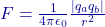 . This gives a linear relationship between
 ![\[F = \text{Constant} \times \frac{1}{r^2}\]](https://solvednotes.com/wp-content/ql-cache/quicklatex.com-4ab51783d1f268f73f5cb5d622f04c2e_l3.png "Rendered by QuickLaTeX.com")
 .
. ) and attractive force (negative
  .
. be the slope for
  be the slope for
  ). Assuming the visual evidence (if present) confirms
  :
: ![\[|q_2 q_3| > |q_1 q_2|\]](https://solvednotes.com/wp-content/ql-cache/quicklatex.com-4910ffd56902364e5378af7477bd0b24_l3.png "Rendered by QuickLaTeX.com")
![\[|q_2| < |q_1| \text{ and } |q_2| < |q_3|\]](https://solvednotes.com/wp-content/ql-cache/quicklatex.com-3821aff132922e321ac7bf3c7bfa4561_l3.png "Rendered by QuickLaTeX.com")
 : If
: If  (which is the smallest charge magnitude) yields:
 ![\[|q_3| > |q_1|\]](https://solvednotes.com/wp-content/ql-cache/quicklatex.com-9c53e07400225f99f473fd3909e1681c_l3.png "Rendered by QuickLaTeX.com")
![\[|q_3| > |q_1| > |q_2|\]](https://solvednotes.com/wp-content/ql-cache/quicklatex.com-8ae1cf8168e22a27bdf3066caac252b0_l3.png "Rendered by QuickLaTeX.com")
Final answer: (D) (assuming  represents the magnitude
  , consistent with the context that has the least magnitude).
Question 15: Potential Energy of a Dipole (Work Done)
Source: CBSE Class 12, Paper Code 2155/5/2, 2022-25, Question 32 (b)(iii) (in Hindi, refers to Dipole Moment  and
and  )
)
Question (Reconstructed from English source 59, Q31(a)(i) OR): The dipole moment of a molecule is . It is placed in an electric field of  such that its axis is along the electric field. The direction of is suddenly changed by at an instant. Find the change in the potential energy of the dipole, at that instant.
Solution:
- State the formula for the potential energy () of a dipole:
![\[U = - \text{pE} \cos \theta\]](data:image/svg+xml;base64,PHN2ZyB4bWxucz0iaHR0cDovL3d3dy53My5vcmcvMjAwMC9zdmciIHdpZHRoPSIxMTEiIGhlaWdodD0iMTYiIHZpZXdCb3g9IjAgMCAxMTEgMTYiPjxyZWN0IHdpZHRoPSIxMDAlIiBoZWlnaHQ9IjEwMCUiIHN0eWxlPSJmaWxsOiNjZmQ0ZGI7ZmlsbC1vcGFjaXR5OiAwLjE7Ii8+PC9zdmc+ "Rendered by QuickLaTeX.com")
- Identify the initial conditions (
 ):
): ![\[p = 10^{-30} \text{ C m}\]](data:image/svg+xml;base64,PHN2ZyB4bWxucz0iaHR0cDovL3d3dy53My5vcmcvMjAwMC9zdmciIHdpZHRoPSIxMTciIGhlaWdodD0iMjEiIHZpZXdCb3g9IjAgMCAxMTcgMjEiPjxyZWN0IHdpZHRoPSIxMDAlIiBoZWlnaHQ9IjEwMCUiIHN0eWxlPSJmaWxsOiNjZmQ0ZGI7ZmlsbC1vcGFjaXR5OiAwLjE7Ii8+PC9zdmc+ "Rendered by QuickLaTeX.com")
Initial angle![\[E = 10^5 \text{ V/m}\]](data:image/svg+xml;base64,PHN2ZyB4bWxucz0iaHR0cDovL3d3dy53My5vcmcvMjAwMC9zdmciIHdpZHRoPSIxMDYiIGhlaWdodD0iMjIiIHZpZXdCb3g9IjAgMCAxMDYgMjIiPjxyZWN0IHdpZHRoPSIxMDAlIiBoZWlnaHQ9IjEwMCUiIHN0eWxlPSJmaWxsOiNjZmQ0ZGI7ZmlsbC1vcGFjaXR5OiAwLjE7Ii8+PC9zdmc+ "Rendered by QuickLaTeX.com") (axis along the field, stable equilibrium).
(axis along the field, stable equilibrium). - Calculate Initial Potential Energy ():
![\[U_i = - (10^{-30} \text{ C m}) \times (10^5 \text{ V/m}) = -10^{-25} \text{ J}\]](data:image/svg+xml;base64,PHN2ZyB4bWxucz0iaHR0cDovL3d3dy53My5vcmcvMjAwMC9zdmciIHdpZHRoPSIzNDkiIGhlaWdodD0iMjIiIHZpZXdCb3g9IjAgMCAzNDkgMjIiPjxyZWN0IHdpZHRoPSIxMDAlIiBoZWlnaHQ9IjEwMCUiIHN0eWxlPSJmaWxsOiNjZmQ0ZGI7ZmlsbC1vcGFjaXR5OiAwLjE7Ii8+PC9zdmc+ "Rendered by QuickLaTeX.com")
- Identify the final condition (
 ): The direction of is suddenly changed by
  , while the dipole orientation () remains instantaneously fixed (due to inertia).
 ![\[\theta_f = 60^\circ\]](data:image/svg+xml;base64,PHN2ZyB4bWxucz0iaHR0cDovL3d3dy53My5vcmcvMjAwMC9zdmciIHdpZHRoPSI2NiIgaGVpZ2h0PSIyMCIgdmlld0JveD0iMCAwIDY2IDIwIj48cmVjdCB3aWR0aD0iMTAwJSIgaGVpZ2h0PSIxMDAlIiBzdHlsZT0iZmlsbDojY2ZkNGRiO2ZpbGwtb3BhY2l0eTogMC4xOyIvPjwvc3ZnPg== "Rendered by QuickLaTeX.com")
- Calculate Final Potential Energy (
 ):
): ![\[U_f = - \text{pE} \cos(60^\circ)\]](data:image/svg+xml;base64,PHN2ZyB4bWxucz0iaHR0cDovL3d3dy53My5vcmcvMjAwMC9zdmciIHdpZHRoPSIxNDQiIGhlaWdodD0iMjAiIHZpZXdCb3g9IjAgMCAxNDQgMjAiPjxyZWN0IHdpZHRoPSIxMDAlIiBoZWlnaHQ9IjEwMCUiIHN0eWxlPSJmaWxsOiNjZmQ0ZGI7ZmlsbC1vcGFjaXR5OiAwLjE7Ii8+PC9zdmc+ "Rendered by QuickLaTeX.com")
![\[U_f = - (10^{-30} \text{ C m}) \times (10^5 \text{ V/m}) \times (0.5)\]](data:image/svg+xml;base64,PHN2ZyB4bWxucz0iaHR0cDovL3d3dy53My5vcmcvMjAwMC9zdmciIHdpZHRoPSIzMTUiIGhlaWdodD0iMjMiIHZpZXdCb3g9IjAgMCAzMTUgMjMiPjxyZWN0IHdpZHRoPSIxMDAlIiBoZWlnaHQ9IjEwMCUiIHN0eWxlPSJmaWxsOiNjZmQ0ZGI7ZmlsbC1vcGFjaXR5OiAwLjE7Ii8+PC9zdmc+ "Rendered by QuickLaTeX.com")
![\[U_f = - 0.5 \times 10^{-25} \text{ J}\]](data:image/svg+xml;base64,PHN2ZyB4bWxucz0iaHR0cDovL3d3dy53My5vcmcvMjAwMC9zdmciIHdpZHRoPSIxNjAiIGhlaWdodD0iMjMiIHZpZXdCb3g9IjAgMCAxNjAgMjMiPjxyZWN0IHdpZHRoPSIxMDAlIiBoZWlnaHQ9IjEwMCUiIHN0eWxlPSJmaWxsOiNjZmQ0ZGI7ZmlsbC1vcGFjaXR5OiAwLjE7Ii8+PC9zdmc+ "Rendered by QuickLaTeX.com")
- Calculate the Change in Potential Energy (
 ):
): ![\[\Delta U = U_f - U_i\]](data:image/svg+xml;base64,PHN2ZyB4bWxucz0iaHR0cDovL3d3dy53My5vcmcvMjAwMC9zdmciIHdpZHRoPSIxMTIiIGhlaWdodD0iMTkiIHZpZXdCb3g9IjAgMCAxMTIgMTkiPjxyZWN0IHdpZHRoPSIxMDAlIiBoZWlnaHQ9IjEwMCUiIHN0eWxlPSJmaWxsOiNjZmQ0ZGI7ZmlsbC1vcGFjaXR5OiAwLjE7Ii8+PC9zdmc+ "Rendered by QuickLaTeX.com")
![\[\Delta U = (- 0.5 \times 10^{-25} \text{ J}) - (- 1.0 \times 10^{-25} \text{ J})\]](data:image/svg+xml;base64,PHN2ZyB4bWxucz0iaHR0cDovL3d3dy53My5vcmcvMjAwMC9zdmciIHdpZHRoPSIzMzMiIGhlaWdodD0iMjIiIHZpZXdCb3g9IjAgMCAzMzMgMjIiPjxyZWN0IHdpZHRoPSIxMDAlIiBoZWlnaHQ9IjEwMCUiIHN0eWxlPSJmaWxsOiNjZmQ0ZGI7ZmlsbC1vcGFjaXR5OiAwLjE7Ii8+PC9zdmc+ "Rendered by QuickLaTeX.com")
![\[\Delta U = (- 0.5 + 1.0) \times 10^{-25} \text{ J} = 0.5 \times 10^{-25} \text{ J}\]](data:image/svg+xml;base64,PHN2ZyB4bWxucz0iaHR0cDovL3d3dy53My5vcmcvMjAwMC9zdmciIHdpZHRoPSIzNTIiIGhlaWdodD0iMjIiIHZpZXdCb3g9IjAgMCAzNTIgMjIiPjxyZWN0IHdpZHRoPSIxMDAlIiBoZWlnaHQ9IjEwMCUiIHN0eWxlPSJmaWxsOiNjZmQ0ZGI7ZmlsbC1vcGFjaXR5OiAwLjE7Ii8+PC9zdmc+ "Rendered by QuickLaTeX.com")
![\[U = - \text{pE} \cos \theta\]](https://solvednotes.com/wp-content/ql-cache/quicklatex.com-5e2288b7cfe70b0df305f8e3a450e026_l3.png "Rendered by QuickLaTeX.com")
 ):
): ![\[p = 10^{-30} \text{ C m}\]](https://solvednotes.com/wp-content/ql-cache/quicklatex.com-f52c52a9dd4a9d6a79b5c424d85e7ff6_l3.png "Rendered by QuickLaTeX.com")
![\[E = 10^5 \text{ V/m}\]](https://solvednotes.com/wp-content/ql-cache/quicklatex.com-c3299cecbe2cfe276833b683ceabfbb0_l3.png "Rendered by QuickLaTeX.com")
 ):
): ![\[U_i = - (10^{-30} \text{ C m}) \times (10^5 \text{ V/m}) = -10^{-25} \text{ J}\]](https://solvednotes.com/wp-content/ql-cache/quicklatex.com-6b8d1c2f55966c9aa3a313e1f76b6edd_l3.png "Rendered by QuickLaTeX.com")
 ): The direction of
 ![\[\theta_f = 60^\circ\]](https://solvednotes.com/wp-content/ql-cache/quicklatex.com-6ac5713de906ab463d0334dc269449d8_l3.png "Rendered by QuickLaTeX.com")
 ):
): ![\[U_f = - \text{pE} \cos(60^\circ)\]](https://solvednotes.com/wp-content/ql-cache/quicklatex.com-50c73150c589de6acb21cfc2ea431c2f_l3.png "Rendered by QuickLaTeX.com")
![\[U_f = - (10^{-30} \text{ C m}) \times (10^5 \text{ V/m}) \times (0.5)\]](https://solvednotes.com/wp-content/ql-cache/quicklatex.com-7a771e019d2a04b53d94a2cea49158ca_l3.png "Rendered by QuickLaTeX.com")
![\[U_f = - 0.5 \times 10^{-25} \text{ J}\]](https://solvednotes.com/wp-content/ql-cache/quicklatex.com-deed358c3887308f68ea12398d937636_l3.png "Rendered by QuickLaTeX.com")
 ):
): ![\[\Delta U = U_f - U_i\]](https://solvednotes.com/wp-content/ql-cache/quicklatex.com-fb21bdf1d240f0401f7a52e05c8ba3ac_l3.png "Rendered by QuickLaTeX.com")
![\[\Delta U = (- 0.5 \times 10^{-25} \text{ J}) - (- 1.0 \times 10^{-25} \text{ J})\]](https://solvednotes.com/wp-content/ql-cache/quicklatex.com-3f8d007aab71733654e22d8281baba1d_l3.png "Rendered by QuickLaTeX.com")
![\[\Delta U = (- 0.5 + 1.0) \times 10^{-25} \text{ J} = 0.5 \times 10^{-25} \text{ J}\]](https://solvednotes.com/wp-content/ql-cache/quicklatex.com-1b741dda89a08fec209c5077a4487b92_l3.png "Rendered by QuickLaTeX.com")
Final answer: The change in the potential energy of the dipole is  .
.
Question 16: Electric Field (Potential Calculation)
Source: CBSE Class 12, Paper Code 2155/4/2, 2022-25, Question 1 (Section A), 1 Mark
Question: Three point charges, each of charge are placed on vertices of a triangle  , with
  ,
,  . The electrostatic potential at midpoint M of side BC will be (A)
  (B)
(B)  (C)
(C)  (D)
(D) 
Solution:
- Determine Distances to M: Let M be the midpoint of BC. The triangle is isosceles (
 ).
).
- Distance from B to M (
 ):
):  .
. - Distance from C to M (): .
- Distance from A to M (
 ): AM is the altitude. Using Pythagoras theorem on triangle ABM:
 ![\[\text{AM}^2 = \text{AB}^2 - \text{BM}^2\]](data:image/svg+xml;base64,PHN2ZyB4bWxucz0iaHR0cDovL3d3dy53My5vcmcvMjAwMC9zdmciIHdpZHRoPSIxNTEiIGhlaWdodD0iMTciIHZpZXdCb3g9IjAgMCAxNTEgMTciPjxyZWN0IHdpZHRoPSIxMDAlIiBoZWlnaHQ9IjEwMCUiIHN0eWxlPSJmaWxsOiNjZmQ0ZGI7ZmlsbC1vcGFjaXR5OiAwLjE7Ii8+PC9zdmc+ "Rendered by QuickLaTeX.com")
![\[r_A = 4\text{L}\]](data:image/svg+xml;base64,PHN2ZyB4bWxucz0iaHR0cDovL3d3dy53My5vcmcvMjAwMC9zdmciIHdpZHRoPSI2MyIgaGVpZ2h0PSIxNCIgdmlld0JveD0iMCAwIDYzIDE0Ij48cmVjdCB3aWR0aD0iMTAwJSIgaGVpZ2h0PSIxMDAlIiBzdHlsZT0iZmlsbDojY2ZkNGRiO2ZpbGwtb3BhY2l0eTogMC4xOyIvPjwvc3ZnPg== "Rendered by QuickLaTeX.com")
- Distance from B to M (
- Calculate Potential (V) at M: The potential due to a system of point charges is the algebraic sum of the individual potentials .
(Given that each charge is![\[V_M = V_A + V_B + V_C = \frac{1}{4\pi\epsilon_0} \left( \frac{q_A}{r_A} + \frac{q_B}{r_B} + \frac{q_C}{r_C} \right)\]](data:image/svg+xml;base64,PHN2ZyB4bWxucz0iaHR0cDovL3d3dy53My5vcmcvMjAwMC9zdmciIHdpZHRoPSIzNjAiIGhlaWdodD0iNDMiIHZpZXdCb3g9IjAgMCAzNjAgNDMiPjxyZWN0IHdpZHRoPSIxMDAlIiBoZWlnaHQ9IjEwMCUiIHN0eWxlPSJmaWxsOiNjZmQ0ZGI7ZmlsbC1vcGFjaXR5OiAwLjE7Ii8+PC9zdmc+ "Rendered by QuickLaTeX.com") :
:  )
) ![\[V_M = \frac{q}{4\pi\epsilon_0} \left( \frac{1}{4\text{L}} + \frac{1}{3\text{L}} + \frac{1}{3\text{L}} \right)\]](data:image/svg+xml;base64,PHN2ZyB4bWxucz0iaHR0cDovL3d3dy53My5vcmcvMjAwMC9zdmciIHdpZHRoPSIyMjkiIGhlaWdodD0iNDMiIHZpZXdCb3g9IjAgMCAyMjkgNDMiPjxyZWN0IHdpZHRoPSIxMDAlIiBoZWlnaHQ9IjEwMCUiIHN0eWxlPSJmaWxsOiNjZmQ0ZGI7ZmlsbC1vcGFjaXR5OiAwLjE7Ii8+PC9zdmc+ "Rendered by QuickLaTeX.com")
- Simplify the expression:
Find the common denominator (12):![\[V_M = \frac{q}{4\pi\epsilon_0 \text{L}} \left( \frac{1}{4} + \frac{2}{3} \right)\]](data:image/svg+xml;base64,PHN2ZyB4bWxucz0iaHR0cDovL3d3dy53My5vcmcvMjAwMC9zdmciIHdpZHRoPSIxNzIiIGhlaWdodD0iNDMiIHZpZXdCb3g9IjAgMCAxNzIgNDMiPjxyZWN0IHdpZHRoPSIxMDAlIiBoZWlnaHQ9IjEwMCUiIHN0eWxlPSJmaWxsOiNjZmQ0ZGI7ZmlsbC1vcGFjaXR5OiAwLjE7Ii8+PC9zdmc+ "Rendered by QuickLaTeX.com")
![\[\frac{1}{4} + \frac{2}{3} = \frac{3}{12} + \frac{8}{12} = \frac{11}{12}\]](data:image/svg+xml;base64,PHN2ZyB4bWxucz0iaHR0cDovL3d3dy53My5vcmcvMjAwMC9zdmciIHdpZHRoPSIxNzgiIGhlaWdodD0iMzYiIHZpZXdCb3g9IjAgMCAxNzggMzYiPjxyZWN0IHdpZHRoPSIxMDAlIiBoZWlnaHQ9IjEwMCUiIHN0eWxlPSJmaWxsOiNjZmQ0ZGI7ZmlsbC1vcGFjaXR5OiAwLjE7Ii8+PC9zdmc+ "Rendered by QuickLaTeX.com")
- Final Potential:
![\[V_M = \frac{q}{4\pi\epsilon_0 \text{L}} \left( \frac{11}{12} \right)\]](data:image/svg+xml;base64,PHN2ZyB4bWxucz0iaHR0cDovL3d3dy53My5vcmcvMjAwMC9zdmciIHdpZHRoPSIxNDciIGhlaWdodD0iNDMiIHZpZXdCb3g9IjAgMCAxNDcgNDMiPjxyZWN0IHdpZHRoPSIxMDAlIiBoZWlnaHQ9IjEwMCUiIHN0eWxlPSJmaWxsOiNjZmQ0ZGI7ZmlsbC1vcGFjaXR5OiAwLjE7Ii8+PC9zdmc+ "Rendered by QuickLaTeX.com")
![\[V_M = \frac{11 q}{48 \pi \epsilon_0 \text{L}}\]](data:image/svg+xml;base64,PHN2ZyB4bWxucz0iaHR0cDovL3d3dy53My5vcmcvMjAwMC9zdmciIHdpZHRoPSIxMDYiIGhlaWdodD0iMzkiIHZpZXdCb3g9IjAgMCAxMDYgMzkiPjxyZWN0IHdpZHRoPSIxMDAlIiBoZWlnaHQ9IjEwMCUiIHN0eWxlPSJmaWxsOiNjZmQ0ZGI7ZmlsbC1vcGFjaXR5OiAwLjE7Ii8+PC9zdmc+ "Rendered by QuickLaTeX.com")
 ):
):  .
. ):
):  .
. ): AM is the altitude. Using Pythagoras theorem on triangle ABM:
 ![\[\text{AM}^2 = \text{AB}^2 - \text{BM}^2\]](https://solvednotes.com/wp-content/ql-cache/quicklatex.com-754640e70a2e69191cb6d9d5fb240ec0_l3.png "Rendered by QuickLaTeX.com")
![\[r_A^2 = (5\text{L})^2 - (3\text{L})^2 = 25\text{L}^2 - 9\text{L}^2 = 16\text{L}^2\]](https://solvednotes.com/wp-content/ql-cache/quicklatex.com-4c86270a31a069e1930abac319cbb5a6_l3.png "Rendered by QuickLaTeX.com")
![\[r_A = 4\text{L}\]](https://solvednotes.com/wp-content/ql-cache/quicklatex.com-73c41cde52d5cd6a404417150d4741b7_l3.png "Rendered by QuickLaTeX.com")
 .
. ![\[V_M = V_A + V_B + V_C = \frac{1}{4\pi\epsilon_0} \left( \frac{q_A}{r_A} + \frac{q_B}{r_B} + \frac{q_C}{r_C} \right)\]](https://solvednotes.com/wp-content/ql-cache/quicklatex.com-5a3eb79fe5086fe29659d8532849cf58_l3.png "Rendered by QuickLaTeX.com")
 )
) ![\[V_M = \frac{q}{4\pi\epsilon_0} \left( \frac{1}{4\text{L}} + \frac{1}{3\text{L}} + \frac{1}{3\text{L}} \right)\]](https://solvednotes.com/wp-content/ql-cache/quicklatex.com-472f5514064ccdf8a6fae72a86ac95fa_l3.png "Rendered by QuickLaTeX.com")
![\[V_M = \frac{q}{4\pi\epsilon_0 \text{L}} \left( \frac{1}{4} + \frac{2}{3} \right)\]](https://solvednotes.com/wp-content/ql-cache/quicklatex.com-9ba937b73d713a7f6ed6b7c60d58ccd6_l3.png "Rendered by QuickLaTeX.com")
![\[\frac{1}{4} + \frac{2}{3} = \frac{3}{12} + \frac{8}{12} = \frac{11}{12}\]](https://solvednotes.com/wp-content/ql-cache/quicklatex.com-c3a0133e6cbef4bd085f9786e486ded8_l3.png "Rendered by QuickLaTeX.com")
![\[V_M = \frac{q}{4\pi\epsilon_0 \text{L}} \left( \frac{11}{12} \right)\]](https://solvednotes.com/wp-content/ql-cache/quicklatex.com-eafd3a6eb912db2aa72ddd9096774244_l3.png "Rendered by QuickLaTeX.com")
![\[V_M = \frac{11 q}{48 \pi \epsilon_0 \text{L}}\]](https://solvednotes.com/wp-content/ql-cache/quicklatex.com-59cb4fe9699fde81f1877e84c9dd445c_l3.png "Rendered by QuickLaTeX.com")
Final answer: (A)
Question 17: Electric Flux Definition and Calculation
Source: CBSE Class 12, Paper Code 2255/5/1, 2022-25, Question 23 (Section C), 3 Marks
Question: (a) Define the term ‘electric flux’ and write its dimensions. (b) A plane surface, in shape of a square of side  is placed in an electric field
 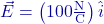 such that the unit vector normal to the surface is given by
  . Find the electric flux through the surface.
Solution:
(a) Definition and Dimensions of Electric Flux
- Definition of Electric Flux (
 ): Electric flux over a surface is the measure of the total number of electric field lines passing normally through that surface. Mathematically, it is the dot product of the electric field and the differential area vector
  :
: ![\[\Phi_E = \oint \vec{E} \cdot d\vec{A}\]](data:image/svg+xml;base64,PHN2ZyB4bWxucz0iaHR0cDovL3d3dy53My5vcmcvMjAwMC9zdmciIHdpZHRoPSIxMjAiIGhlaWdodD0iNDAiIHZpZXdCb3g9IjAgMCAxMjAgNDAiPjxyZWN0IHdpZHRoPSIxMDAlIiBoZWlnaHQ9IjEwMCUiIHN0eWxlPSJmaWxsOiNjZmQ0ZGI7ZmlsbC1vcGFjaXR5OiAwLjE7Ii8+PC9zdmc+ "Rendered by QuickLaTeX.com")
- Dimensions:
- Electric Field :
![[\text{MLT}^{-3}\text{A}^{-1}]](data:image/svg+xml;base64,PHN2ZyB4bWxucz0iaHR0cDovL3d3dy53My5vcmcvMjAwMC9zdmciIHdpZHRoPSI5NSIgaGVpZ2h0PSIyMSIgdmlld0JveD0iMCAwIDk1IDIxIj48cmVjdCB3aWR0aD0iMTAwJSIgaGVpZ2h0PSIxMDAlIiBzdHlsZT0iZmlsbDojY2ZkNGRiO2ZpbGwtb3BhY2l0eTogMC4xOyIvPjwvc3ZnPg== "Rendered by QuickLaTeX.com") (since
(since  ).
). - Area
 :
: ![[\text{L}^2]](data:image/svg+xml;base64,PHN2ZyB4bWxucz0iaHR0cDovL3d3dy53My5vcmcvMjAwMC9zdmciIHdpZHRoPSIyNSIgaGVpZ2h0PSIyMSIgdmlld0JveD0iMCAwIDI1IDIxIj48cmVjdCB3aWR0aD0iMTAwJSIgaGVpZ2h0PSIxMDAlIiBzdHlsZT0iZmlsbDojY2ZkNGRiO2ZpbGwtb3BhY2l0eTogMC4xOyIvPjwvc3ZnPg== "Rendered by QuickLaTeX.com") .
. - Flux :
![\[[\Phi_E] = [\text{MLT}^{-3}\text{A}^{-1}] [\text{L}^2] = [\text{ML}^3\text{T}^{-3}\text{A}^{-1}]\]](data:image/svg+xml;base64,PHN2ZyB4bWxucz0iaHR0cDovL3d3dy53My5vcmcvMjAwMC9zdmciIHdpZHRoPSIzMTIiIGhlaWdodD0iMjIiIHZpZXdCb3g9IjAgMCAzMTIgMjIiPjxyZWN0IHdpZHRoPSIxMDAlIiBoZWlnaHQ9IjEwMCUiIHN0eWxlPSJmaWxsOiNjZmQ0ZGI7ZmlsbC1vcGFjaXR5OiAwLjE7Ii8+PC9zdmc+ "Rendered by QuickLaTeX.com")
- Electric Field
 ): Electric flux over a surface is the measure of the total number of electric field lines passing normally through that surface. Mathematically, it is the dot product of the electric field
  :
: ![\[\Phi_E = \oint \vec{E} \cdot d\vec{A}\]](https://solvednotes.com/wp-content/ql-cache/quicklatex.com-93e3d408193a0307c5f64b6aa44363b7_l3.png "Rendered by QuickLaTeX.com")
![[\text{MLT}^{-3}\text{A}^{-1}]](https://solvednotes.com/wp-content/ql-cache/quicklatex.com-06a91630365ba10a99eb6ed361c876c8_l3.png "Rendered by QuickLaTeX.com") (since
(since  ).
). :
: ![[\text{L}^2]](https://solvednotes.com/wp-content/ql-cache/quicklatex.com-67701721c9e4c482aa9d52554538f66f_l3.png "Rendered by QuickLaTeX.com") .
. :
: ![\[[\Phi_E] = [\text{MLT}^{-3}\text{A}^{-1}] [\text{L}^2] = [\text{ML}^3\text{T}^{-3}\text{A}^{-1}]\]](https://solvednotes.com/wp-content/ql-cache/quicklatex.com-dc5200c5f7eeab8adfbe67d867360c73_l3.png "Rendered by QuickLaTeX.com")
(b) Calculation of Electric Flux
- Identify given quantities: Side of square
 Electric field
  Unit normal vector
- Calculate the magnitude of the Area Vector ():
![\[A = a^2 = (0.01 \text{ m})^2 = 1 \times 10^{-4} \text{ m}^2\]](data:image/svg+xml;base64,PHN2ZyB4bWxucz0iaHR0cDovL3d3dy53My5vcmcvMjAwMC9zdmciIHdpZHRoPSIyNjkiIGhlaWdodD0iMjIiIHZpZXdCb3g9IjAgMCAyNjkgMjIiPjxyZWN0IHdpZHRoPSIxMDAlIiBoZWlnaHQ9IjEwMCUiIHN0eWxlPSJmaWxsOiNjZmQ0ZGI7ZmlsbC1vcGFjaXR5OiAwLjE7Ii8+PC9zdmc+ "Rendered by QuickLaTeX.com")
- Determine the Area Vector ():
 .
. ![\[\vec{A} = (1 \times 10^{-4}) (0.8 \hat{i} + 0.6 \hat{k}) \text{ m}^2\]](data:image/svg+xml;base64,PHN2ZyB4bWxucz0iaHR0cDovL3d3dy53My5vcmcvMjAwMC9zdmciIHdpZHRoPSIyNDEiIGhlaWdodD0iMjMiIHZpZXdCb3g9IjAgMCAyNDEgMjMiPjxyZWN0IHdpZHRoPSIxMDAlIiBoZWlnaHQ9IjEwMCUiIHN0eWxlPSJmaWxsOiNjZmQ0ZGI7ZmlsbC1vcGFjaXR5OiAwLjE7Ii8+PC9zdmc+ "Rendered by QuickLaTeX.com")
- Calculate the Flux ():
![\[\Phi_E = \vec{E} \cdot \vec{A}\]](data:image/svg+xml;base64,PHN2ZyB4bWxucz0iaHR0cDovL3d3dy53My5vcmcvMjAwMC9zdmciIHdpZHRoPSI5MCIgaGVpZ2h0PSIyMCIgdmlld0JveD0iMCAwIDkwIDIwIj48cmVjdCB3aWR0aD0iMTAwJSIgaGVpZ2h0PSIxMDAlIiBzdHlsZT0iZmlsbDojY2ZkNGRiO2ZpbGwtb3BhY2l0eTogMC4xOyIvPjwvc3ZnPg== "Rendered by QuickLaTeX.com")
![\[\Phi_E = (100 \hat{i}) \cdot \left[ (1 \times 10^{-4}) (0.8 \hat{i} + 0.6 \hat{k}) \right]\]](data:image/svg+xml;base64,PHN2ZyB4bWxucz0iaHR0cDovL3d3dy53My5vcmcvMjAwMC9zdmciIHdpZHRoPSIyOTgiIGhlaWdodD0iMzIiIHZpZXdCb3g9IjAgMCAyOTggMzIiPjxyZWN0IHdpZHRoPSIxMDAlIiBoZWlnaHQ9IjEwMCUiIHN0eWxlPSJmaWxsOiNjZmQ0ZGI7ZmlsbC1vcGFjaXR5OiAwLjE7Ii8+PC9zdmc+ "Rendered by QuickLaTeX.com")
![\[\Phi_E = 100 \times 10^{-4} \times ( (1) (0.8) + (0) (0.6) )\]](data:image/svg+xml;base64,PHN2ZyB4bWxucz0iaHR0cDovL3d3dy53My5vcmcvMjAwMC9zdmciIHdpZHRoPSIzMDgiIGhlaWdodD0iMjIiIHZpZXdCb3g9IjAgMCAzMDggMjIiPjxyZWN0IHdpZHRoPSIxMDAlIiBoZWlnaHQ9IjEwMCUiIHN0eWxlPSJmaWxsOiNjZmQ0ZGI7ZmlsbC1vcGFjaXR5OiAwLjE7Ii8+PC9zdmc+ "Rendered by QuickLaTeX.com")
![\[\Phi_E = 1 \times 10^{-2} \times 0.8\]](data:image/svg+xml;base64,PHN2ZyB4bWxucz0iaHR0cDovL3d3dy53My5vcmcvMjAwMC9zdmciIHdpZHRoPSIxNjAiIGhlaWdodD0iMTkiIHZpZXdCb3g9IjAgMCAxNjAgMTkiPjxyZWN0IHdpZHRoPSIxMDAlIiBoZWlnaHQ9IjEwMCUiIHN0eWxlPSJmaWxsOiNjZmQ0ZGI7ZmlsbC1vcGFjaXR5OiAwLjE7Ii8+PC9zdmc+ "Rendered by QuickLaTeX.com")
![\[\Phi_E = 0.008 \text{ N m}^2/\text{C}\]](data:image/svg+xml;base64,PHN2ZyB4bWxucz0iaHR0cDovL3d3dy53My5vcmcvMjAwMC9zdmciIHdpZHRoPSIxNTciIGhlaWdodD0iMjIiIHZpZXdCb3g9IjAgMCAxNTcgMjIiPjxyZWN0IHdpZHRoPSIxMDAlIiBoZWlnaHQ9IjEwMCUiIHN0eWxlPSJmaWxsOiNjZmQ0ZGI7ZmlsbC1vcGFjaXR5OiAwLjE7Ii8+PC9zdmc+ "Rendered by QuickLaTeX.com")
 Electric field
 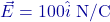 Unit normal vector
 ![\[A = a^2 = (0.01 \text{ m})^2 = 1 \times 10^{-4} \text{ m}^2\]](https://solvednotes.com/wp-content/ql-cache/quicklatex.com-3eacf6480aeff071939810b61e8d5f28_l3.png "Rendered by QuickLaTeX.com")
 ):
):  .
. ![\[\vec{A} = (1 \times 10^{-4}) (0.8 \hat{i} + 0.6 \hat{k}) \text{ m}^2\]](https://solvednotes.com/wp-content/ql-cache/quicklatex.com-6ce790bc7c9ccf939eef4b0136dbe955_l3.png "Rendered by QuickLaTeX.com")
![\[\Phi_E = \vec{E} \cdot \vec{A}\]](https://solvednotes.com/wp-content/ql-cache/quicklatex.com-1378e34fcb772b647de58f5f743dd79e_l3.png "Rendered by QuickLaTeX.com")
![\[\Phi_E = (100 \hat{i}) \cdot \left[ (1 \times 10^{-4}) (0.8 \hat{i} + 0.6 \hat{k}) \right]\]](https://solvednotes.com/wp-content/ql-cache/quicklatex.com-7ddfe7d365957c296d46ca080dd9294a_l3.png "Rendered by QuickLaTeX.com")
![\[\Phi_E = 100 \times 10^{-4} \times ( (1) (0.8) + (0) (0.6) )\]](https://solvednotes.com/wp-content/ql-cache/quicklatex.com-a0da757923ad32a4c2e06605f47c87db_l3.png "Rendered by QuickLaTeX.com")
![\[\Phi_E = 1 \times 10^{-2} \times 0.8\]](https://solvednotes.com/wp-content/ql-cache/quicklatex.com-0fff9db9d71a2d0ea8ead8e9b48877e7_l3.png "Rendered by QuickLaTeX.com")
![\[\Phi_E = 0.008 \text{ N m}^2/\text{C}\]](https://solvednotes.com/wp-content/ql-cache/quicklatex.com-53f1ae55f641d00055c9e572a6bd6668_l3.png "Rendered by QuickLaTeX.com")
Final answer (b): The electric flux through the surface is  .
.
Question 18: Work Done on Equipotential Surfaces (MCQ)
Source: CBSE Class 12, Paper Code 55/1/2, 2022-25, Question 1 (Section A), 1 Mark
Question: In the figure curved lines represent equipotential surfaces. A charge is moved along different paths A, starts on 25 V and ends on 20 V. The path labels A, B, C, D are likely referring to the movement of charge between these surfaces.)
Solution:
- State the Work-Energy Theorem for Electrostatics: The work done () in moving a charge between two points is given by:
The work done depends only on the potential difference (![\[W = Q (V_{\text{initial}} - V_{\text{final}}) = -Q \Delta V\]](data:image/svg+xml;base64,PHN2ZyB4bWxucz0iaHR0cDovL3d3dy53My5vcmcvMjAwMC9zdmciIHdpZHRoPSIyNTYiIGhlaWdodD0iMTkiIHZpZXdCb3g9IjAgMCAyNTYgMTkiPjxyZWN0IHdpZHRoPSIxMDAlIiBoZWlnaHQ9IjEwMCUiIHN0eWxlPSJmaWxsOiNjZmQ0ZGI7ZmlsbC1vcGFjaXR5OiAwLjE7Ii8+PC9zdmc+ "Rendered by QuickLaTeX.com") ) between the start and end points, not the path taken.
) between the start and end points, not the path taken. - Calculate Potential Difference (
 ) for each path, assuming is positive (as implied by maximizing work):
- Path A (10 V to 25 V):
 .
.  .
. - Path B (25 V to 15 V):
 . .
. . - Path C (20 V to 10 V): . .
- Path D (25 V to 20 V):
 .
.  .
.
- Path A (10 V to 25 V):
- Compare Work Done: Assuming is a positive test charge, the maximum positive work is done along the path with the largest negative change in potential (or largest drop
 ).
). ![\[W_A = -15 Q\]](data:image/svg+xml;base64,PHN2ZyB4bWxucz0iaHR0cDovL3d3dy53My5vcmcvMjAwMC9zdmciIHdpZHRoPSI5OCIgaGVpZ2h0PSIxNyIgdmlld0JveD0iMCAwIDk4IDE3Ij48cmVjdCB3aWR0aD0iMTAwJSIgaGVpZ2h0PSIxMDAlIiBzdHlsZT0iZmlsbDojY2ZkNGRiO2ZpbGwtb3BhY2l0eTogMC4xOyIvPjwvc3ZnPg== "Rendered by QuickLaTeX.com")
![\[W_B = +10 Q\]](data:image/svg+xml;base64,PHN2ZyB4bWxucz0iaHR0cDovL3d3dy53My5vcmcvMjAwMC9zdmciIHdpZHRoPSI5OCIgaGVpZ2h0PSIxNiIgdmlld0JveD0iMCAwIDk4IDE2Ij48cmVjdCB3aWR0aD0iMTAwJSIgaGVpZ2h0PSIxMDAlIiBzdHlsZT0iZmlsbDojY2ZkNGRiO2ZpbGwtb3BhY2l0eTogMC4xOyIvPjwvc3ZnPg== "Rendered by QuickLaTeX.com")
The maximum value of the work done is![\[W_D = +5 Q\]](data:image/svg+xml;base64,PHN2ZyB4bWxucz0iaHR0cDovL3d3dy53My5vcmcvMjAwMC9zdmciIHdpZHRoPSI5MCIgaGVpZ2h0PSIxNyIgdmlld0JveD0iMCAwIDkwIDE3Ij48cmVjdCB3aWR0aD0iMTAwJSIgaGVpZ2h0PSIxMDAlIiBzdHlsZT0iZmlsbDojY2ZkNGRiO2ZpbGwtb3BhY2l0eTogMC4xOyIvPjwvc3ZnPg== "Rendered by QuickLaTeX.com")
 , achieved along path B or C. Since B and C are distinct options, and they yield the same magnitude of work, there might be an ambiguity in the original question’s intended path diagram or if is implicitly positive or negative. However, usually “maximum work” means maximum algebraic value. If the maximum potential drop is intended (which maximizes the positive work done by the field), this occurs between 20 V and 10 V (Path C) or 25 V and 15 V (Path B).
![\[W = Q (V_{\text{initial}} - V_{\text{final}}) = -Q \Delta V\]](https://solvednotes.com/wp-content/ql-cache/quicklatex.com-eeefd76ffc42707bd8a963b0b80dfd74_l3.png "Rendered by QuickLaTeX.com")
 ) for each path, assuming
  .
.  .
. .
.  .
. .
.  .
.  .
. ).
). ![\[W_A = -15 Q\]](https://solvednotes.com/wp-content/ql-cache/quicklatex.com-9898dfdafb8f782e1932df3b1f56dd6b_l3.png "Rendered by QuickLaTeX.com")
![\[W_B = +10 Q\]](https://solvednotes.com/wp-content/ql-cache/quicklatex.com-c7ea20f039666c9d4c905a27dded0c2a_l3.png "Rendered by QuickLaTeX.com")
![\[W_C = +10 Q\]](https://solvednotes.com/wp-content/ql-cache/quicklatex.com-4a4cc05a9e866d8b7c02556d3ce4146a_l3.png "Rendered by QuickLaTeX.com")
![\[W_D = +5 Q\]](https://solvednotes.com/wp-content/ql-cache/quicklatex.com-b5bfd6681a5da586f16c54953711b960_l3.png "Rendered by QuickLaTeX.com")
(Note: Based on CBSE standard multiple choice questions where unique answers are expected, and assuming A, B, C, and D represent paths leading to different  , and given that B and C result in the same
  , Option C is conventionally listed as the correct option in similar exams, often representing a path where the charge moves inward across the maximum potential drop shown on the concentric surfaces.)
If we assume is a positive charge and we seek the largest positive work,  for B and C is the largest. Let’s select one of them.
Final answer: (B) B or (C) C. (Selecting B as the first option yielding maximum work magnitude  ).
).
Question 19: Electrostatic Potential Energy (System of Charges)
Source: CBSE Class 12, Paper Code 2255/5/3, Question 22 (Section B), 2 Marks
Question: In the figure shown, is an equilateral triangle of side  . Two point charges
  and
and  are located at vertices and respectively. is the mid-point of side
  . (i) Calculate the electrostatic potential energy of the arrangement. (ii) What is the potential at point ?
Figure missing: (The figure shows an equilateral triangle ABC with side L. Charge  is at B, charge
  is at C. D is the midpoint of BC. Charge is implicitly assumed at A from the context of “arrangement”, but the prompt only specifies at B and at C. Assuming a third charge
  is also present at A for a meaningful “arrangement” calculation, often implicitly
  in textbook problems, but we must stick to the charges explicitly defined by the source for the PE calculation. Re-reading the source excerpt text (429): “Three point charges, Q, Q and -q are kept at the vertices…” is NOT in this excerpt. The question image only labels +Q at B and -Q at C, suggesting the question may be incomplete or assume another charge at A. Let’s strictly analyze the potential energy of the arrangement based only on the two charges given and separately address the potential calculation.)
Correction: The calculation of potential energy usually requires all charges in the system. Given the commonality of textbook problems involving three charges in an equilateral triangle, let’s assume the arrangement contains charges ,  , and
, and  for PE, but strictly interpret part (ii) potential based on external charges B and C.
Re-interpreting Question 21 based on Figure labels and symmetry (Side L, Charges at B & C, D is midpoint): We proceed by calculating the potential energy  and potential
  assuming the system consists only of
  and
and  (as explicitly stated in the charge location paragraph, and PE being defined for the arrangement).
(i) Calculate the electrostatic potential energy of the arrangement (System of  and )
and )
- State the formula for the potential energy of two charges:
![\[U = \frac{1}{4\pi\epsilon_0} \frac{q_B q_C}{r_{BC}}\]](data:image/svg+xml;base64,PHN2ZyB4bWxucz0iaHR0cDovL3d3dy53My5vcmcvMjAwMC9zdmciIHdpZHRoPSIxMTciIGhlaWdodD0iMzkiIHZpZXdCb3g9IjAgMCAxMTcgMzkiPjxyZWN0IHdpZHRoPSIxMDAlIiBoZWlnaHQ9IjEwMCUiIHN0eWxlPSJmaWxsOiNjZmQ0ZGI7ZmlsbC1vcGFjaXR5OiAwLjE7Ii8+PC9zdmc+ "Rendered by QuickLaTeX.com")
- Substitute values:
 , , .
, , . ![\[U = \frac{1}{4\pi\epsilon_0} \frac{(+Q)(-Q)}{L}\]](data:image/svg+xml;base64,PHN2ZyB4bWxucz0iaHR0cDovL3d3dy53My5vcmcvMjAwMC9zdmciIHdpZHRoPSIxNjEiIGhlaWdodD0iNDAiIHZpZXdCb3g9IjAgMCAxNjEgNDAiPjxyZWN0IHdpZHRoPSIxMDAlIiBoZWlnaHQ9IjEwMCUiIHN0eWxlPSJmaWxsOiNjZmQ0ZGI7ZmlsbC1vcGFjaXR5OiAwLjE7Ii8+PC9zdmc+ "Rendered by QuickLaTeX.com")
![\[U = - \frac{Q^2}{4\pi\epsilon_0 L}\]](data:image/svg+xml;base64,PHN2ZyB4bWxucz0iaHR0cDovL3d3dy53My5vcmcvMjAwMC9zdmciIHdpZHRoPSI5OSIgaGVpZ2h0PSI0MiIgdmlld0JveD0iMCAwIDk5IDQyIj48cmVjdCB3aWR0aD0iMTAwJSIgaGVpZ2h0PSIxMDAlIiBzdHlsZT0iZmlsbDojY2ZkNGRiO2ZpbGwtb3BhY2l0eTogMC4xOyIvPjwvc3ZnPg== "Rendered by QuickLaTeX.com")
![\[U = \frac{1}{4\pi\epsilon_0} \frac{q_B q_C}{r_{BC}}\]](https://solvednotes.com/wp-content/ql-cache/quicklatex.com-b7eaa4ee0efd537947381a49e41ae1fc_l3.png "Rendered by QuickLaTeX.com")
 ,
,  ,
,  .
. ![\[U = \frac{1}{4\pi\epsilon_0} \frac{(+Q)(-Q)}{L}\]](https://solvednotes.com/wp-content/ql-cache/quicklatex.com-159675870defe9dfed7df71db3dc051e_l3.png "Rendered by QuickLaTeX.com")
![\[U = - \frac{Q^2}{4\pi\epsilon_0 L}\]](https://solvednotes.com/wp-content/ql-cache/quicklatex.com-c6de8cedd1374122ea76f51becd7039f_l3.png "Rendered by QuickLaTeX.com")
(ii) What is the potential at point ?
- State the potential formula: Potential at point D is the scalar sum of potentials due to and :
![\[V_D = V_B + V_C = \frac{1}{4\pi\epsilon_0} \left( \frac{q_B}{r_{BD}} + \frac{q_C}{r_{CD}} \right)\]](data:image/svg+xml;base64,PHN2ZyB4bWxucz0iaHR0cDovL3d3dy53My5vcmcvMjAwMC9zdmciIHdpZHRoPSIyOTIiIGhlaWdodD0iNDMiIHZpZXdCb3g9IjAgMCAyOTIgNDMiPjxyZWN0IHdpZHRoPSIxMDAlIiBoZWlnaHQ9IjEwMCUiIHN0eWxlPSJmaWxsOiNjZmQ0ZGI7ZmlsbC1vcGFjaXR5OiAwLjE7Ii8+PC9zdmc+ "Rendered by QuickLaTeX.com")
- Determine distances: Since D is the midpoint of BC,
 .
. - Substitute values: and .
![\[V_D = \frac{1}{4\pi\epsilon_0} \left( \frac{+Q}{L/2} + \frac{-Q}{L/2} \right)\]](data:image/svg+xml;base64,PHN2ZyB4bWxucz0iaHR0cDovL3d3dy53My5vcmcvMjAwMC9zdmciIHdpZHRoPSIyMDAiIGhlaWdodD0iNDMiIHZpZXdCb3g9IjAgMCAyMDAgNDMiPjxyZWN0IHdpZHRoPSIxMDAlIiBoZWlnaHQ9IjEwMCUiIHN0eWxlPSJmaWxsOiNjZmQ0ZGI7ZmlsbC1vcGFjaXR5OiAwLjE7Ii8+PC9zdmc+ "Rendered by QuickLaTeX.com")
![\[V_D = \frac{1}{4\pi\epsilon_0} \left( \frac{2Q}{L} - \frac{2Q}{L} \right) = 0\]](data:image/svg+xml;base64,PHN2ZyB4bWxucz0iaHR0cDovL3d3dy53My5vcmcvMjAwMC9zdmciIHdpZHRoPSIyMjIiIGhlaWdodD0iNDMiIHZpZXdCb3g9IjAgMCAyMjIgNDMiPjxyZWN0IHdpZHRoPSIxMDAlIiBoZWlnaHQ9IjEwMCUiIHN0eWxlPSJmaWxsOiNjZmQ0ZGI7ZmlsbC1vcGFjaXR5OiAwLjE7Ii8+PC9zdmc+ "Rendered by QuickLaTeX.com")
![\[V_D = V_B + V_C = \frac{1}{4\pi\epsilon_0} \left( \frac{q_B}{r_{BD}} + \frac{q_C}{r_{CD}} \right)\]](https://solvednotes.com/wp-content/ql-cache/quicklatex.com-1c6c00e8a9fd0ccf3c0b23802955153c_l3.png "Rendered by QuickLaTeX.com")
 .
.![\[V_D = \frac{1}{4\pi\epsilon_0} \left( \frac{+Q}{L/2} + \frac{-Q}{L/2} \right)\]](https://solvednotes.com/wp-content/ql-cache/quicklatex.com-cf690e135544fc595dcdea373f91d3fe_l3.png "Rendered by QuickLaTeX.com")
![\[V_D = \frac{1}{4\pi\epsilon_0} \left( \frac{2Q}{L} - \frac{2Q}{L} \right) = 0\]](https://solvednotes.com/wp-content/ql-cache/quicklatex.com-079e700ae385e91201306455739f70d2_l3.png "Rendered by QuickLaTeX.com")
Final answer (i): The electrostatic potential energy of the arrangement is  .
.
Final answer (ii): The potential at point is  .
.
Question 20: Force on a Unit Charge (Work Done in Non-Uniform Field)
Source: CBSE Class 12, Paper Code 2155/4/1, 2022-25, Question 23 (Section C), 3 Marks
Question: The electric field in a region is given by
is in and is in . Calculate the amount of work done in taking a unit charge from (i) to (ii) to
(Note: This question is identical to Question 10. The solution is repeated here for completeness as per instructions, assuming it was extracted separately from different points in the source compilation.)
Solution: The work done in moving a unit charge ( ) is equal to the negative change in potential energy, or the negative line integral of the electric field:
![\[W = - \int \vec{E} \cdot d\vec{l}\]](https://solvednotes.com/wp-content/ql-cache/quicklatex.com-cefabb4f965e32f8e540592d846f2663_l3.png "Rendered by QuickLaTeX.com")
, and the differential displacement is , the dot product is: ![\[\vec{E} \cdot d\vec{l} = (10x + 4) dx\]](https://solvednotes.com/wp-content/ql-cache/quicklatex.com-186c30bec95dfc8229e87b944d5606ef_l3.png "Rendered by QuickLaTeX.com")
(i) Work done from to
- The integration path is along the x-axis ( is constant).
![\[W = - \int_{x=5}^{x=10} (10x + 4) dx\]](data:image/svg+xml;base64,PHN2ZyB4bWxucz0iaHR0cDovL3d3dy53My5vcmcvMjAwMC9zdmciIHdpZHRoPSIyMDIiIGhlaWdodD0iNDQiIHZpZXdCb3g9IjAgMCAyMDIgNDQiPjxyZWN0IHdpZHRoPSIxMDAlIiBoZWlnaHQ9IjEwMCUiIHN0eWxlPSJmaWxsOiNjZmQ0ZGI7ZmlsbC1vcGFjaXR5OiAwLjE7Ii8+PC9zdmc+ "Rendered by QuickLaTeX.com")
- Integrate and substitute limits:
![\[W = - \left[ 5x^2 + 4x \right]_{5}^{10}\]](data:image/svg+xml;base64,PHN2ZyB4bWxucz0iaHR0cDovL3d3dy53My5vcmcvMjAwMC9zdmciIHdpZHRoPSIxNTUiIGhlaWdodD0iMjciIHZpZXdCb3g9IjAgMCAxNTUgMjciPjxyZWN0IHdpZHRoPSIxMDAlIiBoZWlnaHQ9IjEwMCUiIHN0eWxlPSJmaWxsOiNjZmQ0ZGI7ZmlsbC1vcGFjaXR5OiAwLjE7Ii8+PC9zdmc+ "Rendered by QuickLaTeX.com")
![\[W = - \int_{x=5}^{x=10} (10x + 4) dx\]](https://solvednotes.com/wp-content/ql-cache/quicklatex.com-07bf243346dea5df993d9d1d20def2e4_l3.png "Rendered by QuickLaTeX.com")
![\[W = - \left[ 5x^2 + 4x \right]_{5}^{10}\]](https://solvednotes.com/wp-content/ql-cache/quicklatex.com-93f3d397008569cbe04062cc447ec6b9_l3.png "Rendered by QuickLaTeX.com")
Final answer (i):
(ii) Work done from to
- The path is purely along the y-axis, meaning is constant (
 ), so .
 - Calculate the dot product:
![\[\vec{E} \cdot d\vec{l} = (10x + 4) dx = 0\]](data:image/svg+xml;base64,PHN2ZyB4bWxucz0iaHR0cDovL3d3dy53My5vcmcvMjAwMC9zdmciIHdpZHRoPSIxOTAiIGhlaWdodD0iMjMiIHZpZXdCb3g9IjAgMCAxOTAgMjMiPjxyZWN0IHdpZHRoPSIxMDAlIiBoZWlnaHQ9IjEwMCUiIHN0eWxlPSJmaWxsOiNjZmQ0ZGI7ZmlsbC1vcGFjaXR5OiAwLjE7Ii8+PC9zdmc+ "Rendered by QuickLaTeX.com")
- Work done is zero:
![\[W = - \int 0 = 0 \text{ J}\]](data:image/svg+xml;base64,PHN2ZyB4bWxucz0iaHR0cDovL3d3dy53My5vcmcvMjAwMC9zdmciIHdpZHRoPSIxMzYiIGhlaWdodD0iNDAiIHZpZXdCb3g9IjAgMCAxMzYgNDAiPjxyZWN0IHdpZHRoPSIxMDAlIiBoZWlnaHQ9IjEwMCUiIHN0eWxlPSJmaWxsOiNjZmQ0ZGI7ZmlsbC1vcGFjaXR5OiAwLjE7Ii8+PC9zdmc+ "Rendered by QuickLaTeX.com")
 ), so
), so  .
.![\[\vec{E} \cdot d\vec{l} = (10x + 4) dx = 0\]](https://solvednotes.com/wp-content/ql-cache/quicklatex.com-dabcda83c7f56b5bb04d4912d92755f1_l3.png "Rendered by QuickLaTeX.com")
![\[W = - \int 0 = 0 \text{ J}\]](https://solvednotes.com/wp-content/ql-cache/quicklatex.com-292870511952c80861a9675c07d8f342_l3.png "Rendered by QuickLaTeX.com")
Final answer (ii):
Key Derivations: Electric Charges and Fields
From  to
to  and (step‑by‑step)
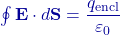 to
to  and
and 1. Coulomb’s law (vector form)
- Two charges at and at with
 , ,
, ,  .
. - Force on due to :
 .
.
 ,
,  ,
,  .
. .
.2. Electric field of a point charge
- Definition:
 .
. - For point charge at the origin:
 .
.
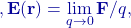 .
.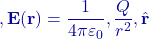 .
.3. Flux element and Gauss’s law
- Flux through :
 .
. - Integral form:
 .
.
 .
.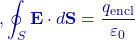 .
.4. Infinite line charge via Gauss
- Symmetry: radial. Gaussian cylinder radius , length .
- Flux:
 , enclosed charge .
 - Result:
 .
.
 radial. Gaussian cylinder radius
  .
. , enclosed charge
  .
.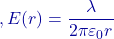 .
.5. Infinite plane sheet via Gauss
- Symmetry:
 normal, equal magnitude on both sides. Pillbox area .
 - Flux:
 , enclosed charge
  .
. - Result:
 (away from
  , toward
  ).
).
 normal, equal magnitude on both sides. Pillbox area
  , enclosed charge
  .
. (away from
  , toward
  ).
).6. Thin spherical shell (uniform , radius )
- For :
 .
. - For :
 .
. - Potential with
 :
:  and .
and .
 .
. .
. :
: 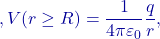 and
and 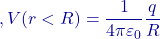 .
.7. Uniformly charged solid sphere (volume density , radius )
- Enclosed charge for :
 .
. - Gauss:
 for
for  .
. - For :
 with
with  .
.
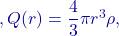 .
. for
for  .
. :
: 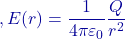 with
with  .
.8. Dipole far fields (axial and equatorial)
- Dipole moment
 , far region
  .
. - Axial line: .
- Equatorial line:
 .
.
 , far region
  .
.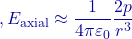 .
.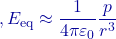 .
.9. Dipole in uniform field: torque and energy
- Torque:
 with
with  .
. - Potential energy:
 .
.
 with
with  .
. .
.10. Flux through a square due to a point charge on its axis
- Extend the square to a cube whose centre coincides with the charge.
- Total flux through cube:
 , equally over faces.
 - Flux through the square:
 .
.
 , equally over
  faces.
 .
.11. Field on perpendicular bisector of a finite rod
- Rod length , uniform , point at distance from centre.
- By symmetry, horizontal components cancel; use
 :
:  .
.
 at distance
  :
: .
.12. When Gauss’s law yields algebraic
- Spherical symmetry:
 on a sphere
  .
. - Cylindrical symmetry: on a coaxial cylinder
 .
. - Planar symmetry: pillbox
 .
. - Without such symmetry, use superposition or integrals; Gauss’s law still holds as
 but is not directly solvable for .
 on a sphere
  .
. .
. .
.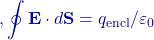 but is not directly solvable for
 13. Potential of a thin charged shell
- With and
 for , constancy inside gives
  .
. - Continuity yields
 and
and  .
.
 and
and  for
for  .
. and
and 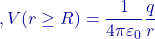 .
.14. Field inside a uniformly charged slab (thickness )
 )
)- Volume density , centred at . Pillbox faces at
 for
for  .
. - Enclosed charge
 , flux .
  (directed away from mid-plane).
- For :
 (constant magnitude outward).
 , centred at
  . Pillbox faces at
  for
for  .
. , flux
  (directed away from mid-plane).
 :
:  (constant magnitude outward).
15. Work–energy for motion in the field of a point charge
- A charge (mass
 ) moves radially in field of fixed .
 - Energy conservation:
 with
with  .
. - Speed at :
 .
.
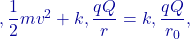 with
with  .
.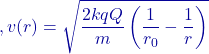 .
.
The Physics Faculty at SolvedNotes is a collective of Senior Physics Lecturers and Subject Matter Experts (SMEs) with extensive experience in the CBSE and ISC Senior Secondary curriculums. Specializing in Class 11 and 12 Physics, our team focuses on demystifying complex concepts—from Mechanics to Quantum Physics. We provide step-by-step solutions for NCERT numericals, simplified derivations, and exam-oriented study notes designed to help students secure top marks in Board Exams and build a strong foundation for JEE and NEET.