Welcome to your all-in-one guide for NCERT Solutions for Class 7 History Ch 2: New Kings and Kingdoms. This post gives you clear, easy-to-understand answers for all the textbook exercise questions. But we don’t stop there! You’ll also find a Quick Revision Guide to help you study the main points fast, and a fun interactive quiz to test your knowledge and prepare you perfectly for your exams.
Let’s recall
- Match the following:
Gurjara-Pratiharas — Gujarat and Rajasthan
Rashtrakutas — Western Deccan
Palas — Bengal
Cholas — Tamil Nadu
Answer:
Gurjara-Pratiharas → Gujarat and Rajasthan;
Rashtrakutas → Western Deccan;
Palas → Bengal;
Cholas → Tamil Nadu.
- Who were the parties involved in the “tripartite struggle”?
Answer:
The three rivals were the Gurjara-Pratiharas, the Rashtrakutas, and the Palas, each competing to control the rich and strategic city of Kanauj in the Ganga valley. - What were the qualifications necessary to become a member of a committee of the sabha in the Chola empire?
Answer:
Members had to own tax-paying land and have a house, be aged 35–70, know the Vedas, be honest and administratively skilled, not have served on a committee in the past three years, and must have submitted all accounts. - What were the two major cities under the control of the Chahamanas?
Answer:
Delhi and Ajmer were the key Chahamana centers, forming their power base as they tried expanding west and east in northwestern India.
Let’s understand
- How did the Rashtrakutas become powerful?
Answer:
Originally Chalukya subordinates, the Rashtrakutas rose when Dantidurga overthrew his overlord in the eighth century and performed the hiranya-garbha ritual, claiming Kshatriya status; they then expanded, built a strong administration, and projected power through warfare, temple patronage, and control of trade routes. - What did the new dynasties do to gain acceptance?
Answer:
They adopted grand royal titles, performed legitimizing rituals like hiranya-garbha, issued land grants to Brahmanas, composed prashastis praising victories, shared authority with local elites, and supported temples to showcase piety and power. - What kind of irrigation works were developed in the Tamil region?
Answer:
Farmers built embankments to stop floods, dug wells, laid canals from river channels, and constructed large tanks to store rainwater; these systems enabled multiple crops, especially rice, in the Kaveri delta. - What were the activities associated with Chola temples?
Answer:
Temples were hubs for worship and also for economic, social, and cultural life: they housed land endowments, supported priests, musicians, dancers, cooks, and artisans, fostered craft production like bronze casting, and anchored settlements.
Let’s discuss
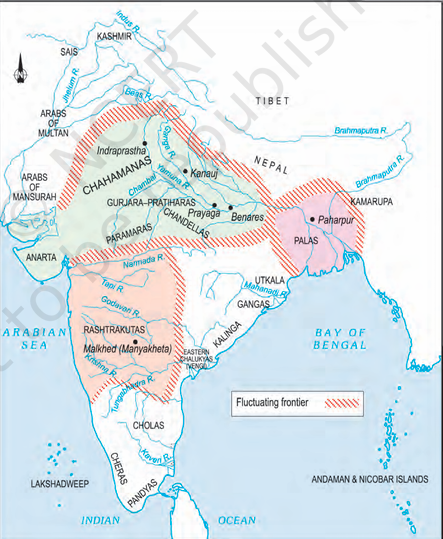
- Look at Map 1 once more and find out whether there were any kingdoms in the state in which you live.
Answer:
Using Map 1, identify your present state and compare it with dynastic regions: for example, Tamil Nadu aligns with the Cholas, Rajasthan with the Gurjara-Pratiharas and Chahamanas, Karnataka with the Rashtrakutas/Chalukyas, and Bengal with the Palas. - Contrast the “elections” in Uttaramerur with present-day panchayat elections.
Answer:
Uttaramerur used eligibility rules (landholding, age, Vedic knowledge), and a lottery of palm-leaf tickets drawn by a child, with disqualification for pending accounts; today’s panchayat polls are universal adult franchise with secret ballots, political candidacy, reservations, and formal election commissions.
Let’s do
- Compare the temple shown in this chapter with any present-day temple in your neighbourhood, highlighting any similarities and differences that you notice.
Answer:
Similarities: both serve worship and community gatherings, feature sculptural decoration, and organize festivals and services. Differences: Chola temples like Thanjavur/Gangaikondacholapuram are monumental royal projects with extensive land endowments and large resident staff; modern temples vary in scale, use contemporary materials and amenities, and often rely on donations rather than royal patronage. - Find out more about taxes that are collected at present. Are these in cash, kind, or labour services?
Answer:
Today taxes are primarily in cash—like income tax, GST, property tax—with digital or bank payments; unlike vetti (forced labour) or varied cesses of the Chola period, present systems avoid labour dues and kind payments, using standardized monetary taxation.
Quick Revision Guide Ch. 2 New Kings and Kingdoms
Here’s a quick, student-friendly revision guide for “New Kings and Kingdoms” to use just before tests. It is structured in short points with simple language. Use it for last-minute recall.
Big picture
- Between 7th–12th centuries, many new dynasties rose in different regions of India.
- Important names: Gurjara-Pratiharas, Palas, Rashtrakutas, Cholas, Chahamanas (Chauhans).
- A key rivalry over Kanauj is called the “tripartite struggle.”
How new dynasties emerged
- Powerful landlords and warrior chiefs, called samantas, first served big kings.
- As they grew stronger, some declared independence and became rulers.
- Example: Dantidurga of the Rashtrakutas overthrew the Chalukyas and performed the hiranya-garbha ritual to claim royal status.
Rulers and administration
- Kings used grand titles like maharaja-adhiraja and tribhuvana-chakravartin.
- Power was shared with samantas and local groups of peasants, traders, and Brahmanas.
- Resources came from taxes on peasants, traders, and various activities.
Taxes (Chola example)
- Over 400 types mentioned in inscriptions.
- Vetti = forced labour; kadamai = land revenue.
- Even small activities (like thatching a roof) could be taxed.
Prashastis and land grants
- Prashastis were praise poems that showed how rulers wanted to be seen (brave, victorious).
- Land was often gifted to Brahmanas on copper plates with royal seals.
- Land grants listed boundaries, rights to collect taxes, and duties like maintaining irrigation.
Warfare for wealth
- Control of Kanauj meant power over rich lands and trade routes.
- Mahmud of Ghazni raided wealthy temples (like Somnath) and took away riches.
- Prithviraja III (Chahamana) first defeated Muhammad Ghori in 1191, but lost in 1192.
The Cholas: rise and power
- Vijayalaya captured the Kaveri delta and built Thanjavur.
- Rajaraja I expanded and reorganized the empire; Rajendra I campaigned to the Ganga valley, Sri Lanka, and Southeast Asia and built a navy.
- Chola temples at Thanjavur and Gangaikondacholapuram are famous for architecture and bronzes.
Temples as hubs
- Temples were not only for worship—they were centers of economy and culture.
- They owned land, supported priests, dancers, musicians, cooks, and artisans.
- Bronze image-making became a special craft.
Agriculture and irrigation
- Kaveri delta had many channels, depositing fertile soil.
- Big works: embankments, canals, large tanks, and wells.
- Planning and community effort were needed to build and maintain these systems.
Chola administration
- Villages (ur) grouped into larger units (nadu).
- Vellala rich peasants had strong local influence under the king’s supervision.
- Land categories in inscriptions:
- vellanvagai (non-Brahmana peasant land)
- brahmadeya (gift to Brahmanas)
- shalabhoga (for schools)
- devadana/tirunamattukkani (for temples)
- pallichchhandam (for Jain institutions)
Sabha and elections (Uttaramerur)
- Brahmana assemblies (sabha) ran local affairs with committees for irrigation, gardens, temples.
- Members needed land, a house, age 35–70, Vedic knowledge, honesty, and clean accounts.
- Selection used a lottery of palm-leaf tickets drawn by a child.
Key names and terms
- Samanta: subordinate chief who could become independent.
- Hiranya-garbha: ritual to claim Kshatriya status.
- Prashasti: praise inscription for rulers.
- Tripartite struggle: fight among Gurjara-Pratiharas, Palas, Rashtrakutas over Kanauj.
- Sultan: title used for rulers (e.g., Mahmud of Ghazni).
- Nadu: a group of villages; ur: a village; sabha: Brahmana assembly; nagaram: traders’ association.
Fast recall boxes
- Tripartite struggle: Gurjara-Pratiharas vs Palas vs Rashtrakutas; goal = Kanauj.
- Chola icons: Rajaraja I, Rajendra I, Thanjavur temple, Gangaikondacholapuram, bronze Nataraja.
- Taxes: vetti (labour), kadamai (land revenue), many cesses on daily activities.
- Local governance: ur → nadu; sabha committees via lottery, strict eligibility.
- Irrigation: embankments, canals, tanks, wells; teamwork and maintenance essential.
Quick compare: past vs present (handy for exams)
- Then: limited eligibility, lottery selection, many in-kind duties; temples as major economic hubs.
- Now: universal adult franchise, secret ballot, cash-based taxes, public bodies manage civic services.
Extra Practice Questions (Short Answer)
1. Who were ‘samantas’?
Samantas were powerful landlords or warrior chiefs who worked for a king. They had to bring gifts and provide soldiers. If a samanta became very rich and strong, he might break away, take a grand title, and start his own kingdom.
2. What was the ‘tripartite struggle’?
This was a long, three-way war between the Gurjara-Pratiharas, Rashtrakutas, and Palas. All three dynasties wanted to control the valuable city of Kanauj, which was a symbol of power located in the rich Ganga valley.
3. How did the Rashtrakutas become powerful?
They started out working for the Chalukya kings. Then, their chief, Dantidurga, overthrew his Chalukya ruler. Even though he was not a Kshatriya (warrior) by birth, he performed a special ritual called hiranya-garbha (the golden womb) to be “reborn” as one.
4. What do ‘prashastis’ tell us?
Prashastis are special inscriptions, written by learned Brahmanas, that praised the king. They described rulers as brave and victorious. While they might exaggerate, they show us how kings wanted to be remembered.
5. Name the main dynasties and their regions.
The main dynasties were the Gurjara-Pratiharas (Gujarat/Rajasthan), the Rashtrakutas (Western Deccan), the Palas (Bengal), the Cholas (Tamil Nadu), and the Chahamanas, or Chauhans (around Delhi/Ajmer).
6. What kinds of taxes did the Cholas collect?
The Cholas collected many taxes. The two most famous were vetti, which was paid in the form of forced labor, and kadamai, which was the main tax on land. They also had smaller taxes on things like thatching a house.
7. How did the Cholas water their farms?
They were very skilled at irrigation. They built embankments to stop floods from the Kaveri river, dug canals to move water to fields, built large tanks to store rainwater, and dug wells. This helped them grow a lot of rice.
8. What were Chola temples used for (besides prayer)?
Chola temples were the center of community life. They were hubs for economic, social, and cultural activities. Land given to temples helped pay for priests, musicians, and dancers. They were also famous centers for crafts, like making bronze statues.
9. How did the Cholas manage their towns and villages?
They had special groups for different jobs. Settlements of peasants were called an ur. Groups of villages formed a nadu, which collected taxes. Brahmanas had assemblies called a sabhā to manage temples and gardens. Groups of traders, called nagarams, helped run the towns.
10. How did someone get chosen for a ‘sabhā’ committee?
The Uttaramerur inscription tells us the rules. A person had to own tax-paying land, have their own home, be between 35-70 years old, and know the Vedas. They also had to be honest. Members were then chosen by a lottery using palm-leaf tickets.
Interactive Quiz on Ch. 2 New Kings and Kingdoms
Loading Your Quiz!

The Social Science Faculty at SolvedNotes comprises passionate educators and storytellers dedicated to the CBSE Class 7 curriculum. We specialize in decoding the complex era of Medieval India covered in the ‘Our Pasts – II’ NCERT textbook. From the rise of the Delhi Sultans and the Mughal Empire to the vibrant regional cultures, our notes transform heavy historical data into engaging narratives and easy-to-recall timelines. Designed for clarity and retention, our content helps middle school students master NCERT History solutions and excel in their school examinations with confidence.