
Complete Solution for Unit 4 of New Learning to Communicate Workbook 8 by Oxford University Press. Grammar in Use ‘Past Perfect Continuous’, and ‘Future Simple’ solved. Words in Action, Writing Practice: Biographical Sketch and more.
Grammar in Use
Past Perfect Continuous
A. In a robbery investigation, the police asked some usual suspects what they had been doing at 10 p.m. the previous night. This is what the suspects told the police.
| Their names | What they said |
|---|---|
| 1. Hitesh | having his supper |
| 2. Vadivelu | watching TV |
| 3. Kankan | making dinner |
| 4. Louis | playing with his daughter |
| 5. Surjit | making a long-distance phone call |
| 6. Zakir | working on the computer |
Now write complete sentences saying what the suspects told the police. The first one has been done for you.
- Hitesh said he had been having his supper.
- Vadivelu said he had been watching TV.
- Kankan said he had been making dinner.
- Louis said he had been playing with his daughter.
- Surjit said he had been making a long-distance phone call.
- Zakir said he had been working on the computer.
B. Fill in the blanks with the past perfect continuous or the past continuous form of the verbs given in the brackets. The first one has been done for you.
- Vinesh was resting on the bench. She had been wrestling for several minutes. (wrestle)
- Before he returned to India, Chelladorai had been working in a software company in the USA. (work)
- Uma was standing on a stool in the library. She was searching for a biography of P.T. Usha on the top shelf. (search)
- When the lights went out last night, Kiran was playing a video game. (play)
- Daphne had been watching the news for half an hour when someone rang the doorbell. (watch)
- When Paul arrived, Lotika had been waiting for him. She was annoyed with him because he was late and she had been waiting for an hour. (wait)
Future Simple
C. Sania wants you to have lunch with her but you are very busy. Look at your diary for the next few days and explain to her why you can’t come. The first one has been done for you.
SANIA: Can you come on Monday?
YOU: Sorry, I’d love to but I’m playing badminton.
SANIA: What about Tuesday, then?
YOU: I can’t, I’m afraid. I’m watching a movie with Mother at 1:30pm.
SANIA: Well, what are you doing on Wednesday?
YOU: Sorry, I’m attending my music class at 12 noon.
SANIA: I see. How about Thursday?
YOU: I’m afraid I can’t come on Thursday either.
I’m leaving for Bengaluru at 2 p.m..
D. Fill in the blanks in these dialogues using the will or the going to form of the verbs given in the brackets.
Examples:
RAMA: Why are you dressing up?
MEENAKSHI: I’m going to attend (attend) a wedding reception.
b. MINAL: Oh, I can’t buy this book. I haven’t got any money.
IQBAL: Don’t worry, I’ll lend (lend) you some.
- RAJNI: What shall we have for lunch?
ARTHUR: I don’t know, I can’t decide.
RAJNI: Come on, hurry up! Make up your mind!
ARTHUR: Okay, then. We will have (have) biryani. - ASMA: Why are you filling the kettle with water?
HABIB: I am going to make (make) some tea. - MOTHER: Did you buy the shampoo?
PREETI: Oh, I’m sorry. I forgot. I will get (get) it now. - BEHRAM: That swing in the children’s playground doesn’t look very safe, does it?
KASHMIRA: No, it looks as if it is going to fall (fall) down. - FATHER: We need some bread and eggs.
SWARNA: All right, Papa, I will go (go) to the supermarket and get some.
(Before she goes out, Swarna talks to her mother.)
SWARNA: I am going to get (get) some bread and eggs, Mummy. Do you want anything from the supermarket?
MOTHER: Yes, please, I’d like some sugar.
SWARNA: Okay, I will get (get) you a kilo of sugar. - RAESHA: Are you coming with me for the dance rehearsal?
RIDHIMA: No, I’m going to finish (finish) my homework first. I will see (see) you tomorrow for the rehearsal.
Words in action
A. Substitute a five-letter word of a similar meaning for each of the words in italics and write out the sentence.
Example:
We should not squander our money.
We should not waste our money.
- The material is very coarse. It isn’t suitable for making a dress.
The material is very rough. It isn’t suitable for making a dress. - The enemy will stop fighting after sunset.
The enemy will cease fighting after sunset. - The largest clock is circular in shape.
The largest clock is round in shape. - The old man refused to abandon his ruined house.
The old man refused to leave his ruined house. - The monsoon will commence in July.
The monsoon will begin in July.
B. Complete the puzzle given below with the help of the clues on the next page.
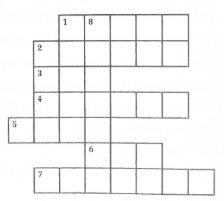
Clues across
- Dutee’s coach asked her to run five kilometres every day.
- Murray was almost killed in an accident.
- Sportspersons never cry when they lose a game.
- Kohli and Mithali are famous cricketers.
- A good coach will always help a promising athlete.
- Put some ice on your swollen eye.
- Murray did not attach any importance to his famous victory in Rome in September 1960.
Clue down
8. Would you like to take part in the next Olympic Games?
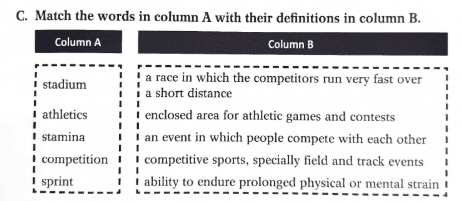
C. Match the words in column A with their definitions in column B.
| Column A | Column B |
|---|---|
| stadium | enclosed area for athletic games and contests |
| athletics | competitive sports, specially field and track events |
| stamina | ability to endure prolonged physical or mental strain |
| competition | an event in which people compete with each other |
| sprint | a race in which the competitors run very fast over a short distance |
Writing Practice
A. Read this passage.
Mountains
It was only in the eighteenth century that people in Europe began to think that mountains are beautiful. Before that time, they were feared by the inhabitants of the plains, especially by the townspeople, to whom they were wild, dangerous places in which one was lost or killed by terrible animals. Townspeople saw, in their cities, the victory of man over nature: civilization, order, peace and beauty over what was wild, cruel, disorderly and ugly.
Slowly, however, many of the people who were living comfortably in towns began to grow tired of it. A human being has many instincts in his breast, some of which fight against others: one of these instincts is to explore the unknown, not be satisfied with a life in which everything is orderly and peaceful and easily understood, but to look for mystery, for things which reason cannot explain, for sights and sounds which produce in one a thrill of fear.
So, in the eighteenth century, people began to turn away from the man-made towns to the untouched country and particularly to places where it was dangerous, rough and disorderly. Wild rocks and high mountains began to take their place in poems and novels, and the Lake District in north-west England, with its mountains and lakes, became a popular place for a holiday.
Then, mountain-climbing began to grow popular as a sport. To some people, there is something enormously attractive about setting out to conquer a mountain: a struggle against nature is finer than a battle against other human beings. And then, when you are at the top of a giant mountain, after a long and difficult climb, what a satisfactory reward it is to be able to look down over everything within sight! At such times, you feel nobler and purer than you can ever feel down below.
Answer these questions:
- When did the Europeans start thinking that mountains are beautiful?
Europeans started thinking that mountains are beautiful only in the eighteenth century. - Why were people living in the plains afraid of the mountains?
People living in the plains were afraid of the mountains because they were wild, dangerous places where one could get lost or killed by terrible animals. - What did people associate towns with?
People associated towns with civilization, order, peace, and beauty. - What does a human being look for while exploring the unknown?
A human being looks for mystery, for things which reason cannot explain, for sights and sounds which produce a thrill of fear. - Why did the Lake District in England become a popular holiday resort?
The Lake District in England became a popular holiday resort because of its wild mountains and lakes, which attracted people who wanted to experience untamed and beautiful nature. - a. What reward do we get when we reach the top of a high mountain?
The reward is the great satisfaction of being able to look down over everything within sight after a long and difficult climb.
b. How does a person feel at such moments?
At such moments, a person feels nobler and purer than ever before.
B. Given below is some information about the writer Ruskin Bond. Using the information, write a brief biographical sketch of this popular author.
- an Indian author of British descent
- born in Kasauli in 1934
- grew up in Jamnagar, Dehradun and Shimla
- published his first novel The Room on the Roof in 1956
- has written over two hundred short stories, essays and novellas, and more than thirty books for children
- received the Sahitya Akademi Award in 1992 and Padma Shri in 1999
- now lives with his family in Landour near Mussoorie
Brief Biographical Sketch:
Ruskin Bond is an Indian author of British descent. He was born in Kasauli in 1934. He grew up in Jamnagar, Dehradun and Shimla. He published his first novel, The Room on the Roof, in 1956. Ruskin Bond has written over two hundred short stories, essays and novellas, and more than thirty books for children. He received the Sahitya Akademi Award in 1992 and the Padma Shri in 1999. Now, he lives with his family in Landour near Mussoorie.

Malik Mohd. Arshad is a Senior English Teacher at STS High School, Aligarh Muslim University, with 21+ years of experience in English Language Teaching (ELT). An M.A. in English and Linguistics, he combines traditional academic values with modern digital learning methods. He is also a certified alumnus of the Texas Intensive English Program (USA).